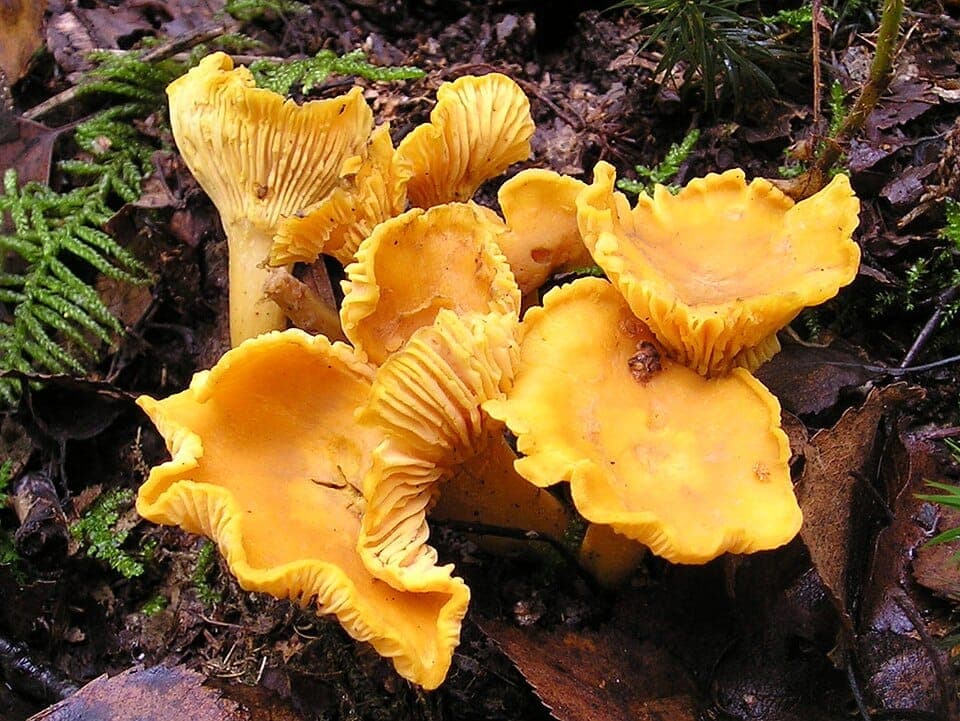
A few warm, humid days after summer rain, and the forest floor starts producing color. Among the most eye-catching are chanterelles — glowing golden to egg-yolk-orange mushrooms shaped like little vases or trumpets, often scattered in loose troops on the ground under oaks, beeches, and other hardwoods. From roughly midsummer into fall they are one of the most searched-for wild mushrooms, prized by foragers and famous in restaurants. They are also one of the mushrooms most often confused with dangerous look-alikes, so knowing the identifying features matters — as a way to appreciate what you found, not as permission to eat it.
How to Identify a Chanterelle
Chanterelles (species in the genus Cantharellus) share a distinctive combination of traits that, taken together, set them apart:
- A cap that is golden-yellow to orange, wavy and irregular, often depressed in the center so the whole mushroom looks like a shallow vase or trumpet
- False gills instead of true gills: the underside has blunt, forked, vein-like ridges that run down the stem, rather than thin, blade-like plates you could peel off
- The ridges run down onto the stem (they are "decurrent") and connect and fork like wrinkles, not separate knife-edge gills
- Solid, meaty flesh all the way through the stem — not hollow — that tears like string cheese rather than snapping cleanly
- A mild, often fruity or apricot-like smell, and growth on the ground (from soil), never in clusters straight out of wood
The single most useful feature is the underside. True chanterelles have those blunt, forked, ridge-like "false gills" that fade gradually into the cap and run down the stem. If you see crisp, thin, closely spaced true gills, you are not looking at a chanterelle.
Try Spotter Free on iOS & Android
Plants, animals, fungi, and rocks — all from a photo. 5 free identifications every day, no credit card required.
The Dangerous Look-Alikes
Several mushrooms wear chanterelle colors, and two are important to know because they are where people get hurt:
- Jack-o’-lantern mushroom (Omphalotus) — bright orange and superficially similar, but it grows in dense clusters at the base of stumps or on buried wood, and it has true, thin, sharp gills (not blunt ridges). It is toxic and causes serious stomach illness; it is the classic chanterelle mix-up
- False chanterelle (Hygrophoropsis aurantiaca) — orange with more distinct, forking, gill-like folds and a thinner, softer texture; best avoided
- Certain small orange Cortinarius and other gilled mushrooms — some are dangerously toxic, and color alone tells you nothing
The jack-o’-lantern is the key warning: it favors wood and grows in tight bunches, while true chanterelles come up singly or in scattered groups from soil and have ridges, not gills. Confusing the two lands people in the emergency room every year.
A Safety-First Word on Wild Mushrooms
This guide is for recognizing and appreciating chanterelles, not for deciding what is safe to eat. No app, website, or single article can make a wild mushroom safe to consume — edibility depends on absolute certainty of species, condition, and preparation, and toxic look-alikes are exactly why beginners get poisoned. If you are curious about eating wild fungi, learn in person from an experienced local mycologist or foraging club, and when in doubt, throw it out. Enjoy chanterelles the safest way there is: find them, photograph them, and leave them where they grow.
Found a golden, trumpet-shaped mushroom and want to know whether it is a chanterelle or a toxic jack-o’-lantern? Take a clear photo of the cap and the underside and let Spotter identify the fungus, so you can learn what you are looking at without ever putting it in a basket.
Try Spotter Free on iOS & Android
Plants, animals, fungi, and rocks — all from a photo. 5 free identifications every day, no credit card required.