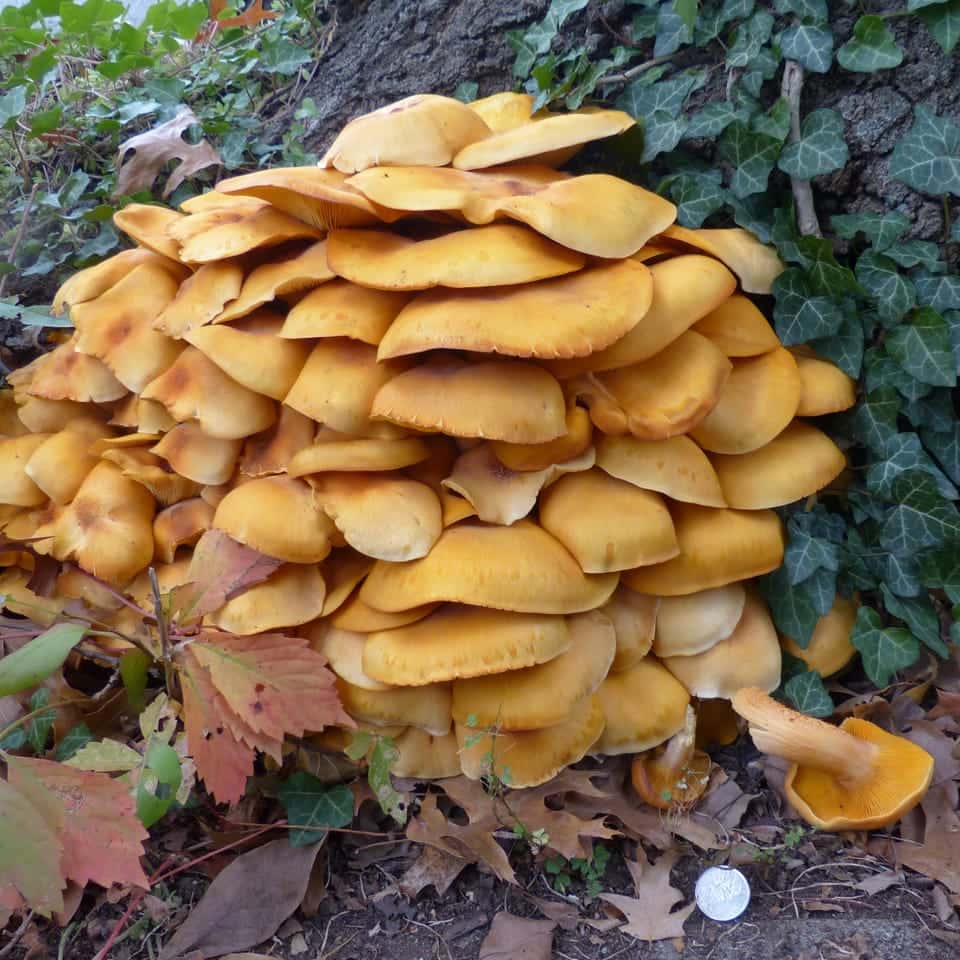
You are walking through the woods or across the yard in fall and a vivid patch of color stops you: a big, dense cluster of pumpkin-orange mushrooms pouring out of an old stump, a buried root, or the base of a hardwood tree. They are glowing-bright even in shade, packed together in overlapping tiers, and someone nearby says the word every forager loves — "chanterelles." Put the knife away. What you are looking at is almost certainly a jack-o’-lantern mushroom, a toxic species that mimics several prized edibles and lands people in the emergency room every autumn. It is not usually deadly, but it will make you violently ill, and it is one of the most valuable fall mushrooms to learn precisely because it is so convincing. Here is how to recognize it.
How to Identify a Jack-o’-Lantern Mushroom
Jack-o’-lanterns are eye-catching and fairly consistent once you know what to check. Look at the whole picture — color, gills, and especially how and where they grow:
- The color: a saturated orange to orange-yellow throughout — cap, gills, and stem — often described as pumpkin- or Halloween-orange, which is where the name comes from
- True gills: sharp, blade-like gills that run down onto the stem, thin and crowded like the pages of a book — this is the single most important feature
- The growth habit: dense, overlapping clusters of many caps fused at the base, always growing directly from wood — a stump, a fallen log, or buried roots at the base of a living or dead hardwood
- The size and shape: medium to large mushrooms with caps that flatten and often develop a shallow central dimple, on a firm tapering stem
- The glow: fresh gills can give off a faint greenish bioluminescence in full darkness — a real but subtle effect, not something you can count on seeing outdoors
- The spore print: whitish to pale cream (a detail experienced identifiers use, done at home on paper)
A big, packed cluster of bright orange mushrooms with true, knife-edged gills growing straight out of wood is the jack-o’-lantern. That combination — clustered on wood, orange, and true gills — is the fingerprint.
Try Spotter free on iPhone or Android
Plants, animals, fungi and rocks from one photo. 5 free identifications every day, no card required.


Why It Fools Foragers: The Chanterelle and Chicken-of-the-Woods Trap
The jack-o’-lantern gets people because it sits in the same orange color range as two of the most sought-after fall edibles — the golden chanterelle and, at a glance, chicken of the woods. The decisive difference from a chanterelle is underneath the cap. Chanterelles do not have true gills; they have blunt, forking, vein-like ridges (false gills) that look more like wrinkles running down the stem, and chanterelles grow one at a time from the soil, connected to living tree roots, never in fused clusters on wood. The jack-o’-lantern has thin, sharp, crowded true gills and grows in big bundles straight out of wood. Chicken of the woods, meanwhile, forms shelf-like brackets with a pore surface (tiny holes) underneath and no gills at all. If your orange mushroom is clustered on wood and has real gills, it is a jack-o’-lantern — not dinner.
The rule that keeps foragers safe: chanterelles have false gills (blunt ridges) and grow from soil; jack-o’-lanterns have true gills and grow in clusters on wood. When those two features disagree, believe the gills and the wood.
Is It Dangerous? What Happens If You Eat One
Jack-o’-lanterns contain a toxin called illudin S. They are generally not considered deadly, but eating one is a genuinely miserable experience: within a few hours it typically causes severe stomach cramps, repeated vomiting, and diarrhea that can last a day or two, sometimes bad enough to require medical care for dehydration. The mushroom is not dangerous to touch or to have in your yard — the risk is entirely from eating it. This is the core reason we never publish edibility or preparation guidance for wild mushrooms: the difference between a delicious chanterelle and a night of violent illness comes down to details like whether the underside has true gills or blunt ridges, and no photo or article is a safe substitute for hands-on expertise. If you or someone else may have eaten a wild mushroom and feels ill, contact Poison Control or a doctor right away, and if you can, keep a sample of the mushroom for identification.
Where and When You’ll See Them
Jack-o’-lanterns are a classic late-summer and fall mushroom across much of eastern and central North America, fruiting from roughly late summer through the first hard frosts, with a peak in the cooler, wetter weeks of autumn. Look for them on and around hardwood stumps, at the base of oaks and other trees, and over buried roots — anywhere dead wood is breaking down. Because they can appear year after year on the same rotting stump, a spot that produced them last fall will often produce them again. They are worth admiring: few mushrooms are as boldly colored, and on a still, truly dark night a fresh cluster can show its eerie green glow.
Not sure whether the orange mushrooms on that stump are a jack-o’-lantern, a chanterelle, or something else entirely? Snap a photo and let Spotter help you narrow it down — then treat every wild mushroom as look-only until an expert confirms it in person. Learning the jack-o’-lantern is one of the best first steps to reading the fall woods safely.
Try Spotter free on iPhone or Android
Plants, animals, fungi and rocks from one photo. 5 free identifications every day, no card required.