
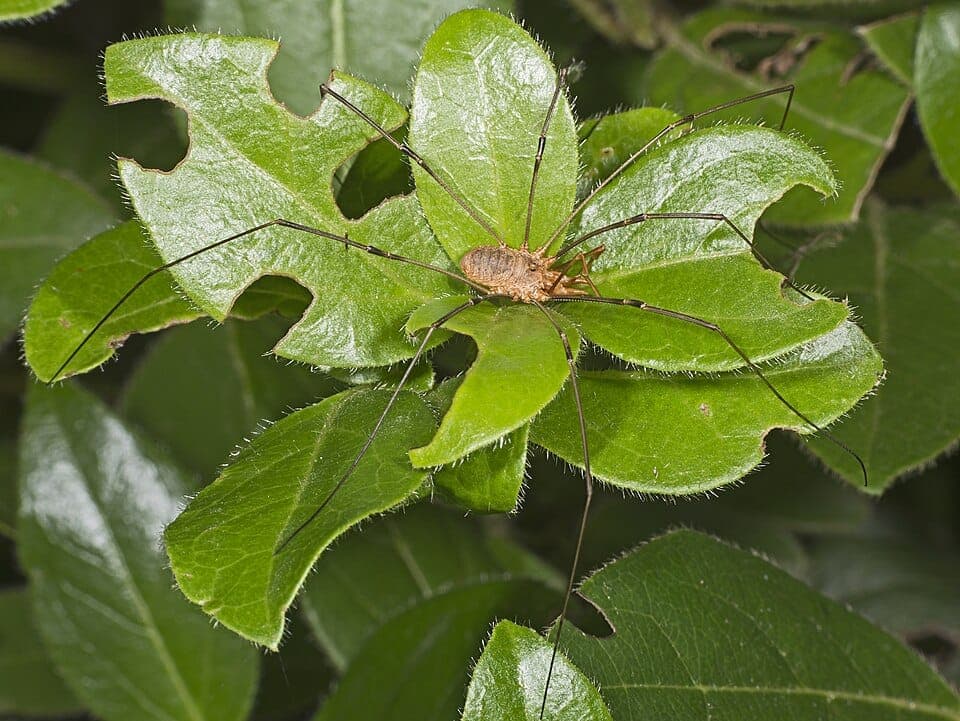
Late summer is peak season for one of the most recognizable — and most misunderstood — creatures in the yard. A small oval body perched on eight long, thread-thin legs, often found in loose clusters on the shady side of a shed, a tree trunk, or a basement wall. The old name gives away the timing: "harvestman," for the harvest season when they suddenly seem to be everywhere. Most people know them as daddy longlegs, and most people also believe a piece of folklore about them that is completely false. Sorting out what they really are is worth doing, because harvestmen are harmless allies, not the deadly spiders of legend.
It Is Not Actually a Spider
A harvestman is an arachnid — it has eight legs, like spiders, scorpions, and ticks — but it belongs to its own order, separate from true spiders. The clearest difference is the body. A spider has two obvious segments, a cephalothorax and an abdomen, joined by a narrow waist. A harvestman looks like a single rounded pea, because its two body regions are broadly fused with no visible waist at all. That one feature settles the identification instantly once you know to look for it.
- One oval body with no waist — not the two-part, cinched shape of a spider
- A single pair of eyes on a small bump, versus the several eyes most spiders have
- No silk — harvestmen have no spinnerets and never build webs
- No venom glands and no fangs capable of injecting venom
- Extremely long, delicate legs; a leg lost to a predator does not grow back
The Famous Venom Myth
You have almost certainly heard it: "daddy longlegs are the most venomous animals in the world, but their fangs are too small and weak to break human skin." It is a great story and it is false on every count. Harvestmen have no venom glands whatsoever, and they have no fangs — they eat by grabbing small food items and passing them to their mouthparts, not by injecting venom. There is nothing dangerous being held in check by tiny fangs, because there is no venom to begin with. The myth is sometimes muddled further by the fact that a completely different animal, the cellar spider, is also nicknamed "daddy longlegs"; even that spider, a true web-builder, is not dangerous to people.
Try Spotter Free on iOS & Android
Plants, animals, fungi, and rocks — all from a photo. 5 free identifications every day, no credit card required.
Why So Many, and Why Now
Harvestmen have been maturing all summer, and by August and September their numbers peak — the reason the harvest-season name stuck. On hot or dry days they gather in shaded, humid spots to conserve moisture, which is why you find them balled together under eaves, on north-facing walls, or in a corner of the garage. They are not swarming to invade; they are simply crowding into the cool, damp microclimates that remain as the season dries out.
Should You Get Rid of Them?
There is little reason to. Harvestmen are gentle scavengers and predators that eat aphids, mites, small insects, and decaying matter, quietly helping keep a garden in balance. They do not bite people, damage homes, or harm plants. If a cluster indoors bothers you, gently sweep or carry them back outside rather than killing them — they are among the most benign creatures you will ever share a wall with.
Curious whether the long-legged creature in the corner is a true harvestman or one of the cellar spiders that share the nickname? Snap a photo and let Spotter help you identify it, and enjoy knowing the truth behind one of nature’s most persistent myths.
Try Spotter Free on iOS & Android
Plants, animals, fungi, and rocks — all from a photo. 5 free identifications every day, no credit card required.