You look up and there it is: a large dark bird riding high on broad wings, circling and tilting without a single wingbeat, sometimes joined by a dozen or more of its kind wheeling in a slow column. In late summer and fall these gatherings — called kettles — grow especially large as the birds ride rising warm air and drift south, and they are one of the easiest big-bird spectacles to notice overhead. Across most of the United States, that soaring scavenger is one of two species: the turkey vulture or the black vulture. From directly below they can look almost the same, but a few features sort them out quickly once you know where to look. Here is how to tell them apart.
Watch How It Flies
Flight style is the fastest way to name a distant vulture, before you can make out any detail:
- Turkey vulture: holds its wings in a shallow V (a "dihedral") and rocks or teeters side to side as it soars, tipping in the wind and rarely flapping — a wobbly, unsteady look
- Black vulture: holds its wings flatter and flaps more often in quick, choppy, labored bursts between short glides, looking steadier but more effortful
- Silhouette: turkey vultures look long and slender, with longer wings and a longer tail; black vultures look stocky and compact, with broad wings and a short tail that barely clears the wings
- A rocking bird gliding on raised wings almost certainly a turkey vulture; a flatter-winged bird with snappy flaps and a stubby tail is a black vulture
Check the Wings From Below
When one passes overhead, the pattern on the underside of the wings is one of the most reliable marks:
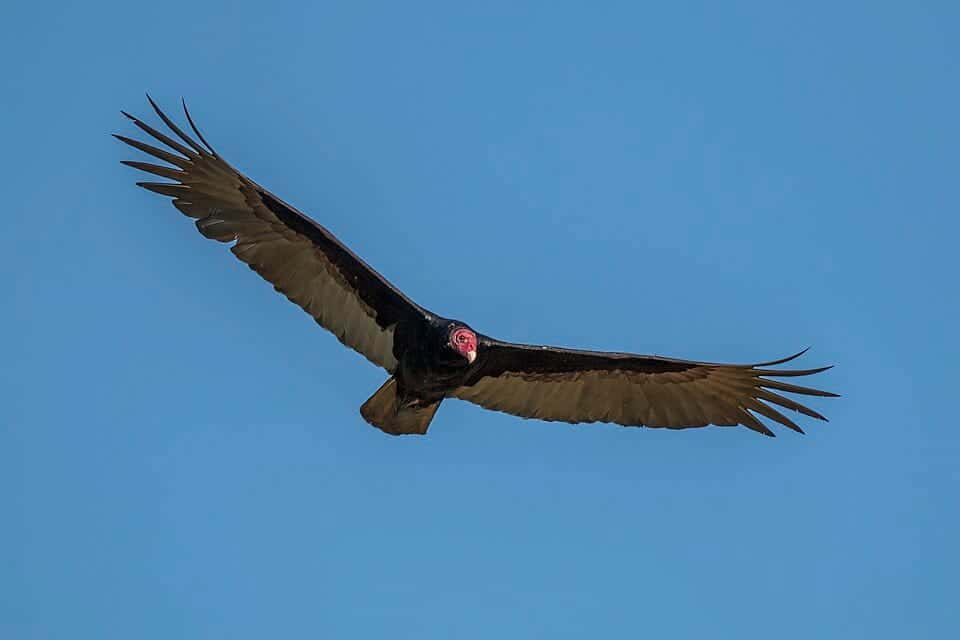
- Turkey vulture: the entire trailing (rear) half of the underwing is pale silvery-gray, contrasting with the black leading half, so the whole flight feathers look two-toned along the length of the wing
- Black vulture: mostly all-dark underwings with a bright whitish patch only at the wingtips ("silver stars" at the hands), so the pale shows just at the ends rather than along the back edge
- From a distance, remember it as pale along the whole back edge of the wing (turkey) versus pale only at the tips (black)
Try Spotter free on iPhone or Android
Plants, animals, fungi and rocks from one photo. 5 free identifications every day, no card required.


Look at the Head and Size
If the bird is perched or flying low, the head seals the identification:
- Turkey vulture: a bare, wrinkled, red head on an adult (dark gray on younger birds), small relative to the body — the "turkey" name comes from that red head
- Black vulture: a bare, wrinkled, dark gray to blackish head
- Size: turkey vultures are a bit longer-winged and lankier; black vultures are shorter and more compact, and often look smaller and chunkier in a mixed group
- On the ground at a carcass or roost, black vultures are pushier and travel in tighter groups, while turkey vultures are more solitary and wary
Not a Bird to Fear
Both vultures are nature’s cleanup crew, feeding almost entirely on carrion — already-dead animals — and doing the essential, unglamorous work of clearing carcasses from the landscape. They are not birds of prey that hunt healthy pets or livestock the way people sometimes worry; a soaring vulture circling overhead is following its remarkable sense of smell (in the turkey vulture) or watching other vultures drop (in the black vulture) toward something already dead, not stalking you or your dog. Both are native, migratory birds protected by law. Seeing a kettle of them spiraling upward on a warm fall afternoon is simply a sign that the season’s thermals — and migration — are in full swing.
Caught a photo of a big dark soaring bird and not sure whether it is a turkey vulture, a black vulture, or a hawk or eagle? Snap a shot — even a distant one showing the underwing — and let Spotter help you narrow it down, so you can put a name to the scavengers riding the sky overhead.
Try Spotter free on iPhone or Android
Plants, animals, fungi and rocks from one photo. 5 free identifications every day, no card required.