
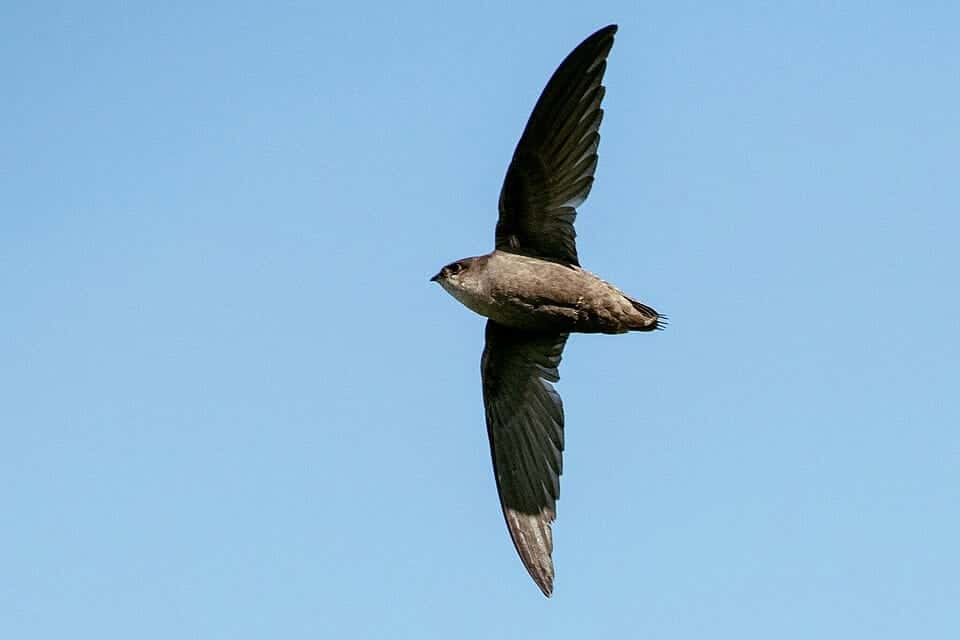
It is a mild evening in late summer or early fall and, as the light starts to fade, you notice birds gathering over a rooftop — first a few, then dozens, then hundreds — small, dark, fast-flying shapes wheeling in a great swirling cloud above an old brick chimney. The flock tightens into a slow, churning vortex, circling and circling as the sky darkens. Then, a few at a time and finally in a sudden rush, the birds begin to pour down into the chimney, funneling in like water down a drain until, minutes later, the sky is empty and silent. If you have stumbled onto this, you have witnessed one of the most enchanting and least-known wildlife spectacles in any American town: a fall roost of chimney swifts staging for their long migration south. Here is how to recognize the birds and their extraordinary evening ritual.
How to Identify a Chimney Swift
Chimney swifts are strange, wonderful birds that spend almost their entire lives on the wing, and they look and behave unlike anything else in the sky. A few marks and habits give them away:
- The shape: often described as a "flying cigar" — a chunky, curved body with long, slender, swept-back wings and a short, stubby tail, all dark sooty gray-brown
- The flight: fast, stiff, and fluttery, with quick shallow wingbeats alternating with brief glides, twisting and darting erratically as they chase insects
- The voice: a high, rapid, chattering twitter given constantly in flight — often you hear the flock before you pick it out against the sky
- They never perch like normal birds: swifts cannot stand on a branch or wire, and instead cling vertically to the inside of a chimney or hollow tree with tiny clawed feet and a spiny tail
- The behavior that clinches it: gathering in a swirling flock at dusk in late summer or fall and funneling down into a chimney to roost for the night
A flock of dark, cigar-shaped, twittering birds circling a chimney at dusk and dropping in to roost is chimney swifts and essentially nothing else. In flight they are most often confused with swallows or bats: swallows have broader, more triangular wings and will perch on wires, while bats have a fluttering, moth-like flight and leathery wings without feathers. The swift’s stiff-winged, twinkling flight and its habit of pouring into a chimney set it apart.
Try Spotter free on iPhone or Android
Plants, animals, fungi and rocks from one photo. 5 free identifications every day, no card required.


The Dusk Vortex — What Is Happening
During the breeding season chimney swifts nest singly, but as fall migration approaches they abandon their separate territories and gather into large communal roosts to spend the nights together — sometimes a few dozen birds, sometimes many hundreds or even thousands in a single big chimney. Each evening the flock assembles in the sky above the roost and circles in a rising, swirling column, gathering stragglers as the light fades. Then, as if on a signal, they begin to spiral downward and drop into the chimney a few at a time, clinging to the vertical walls inside to sleep packed together for warmth and safety, before pouring back out at first light to hunt insects on the wing all day. These migration-season roosts build over late summer and peak in the weeks the swifts are staging to leave, funneling south all the way to the Amazon basin of South America for the winter. Because the birds gather in the same traditional chimneys year after year, a single good roost can put on the show night after night for weeks each fall.
Where and When to Watch — and How to Help
To catch the spectacle, look for large old masonry chimneys — on schools, churches, factories, and other historic buildings are classic sites — and arrive about twenty to thirty minutes before sunset on a calm evening in late summer or early fall. Watch the sky above the chimney for the gathering, swirling flock, and stay until the birds begin their dive; the whole descent can take just a few minutes once it starts. Many communities hold public "Swift Night Out" events where birders gather to watch and count the roosting flocks, which helps track the species. That tracking matters: chimney swifts have declined sharply in recent decades, in part because the open masonry chimneys they depend on for nesting and roosting are increasingly capped, torn down, or lined in ways they cannot cling to. If you have a suitable uncapped brick chimney, leaving it open and unlined outside of heating season — or building a dedicated swift tower — gives these aerial acrobats a home. They are entirely harmless houseguests: they eat only flying insects, raise their young quietly, and are gone south by mid-fall.
Watched a cloud of birds funnel into a chimney at dusk and want to confirm you saw chimney swifts and not swallows or bats? Snap a photo of the flock or a bird in flight and let Spotter help you identify it as a starting point, so you can put a name to one of the season’s most spellbinding evening shows.
Try Spotter free on iPhone or Android
Plants, animals, fungi and rocks from one photo. 5 free identifications every day, no card required.