
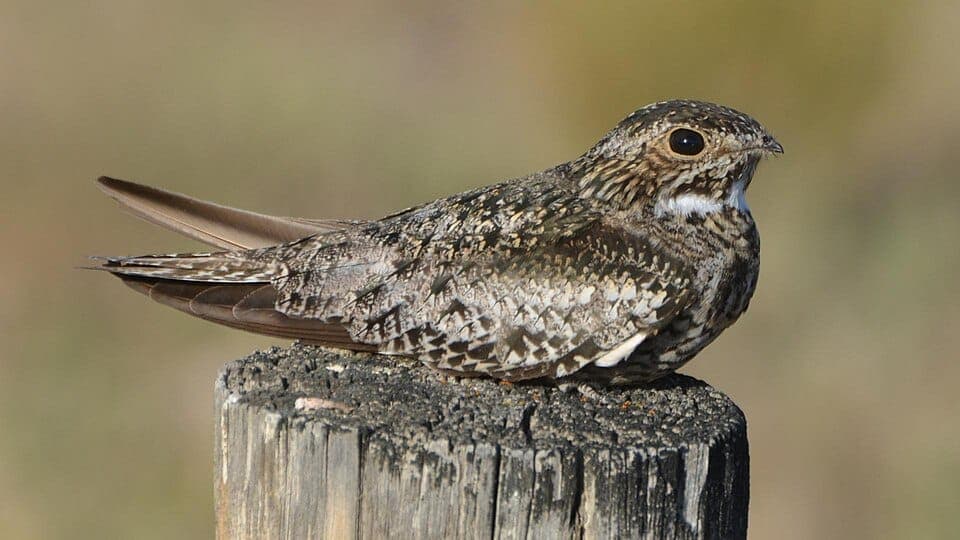
On a warm evening toward the end of August or the start of September, you glance up and notice them: slim, long-winged birds — a few at first, then dozens, sometimes hundreds — wheeling, darting, and gliding high overhead in a loose, restless flock that keeps drifting steadily in one direction. Their flight is buoyant and erratic, a little to the left, a little to the right, with a bounding glide thrown in, and every so often you catch a flash of white near the tip of each wing. These are common nighthawks, and what you are watching is one of the earliest and most dramatic events of fall bird migration. Here is how to identify them and understand what you are seeing.
How to Identify a Common Nighthawk
Despite the name, a nighthawk is not a hawk at all — it is a nightjar, a relative of the whip-poor-will, built for catching insects on the wing at dawn and dusk. In flight overhead they show a distinctive set of marks:
- The shape: about robin-sized but far slimmer, with long, narrow, pointed wings that can suggest a small falcon, and a notched or slightly forked tail
- The wing patch: the clincher — a bold white bar or "window" across each wing, set about two-thirds of the way out toward the tip, easy to see against the sky even without binoculars
- The color: overall dark and cryptically mottled gray-brown, so they read as uniformly dusky as they pass overhead
- The flight: light, bounding, and unpredictable, with quick flickering wingbeats and abrupt changes of direction as they snap up flying insects, not the steady flapping of a hawk
- The voice: a nasal, buzzy "peent" call, though migrating flocks often move silently
That white wing-bar on a slim, long-winged, erratically flying bird at dusk is the combination to look for. Migrating nighthawks feed as they travel, snapping up mosquitoes, flying ants, beetles, and other insects, so the loose flocks often swirl and mill about over rivers, fields, and even town streetlights where insects are thickest, rather than flying in tidy lines like geese.
Try Spotter Free on iOS & Android
Plants, animals, fungi, and rocks — all from a photo. 5 free identifications every day, no credit card required.
Why They Gather in Late August
Common nighthawks are long-distance champions. They spend the summer breeding across much of North America — nesting on open ground, gravel bars, and even flat gravel rooftops in towns — and then travel all the way to South America for the winter, one of the longest migrations of any North American bird. That enormous journey starts early, and late August into September is the peak of it across the northern and central states. Because they funnel south in loose aggregations and feed together over insect-rich spots, the birds pile up into the wheeling evening flocks that catch everyone’s eye, often most impressive in the last hour or two before dark.
These evening flights are a fleeting show. The push runs for only a few weeks, and by early fall the great majority have already passed through on their way south, so a warm, calm evening in late August is one of the best times of the whole year to look up and catch it. It is worth stepping outside around sunset and scanning the sky — a good pair of binoculars helps, but the white wing-flashes are often visible with the naked eye.
Nighthawks are also a bird of conservation concern, with populations declining in many areas as insect numbers fall and open nesting habitat disappears, which makes these late-summer gatherings all the more worth pausing to appreciate. If you are curious what else is on the move, this is the front edge of fall migration — hawks, songbirds, and monarch butterflies are all beginning to head south around the same time.
Not sure whether the slim, long-winged birds swirling over your neighborhood at dusk are nighthawks, swallows, swifts, or bats? Snap a photo or note the field marks and let Spotter help you identify what you are seeing as fall migration gets underway.
Try Spotter Free on iOS & Android
Plants, animals, fungi, and rocks — all from a photo. 5 free identifications every day, no credit card required.