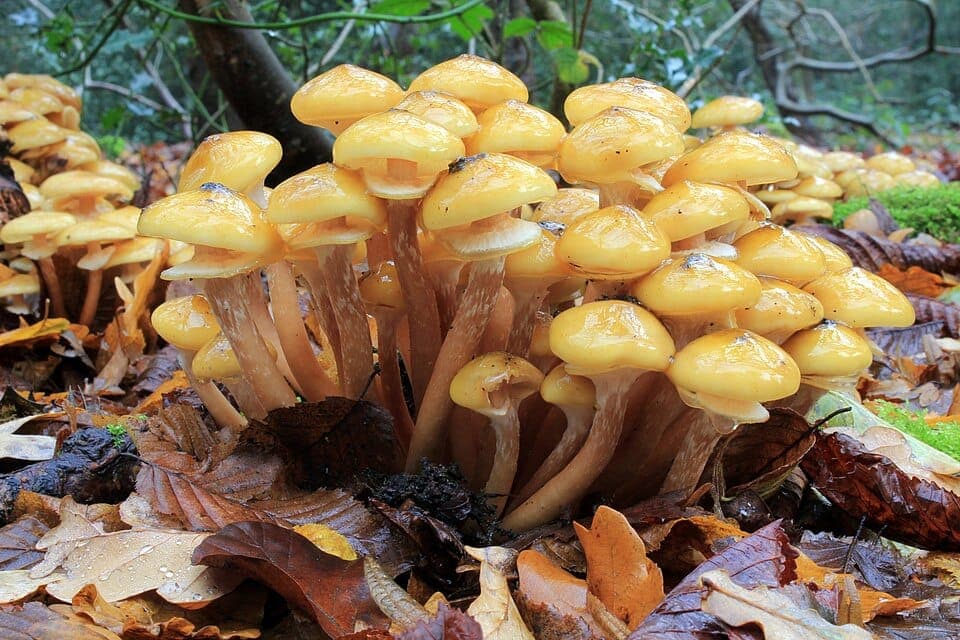
As the nights turn cool and fall rains soak the ground, you glance at the base of a tree, an old stump, or a spot in the lawn over a buried root and find a striking sight: a dense, crowded clump of mushrooms, sometimes dozens at once, all honey- to tan-colored, their stems packed together and fused at the bottom into a single tight cluster. They seem to have erupted overnight, and there is often more than one clump nearby. This is very likely a honey mushroom (Armillaria), one of the signature fungi of autumn. Here is how to identify it and what its appearance is telling you.
How to Identify a Honey Mushroom
Honey mushrooms are a group of related Armillaria species that share a family look, and they fruit in clusters from late summer through fall, dying back after the first hard frosts. Look for this combination:
- Growth habit: dense, crowded clusters (often called cespitose) where many stems fuse together at a shared base — rarely single mushrooms, usually a tight bouquet of them
- Where it grows: at the base of living or dead trees, on stumps, or seemingly from the lawn or soil directly over buried roots — always tied to wood, even when the wood is hidden underground
- Caps: honey-yellow to tan or brownish, often with fine dark hairs or tiny scales toward the center, a few inches across, sticky when wet
- A ring: many honey mushrooms have a whitish ring (annulus) on the upper stem, left behind as the cap expands — though one common type, the ringless honey mushroom, lacks it
- Spore print: white — a print taken by laying a cap gills-down on paper comes out white, which helps separate honey mushrooms from look-alikes with brown or rusty prints
- Under the bark: on infected trees you can sometimes find flat, white, fan-shaped sheets of fungal tissue (mycelial fans) and long, dark bootlace-like strands (rhizomorphs) running under the bark or through the soil
The clustered, fused-at-the-base growth right at a tree or stump, honey-colored caps, and a white spore print together make a strong case for a honey mushroom. Those black, shoestring-like rhizomorphs are especially diagnostic — few other fungi produce them — and they are how the fungus spreads from root to root underground.
Try Spotter Free on iOS & Android
Plants, animals, fungi, and rocks — all from a photo. 5 free identifications every day, no credit card required.
Why Honey Mushrooms Can Be a Warning Sign
Honey mushrooms are more than a pretty fall fungus — they are the fruiting bodies of Armillaria, a group that causes armillaria root rot, one of the most significant root and butt-rot diseases of trees and shrubs. The fungus attacks and decays the roots and lower trunk, and its underground network of rhizomorphs can spread to nearby woody plants. When you see the mushrooms erupt at the base of a living tree in fall, it can mean the fungus is at work in that tree’s roots. That does not automatically doom the tree — many trees live for years with some Armillaria present, and the fungus is also a natural, valuable decomposer of dead wood and stumps — but a cluster on a specimen tree you care about is a reasonable prompt to watch it and, if it shows dieback or decline, consult a certified arborist.
On a stump or a clearly dead log, honey mushrooms are simply doing the good work of recycling: breaking down the wood and returning its nutrients to the soil. The same fungus, in other words, can be a forest recycler in one spot and a slow problem for a landscape tree in another. The presence of the mushrooms tells you the fungus is there; it does not by itself tell you how much trouble a given tree is in.
Honey Mushroom Safety and Look-Alikes
This is an identification guide, not a foraging guide, and honey mushrooms are a case where that distinction really matters. Several dangerous mushrooms grow in a similar clustered, wood-associated way, and telling them apart takes expertise:
- Deadly galerina (Galerina marginata): a small brown mushroom that can grow in clusters on wood and contains the same deadly toxins as the destroying angel — a genuinely lethal look-alike, best separated by its rusty-brown spore print versus the honey mushroom’s white
- Jack-o’-lantern (Omphalotus): bright orange, clustered at the base of trees and stumps, and toxic — sometimes mistaken for a honey mushroom but with orange gills and an orange spore print, not white
- Deadly galerina and other little brown mushrooms make spore-print and expert checks essential — never rely on color and cluster habit alone
Because of those look-alikes, never eat any wild mushroom based on an app, a photo, or an article, and keep pets and children from chewing on ones in the yard; check with a veterinarian if a dog swallows any wild mushroom. The pleasure here is in recognizing a defining fungus of the fall woods and understanding what its sudden appearance at a tree’s base may be signaling.
Found a crowded cluster of honey-colored mushrooms at the foot of a tree and want a starting point for what it is? Snap a photo and let Spotter identify the fungus — then treat any wild mushroom as one to study, not to eat.
Try Spotter Free on iOS & Android
Plants, animals, fungi, and rocks — all from a photo. 5 free identifications every day, no credit card required.