
It is a warm, clear afternoon in the first half of September and you glance up to see something that stops you cold: the sky is full of hawks. Not a single soaring bird, but dozens — sometimes hundreds or even thousands — wheeling together in a slow, rising spiral that looks for all the world like a tornado made of birds. They circle upward without a single wingbeat, packed into a churning column, and then, one after another, they peel off the top and glide away in a long, streaming line toward the south. A few minutes later another swirling mass builds behind them. If you have never seen it before, it can look almost supernatural. What you are watching is a "kettle," and it is one of the great wildlife spectacles of North America: the fall migration of the broad-winged hawk. Here is how to recognize it and understand what is going on overhead.
What a "Kettle" Actually Is
Migrating hawks are lazy in the best possible way — they let the weather do the work. On sunny days, the ground heats the air and sends up invisible columns of rising warm air called thermals. A hawk that finds a thermal can set its wings and be carried thousands of feet up in a slow spiral without flapping, spending almost no energy. When many hawks pile into the same thermal at once, they form that swirling, boiling column of birds that watchers call a kettle (because it looks like water churning in a pot). Once they reach the top of the thermal, they glide off in the direction they are traveling — losing altitude gradually — until they find the next thermal and kettle up all over again. That rise-and-glide, rise-and-glide rhythm lets them cover enormous distances on very little fuel, and it is why the biggest flights happen on warm, sunny afternoons with a helpful tailwind rather than on cold or rainy days.
How to Identify a Broad-Winged Hawk
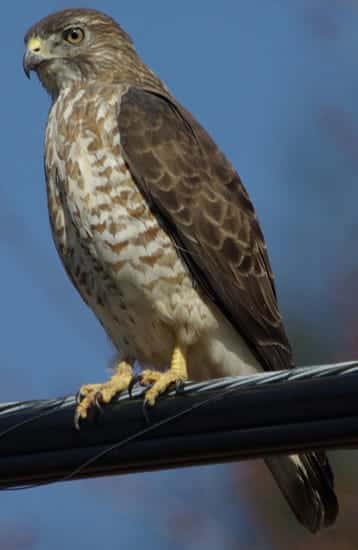
The broad-winged hawk is the classic kettle bird, and while a soaring hawk high overhead is never the easiest thing to name, this species has a distinctive compact shape and a few good field marks:
- The size and shape: a small, stocky raptor, roughly the size of a crow, with a chunky body, a big head, and broad wings that taper to a noticeable point at the tip
- The tail: short and square, with bold, wide black-and-white bands — the broad white tail band is one of the best marks when a bird passes close enough to see it
- The underside: pale and clean, with a rusty-brown barred chest and a crisp dark border outlining the trailing edge and tips of the pale wings
- The behavior: soaring in tight circles within a large flock, rising on thermals and then gliding off in a stream — solitary soaring hawks in summer are more often red-tailed hawks
- The season and timing: broad-wings move through in a remarkably tight window, with roughly 95% passing in a two-week stretch in the middle of September, so a huge September kettle is broad-wings until proven otherwise
A crow-sized, pointed-winged hawk soaring in a big swirling flock in mid-September is almost the definition of a broad-winged hawk. Other raptors ride the same thermals and mix into the flights — sharp-shinned and Cooper’s hawks, red-tailed hawks, ospreys, bald eagles, and falcons all migrate along the same routes — but no other eastern hawk gathers in the sheer, tornado-like numbers of the broad-wing.
Try Spotter free on iPhone or Android
Plants, animals, fungi and rocks from one photo. 5 free identifications every day, no card required.


Why They Gather in Such Numbers
Broad-winged hawks are what biologists call complete migrants: nearly the entire population leaves North America for the winter, funneling down through Texas and Mexico and continuing all the way into Central and South America. Because they depend on thermals — and because thermals form over land, not open water — the birds avoid long water crossings and instead pour along coastlines, mountain ridges, and river valleys that concentrate them into narrow corridors. Landforms like the Appalachian ridges or the Texas coast act like funnels, squeezing millions of hawks into a few predictable flight lines. When a cold front passes and pushes a wave of birds south on a favorable wind, a single lookout can tally thousands, tens of thousands, or on legendary days hundreds of thousands of broad-wings in an afternoon. It is one of the largest and most watchable raptor migrations on Earth, and it is happening right now, high over ordinary backyards.
Where and When to Watch
You do not need a mountaintop to see a kettle — on the right September day, one can drift over a parking lot, a soccer field, or your own yard. But dedicated "hawk watch" sites along ridges, lakeshores, and coastlines see the biggest concentrations, and many post daily counts online during the season. For the best odds, look up on a sunny early-to-mid-September afternoon, especially in the day or two after a cold front has moved through with north or northwest winds. Scan the blue sky well overhead rather than the horizon — kettles often form so high that the birds look like drifting pepper flakes, and a pair of binoculars turns those specks into a churning column of hawks. Once the peak passes in late September, the broad-wing flood tapers off, though other raptors keep moving through fall.
Caught a photo of a soaring hawk from a swirling flock and want to know if you have witnessed the broad-winged migration? Snap a shot showing the wing shape and tail bands and let Spotter help you identify it as a starting point, so you can put a name to the river of raptors passing overhead this fall.
Try Spotter free on iPhone or Android
Plants, animals, fungi and rocks from one photo. 5 free identifications every day, no card required.