
It usually starts as a sound with no obvious source — a loud, rolling, rattling bugle drifting down out of a blue autumn sky, so far up that you scan for a while before you find the birds making it. When you do, it is a long, wavering line or a loose V of very large birds flying high overhead, necks stretched straight forward and long legs trailing behind, calling back and forth as they push south on the wind. If you live across much of the northern and central United States in fall, you have just witnessed one of the season’s signature spectacles: the migration of the sandhill crane, a bird that has been making this same journey for millions of years. Here is how to know a sandhill crane when you see or hear one, why that call is impossible to ignore, and how to catch the show as it passes over.
How to Identify a Sandhill Crane
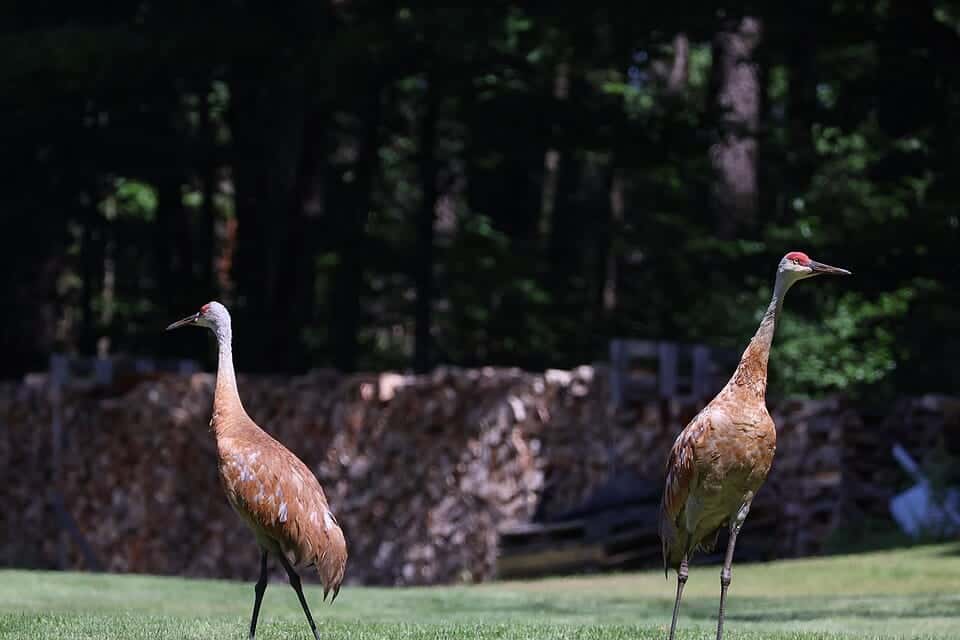
Sandhill cranes are enormous, elegant birds, and once you know what to look and listen for they are hard to mistake for anything else:
- The size: very tall for a bird — standing three to four feet high with a wingspan of five to six and a half feet, among the largest birds most people ever see in their area
- The color: overall slate gray, often washed with rusty brown on the back and wings (the birds preen iron-rich mud into their feathers), with a bright red patch of bare skin on the crown and forehead and pale cheeks
- The shape in flight: neck held straight out in front and legs trailing straight behind, so the bird looks like a long, stiff cross gliding across the sky — with slow, powerful wingbeats that flick up a little at the top
- The bustle: standing on the ground, adults show a distinctive shaggy "bustle" of drooping feathers over the rump, giving them a graceful, ruffled backside
- The flocks: they travel in lines, ragged Vs, and swirling kettles, often at great height, and frequently in the hundreds or thousands where the migration concentrates
A very large, long-necked gray bird flying high in a calling flock, neck and legs stretched straight out, is almost certainly a sandhill crane. The single most useful field mark is that outstretched neck: it separates cranes at a glance from the great blue heron, the other tall gray bird people confuse them with, which always folds its neck back into a tight S-curve in flight and flies alone rather than in big, noisy flocks.
Try Spotter free on iPhone or Android
Plants, animals, fungi and rocks from one photo. 5 free identifications every day, no card required.


The Rattling Call — and Why It Carries So Far
The sound is the giveaway, and it is unforgettable: a deep, rolling, rattling bugle — often written as a trumpeting "gar-oo-oo" — that seems far too loud for a bird you can barely see. There is a reason it carries for miles. A sandhill crane’s windpipe is extraordinarily long and coils back on itself inside the bird’s breastbone, like the tubing of a French horn. That coiled trachea lets the crane produce a low, resonant, penetrating call that travels enormous distances across open country, which is why you so often hear the migration long before you find it overhead. Cranes call constantly on the wing to keep the flock together, so an autumn sky full of that rolling rattle is the sound of a family group or a whole flock staying in touch as it flies. Learning the call is honestly the easiest way to notice the migration at all — once you know it, you will catch cranes passing over that you would otherwise never have looked up to see.
Where and When to See the Migration
Sandhill cranes breed across the northern states, Canada, and Alaska, and winter in the southern United States and Mexico — Florida, Texas, the Southwest, California, and the Gulf Coast — so most of the country sees them passing through in between. Fall migration builds through the autumn: the first birds start moving in September as they gather at staging grounds, and the big push generally peaks from mid-October into November, wrapping up by early winter. Along the way, huge numbers stage at traditional stopover marshes and grain fields to rest and feed — famous fall gathering spots include Jasper-Pulaski Fish and Wildlife Area in Indiana, the Wisconsin marshes, and refuges across the Dakotas, Nebraska, Kansas, and New Mexico — where thousands of cranes can gather and fly out to feed at dawn and back to roost at dusk in a genuinely jaw-dropping spectacle. Even far from those hotspots, though, you can catch migrating flocks simply by going outside on clear fall days, listening for that rattle, and scanning high overhead. Cranes ride favorable tailwinds, so the days after a cold front passes are often the best for a sky full of them.
Crane, Heron, or Goose?
Three tall or flocking birds get mixed up with sandhill cranes, and a few marks sort them out fast. The great blue heron is the classic mix-up on the ground — also tall and gray — but in flight the heron tucks its neck into an S and travels solo, while the crane flies with its neck straight out in noisy flocks. Canada geese also fly south in honking Vs, but geese are much smaller and chunkier with short necks and a black head and white chinstrap, and their call is a nasal honk rather than a rolling rattle. And unlike a heron, a flying crane shows that straight neck and those long trailing legs at once. When in doubt, let the sound decide: nothing else in the fall sky makes that deep, carrying, prehistoric rattle.
Heard a wild rattling call and found big gray birds streaming high overhead this fall? Grab a photo or just note the outstretched neck, trailing legs, and calling flock, and let Spotter help you identify it as a starting point — so you can put a name to one of the oldest migrations on the continent as it passes over your own backyard.
Try Spotter free on iPhone or Android
Plants, animals, fungi and rocks from one photo. 5 free identifications every day, no card required.