
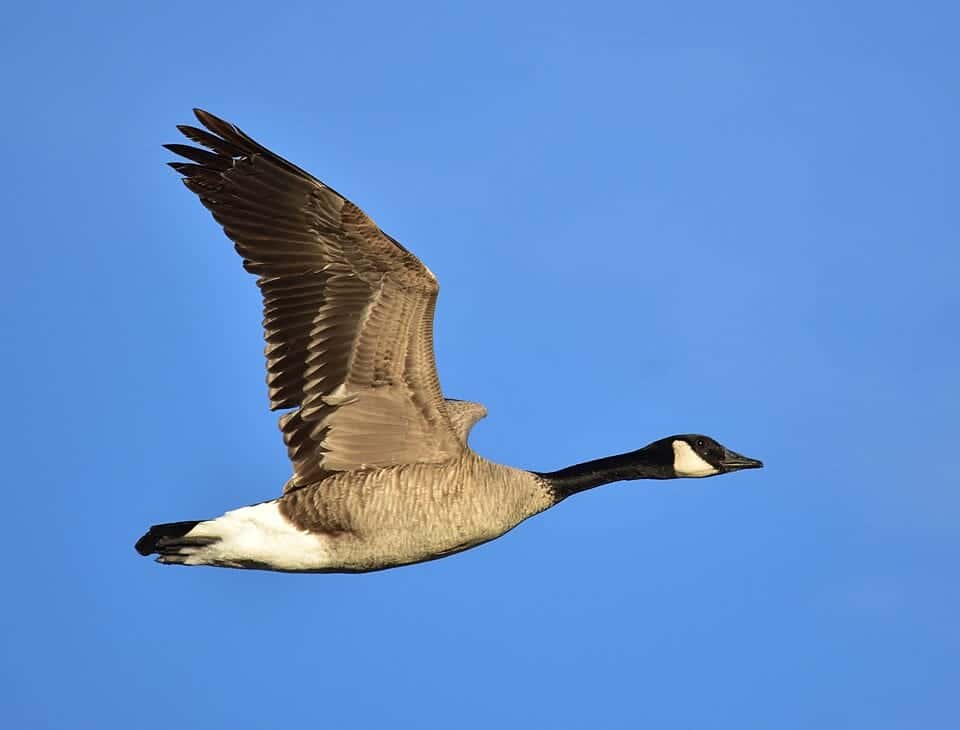
It is a clear, cool day in fall and you hear them before you ever see them: a rising, rhythmic chorus of honks drifting down from high overhead. You look up, and there they are — a long, ragged V of big, long-necked birds beating steadily across the sky, calling back and forth as they go. Few sights and sounds say "the season is changing" quite like a skein of geese pushing across an autumn sky. Most people know instantly that they are geese, but the flight raises real questions: why do they fly in that V, why all the honking, and are these birds actually going somewhere or just moving between local ponds? Here is how to identify the Canada goose and read what its flight is telling you.
How to Identify a Canada Goose
The Canada goose (Branta canadensis) is the default large goose across most of North America, and it is easy to recognize once you know the marks:
- The head and neck: a long black neck and black head with a bold white "chinstrap" patch that wraps from cheek to cheek under the chin — the signature field mark
- The body: a large, heavy-bodied bird with a brown back and wings, a paler tan-to-cream breast, and a white rear beneath a black tail
- The size: big — commonly two to three feet long with a wingspan up to five or six feet, and a slow, powerful wingbeat in flight
- The voice: the loud, resonant, two-note "ah-honk" call, given constantly in flight and often the first thing you notice
- The flight shape: strings and V-formations of birds flying in a line, unlike the shapeless flocks of many smaller birds
A big brown-bodied goose with a black neck and a white chinstrap is a Canada goose almost anywhere in North America. The similar-looking cackling goose is smaller with a stubbier bill, and the very rare Barnacle goose has a mostly white face, but for the overwhelming majority of sightings, the honking V overhead is Canada geese.
Try Spotter free on iPhone or Android
Plants, animals, fungi and rocks from one photo. 5 free identifications every day, no card required.


Why the V, and Why the Honking
The V-formation is a fuel-saving trick. As each goose flaps, its wingtips throw off a swirl of air, and the bird just behind and to the side can ride that rising wake, getting a small lift for free. Stacked into a V, the whole flock drafts off one another so that every bird except the leader saves energy — studies suggest geese can fly substantially farther in formation than any one bird could alone. Because the lead position is the hardest work, the birds trade off, with tired leaders dropping back and a fresh goose moving up to take the point. The constant honking is how they coordinate all this: the calls help the flock keep contact, hold their spacing, and signal position as they shift places, and they help keep weaker or slower birds from falling behind on a long haul. So the noisy, shifting V is not chaos — it is a remarkably efficient traveling team, talking constantly to stay together.
Migrants or Locals?
Not every V is bound for the far north or south. Many Canada geese have become year-round residents of parks, golf courses, and retention ponds, and these local birds fly in Vs on short daily commutes between feeding and roosting sites without truly migrating. True migrants, by contrast, are the flocks that pass high overhead in long, purposeful lines during the spring and fall — moving between northern breeding grounds and southern wintering areas, often traveling by day and by night and stopping at wetlands and harvested fields to rest and refuel along the way. A good rule of thumb: geese circling low around a familiar pond are probably locals, while a high, steady skein pushing one direction across the sky on a crisp fall day — especially after a cold front — is more likely the real migration. Either way, they are harmless to watch and one of the easiest seasonal spectacles to enjoy from your own backyard.
Heard the honking and want to confirm the big birds crossing your sky are Canada geese and not one of their look-alikes? Snap a photo showing the black neck and white chinstrap and let Spotter help you identify it as a starting point, so you can put a name to the flight overhead this fall.
Try Spotter free on iPhone or Android
Plants, animals, fungi and rocks from one photo. 5 free identifications every day, no card required.