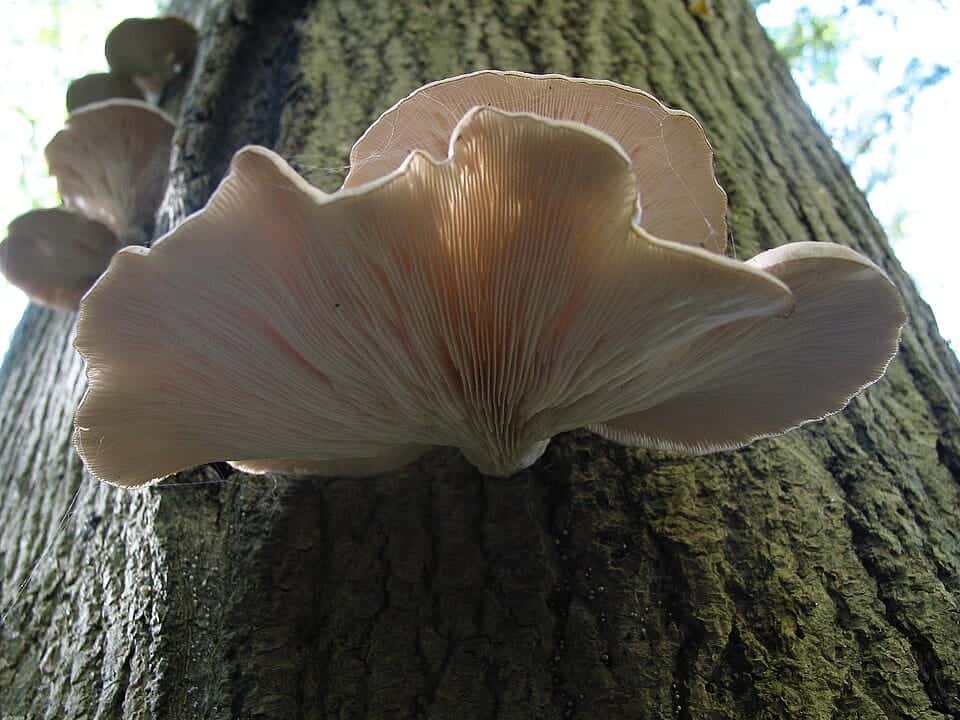
You are walking past a dead standing trunk, a fallen log, or a stump — often a day or two after a good rain in the cool of fall — when you notice them: soft, smooth-capped mushrooms growing in an overlapping, shelf-like cluster straight out of the wood, with gills running down toward where they attach. They look almost like a stack of pale seashells or fans. That form is the classic look of an oyster mushroom, one of the most widespread and recognizable wood-rotting fungi, and cooler, damp fall weather is prime time for it to appear. This guide covers how to recognize the oyster mushroom group and, just as importantly, the look-alikes that make caution essential.
How to Identify an Oyster Mushroom
Oyster mushrooms share a distinctive combination of shape, gills, and growth habit:
- The cap: broad, smooth, and fan- or oyster-shell-shaped, typically white to gray, tan, or soft brown, from a couple of inches to the size of your hand
- The gills: white to cream, and — a key trait — running down onto and along the stem area rather than stopping cleanly at it (called "decurrent" gills)
- The stem: short and off-center, or nearly absent, so the cap looks attached to the wood along one edge; caps often overlap in shelving, tiered clusters
- The habitat: growing directly on dead or dying wood — logs, stumps, standing dead trunks — most often on hardwoods such as beech, oak, aspen, and maple
- The spore print: white to pale lilac-gray, a detail experienced identifiers use to help confirm the group
Overlapping, smooth, pale fan-shaped caps with white gills running down a stubby off-center stem, growing in shelving clusters on dead hardwood, is the classic oyster mushroom pattern.
Try Spotter free on iPhone or Android
Plants, animals, fungi and rocks from one photo. 5 free identifications every day, no card required.


Look-Alikes You Must Rule Out
Several other mushrooms grow in oyster-like shelves, and a few are dangerous, which is exactly why identification here demands care:
- Jack-o’-lantern mushroom: vivid orange all over (cap and gills), growing in big clustered clumps usually at the base of trees or from buried roots with a real central stem — not the pale, sessile shelf of a true oyster; it is toxic and causes serious digestive illness
- Angel wings: small, thin, pure-white oyster-shaped mushrooms that grow specifically on conifer (pine, spruce, fir) wood — these have been linked to serious, even fatal poisonings, so a white "oyster" on a conifer is a hard stop
- Mock oyster (orange mossy oyster): fuzzy, bright orange, and bitter, growing shelf-like on wood but easily separated by its color and hairy cap surface
- Various small brown gilled shelf fungi and bracket fungi that can superficially resemble oysters from a distance
The takeaway: "shelf mushroom on a log" is a starting point, not an identification. Color, gill structure, and — critically — whether the wood is a hardwood or a conifer all change the answer.
A Safety-First Word on Wild Mushrooms
Enjoy oyster mushrooms for what they are — a beautiful, common, easy-to-notice part of the fall woods — but treat any wild mushroom with respect. Never eat a wild mushroom based on a photo, an app, a website, or a general resemblance; deadly and merely toxic look-alikes exist for many popular edibles, and mushroom identification for the table should only ever be confirmed in person by a knowledgeable expert or local mycological society. This guide is for identification and appreciation, not for foraging or consumption decisions. When in doubt, look, photograph, and leave it be.
Not sure whether those shelves on the log are oyster mushrooms, a bracket fungus, or one of the toxic look-alikes? Photograph the cluster, the gills, and the wood it is growing on, and let Spotter help you narrow down what you are looking at — a safer first step than guessing.
Try Spotter free on iPhone or Android
Plants, animals, fungi and rocks from one photo. 5 free identifications every day, no card required.