
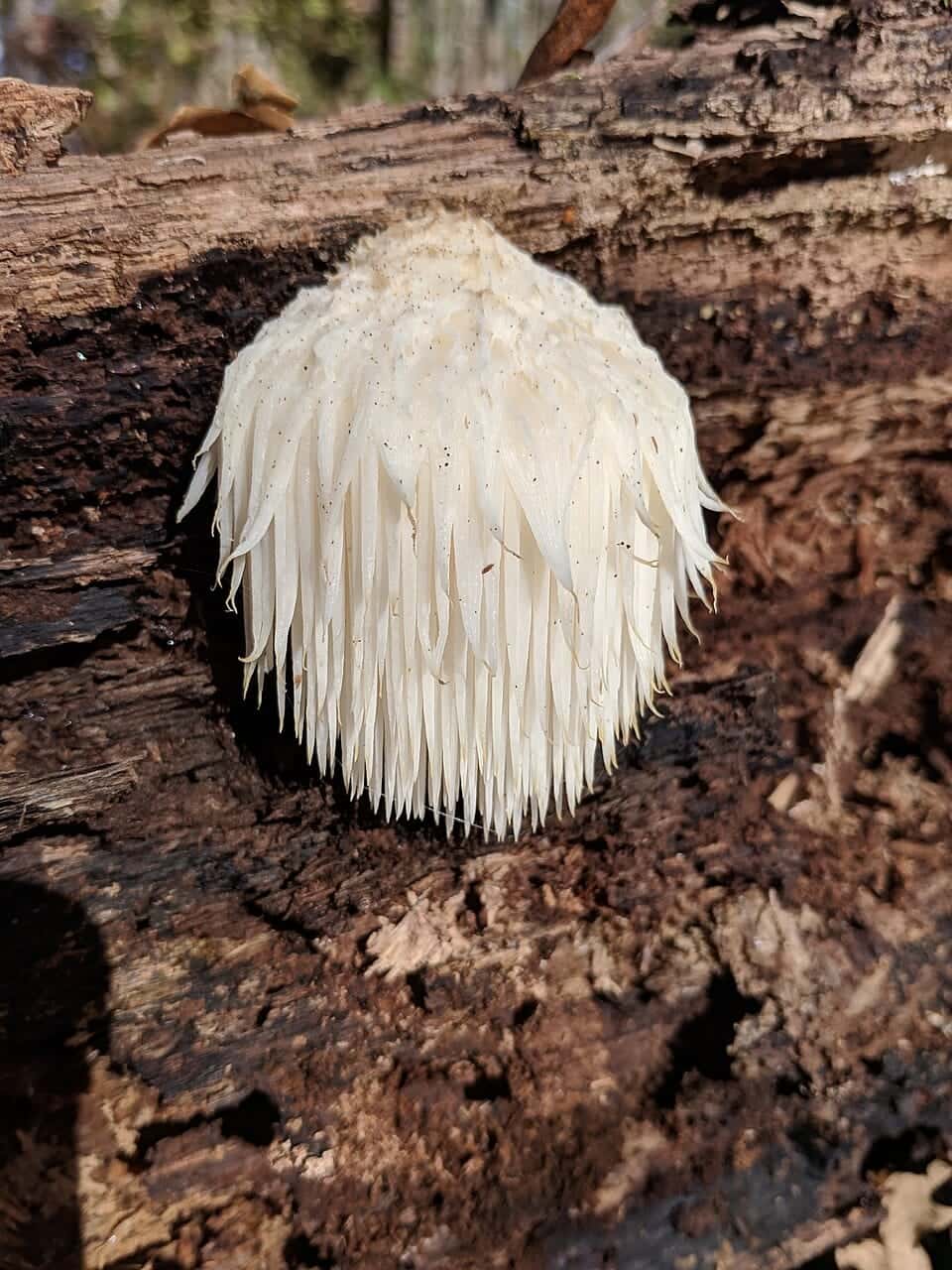
You are walking a hardwood trail in early fall when a flash of white on a tree trunk stops you: a soft, rounded mass clinging to the bark or to a fallen log, covered in dozens of downward-hanging spines like a cascade of icicles, a shaggy white pom-pom, or a small frozen waterfall. It is unlike any toadstool you have seen — there is no cap-and-stem "mushroom" shape at all, just a shaggy cushion of dangling teeth. It catches your eye precisely because so little else in the woods is that pure, creamy white. This is lion’s mane, one of the most recognizable and least confusable mushrooms on the continent, and fall is exactly when it fruits. Here is how to identify it.
How to Identify Lion’s Mane
Lion’s mane (Hericium erinaceus) and its close relatives are "tooth fungi" — instead of gills or pores under a cap, they release spores from soft, hanging spines. Look for this combination of traits:
- The shape: a single rounded, cushion- or snowball-like mass with no distinct cap or stem, growing straight out of wood — often the size of a fist to a soccer ball
- The spines: soft, downward-pointing "teeth" or icicles hanging from the surface, roughly a quarter-inch to over an inch long, giving the whole thing a shaggy, bearded look
- The color: creamy white to off-white when fresh, aging to yellowish, tan, or brownish as it gets older — a fresh one is startlingly bright against dark bark
- The home: growing on the wood of living or dead hardwoods, especially oak, beech, maple, and walnut, usually emerging from a wound, scar, or the cut end of a log rather than from the ground
- The season and feel: appearing from late summer through fall (roughly August into November), often after rain and cool nights, with a soft, spongy texture when fresh
A bright white, shaggy, toothed mass growing directly out of a tree trunk or log in fall is the signature look — there is very little else in the woods it can be mistaken for. Its cousins in the genus Hericium (such as bear’s head and comb tooth) share the white color and hanging teeth but branch into coral-like or tiered clumps rather than forming one solid pom-pom; all of them are toothed white fungi on wood, and none has a dangerous poisonous look-alike, which is part of why lion’s mane is a favorite among new mushroom watchers.
Try Spotter free on iPhone or Android
Plants, animals, fungi and rocks from one photo. 5 free identifications every day, no card required.


Where and When to Look
Lion’s mane is a cool-weather mushroom that fruits as summer heat breaks. In most of North America it appears from late summer into fall — often best from September through mid-October — and tapers off after hard frosts. It grows on hardwoods, frequently high up on a standing trunk where a branch broke or the bark was injured, as well as on fallen logs and stumps. Because it favors wounds on living trees, the same tree can produce a fruiting in the same spot for several years running. It is genuinely easy to spot in autumn: once the leaves start to thin, a clean white lump on a gray trunk stands out from a long way off, since almost nothing else in the forest is that bright.
A Word on Safety
Lion’s mane is often called one of the safest wild mushrooms for beginners to recognize because its shape is so distinctive and it has no toxic twins, but "easy to identify" is never the same as "safe to eat," and this guide is about identification only. As with any wild mushroom, never eat anything you cannot identify with total certainty, and treat online tools — including Spotter — as a starting point for learning, not as clearance to consume a wild find. Confirm any potential edible with an experienced local forager or a regional field guide, be sure it is fresh and not old, waterlogged, or spoiled, and know that even widely eaten mushrooms can disagree with some people. When in doubt, admire and photograph it and leave it on the tree.
Found a shaggy white icicle-like mushroom on a trunk or log and want to know what it is? Snap a photo — ideally showing the hanging spines and the wood it is growing from — and let Spotter help you identify it as a starting point, so you can put a name to one of fall’s most striking finds.
Try Spotter free on iPhone or Android
Plants, animals, fungi and rocks from one photo. 5 free identifications every day, no card required.