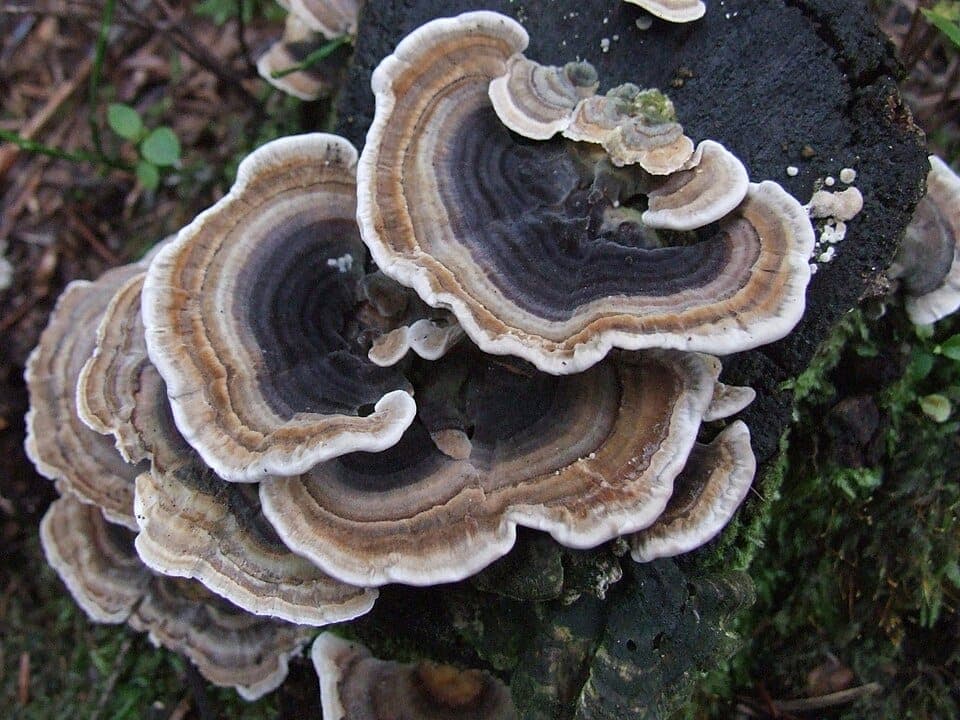
Walk past a fallen log or an old stump in the woods, especially as the weather cools into fall, and you will often find it lined with row upon row of small, fan-shaped brackets, each banded with concentric rings of color — brown, tan, rust, blue-gray, and cream — overlapping in rosettes like shingles. It is one of the most eye-catching and widespread fungi in North America, and its name is a perfect description: turkey tail, so called because a colony really does look like a flock of miniature wild-turkey tails fanned out across the wood. Here is how to identify it and separate it from its common look-alikes.
How to Identify Turkey Tail
Turkey tail (Trametes versicolor — the species name means "of many colors") is a polypore, a bracket fungus that releases its spores through tiny pores rather than gills. Look for this combination:
- Thin, flexible, fan- or shell-shaped brackets, usually 1 to 4 inches across, growing in overlapping tiers and rosettes
- Concentric bands of contrasting color across the top — browns, tans, rusts, grays, blue-grays, and creams — alternating light and dark like rings on a target
- A finely fuzzy or velvety surface texture on the top (run a finger across it and it feels slightly hairy, not slick)
- A whitish underside covered in very fine pores — roughly 3 to 8 tiny pores per millimeter, so many that the surface looks solid white until you look closely
- Growing on dead hardwood: fallen logs, stumps, and dead branches, where it is one of the workhorses of wood decay; it is thin and pliable, not a thick, hard shelf
The single most important feature is the underside. Flip a bracket over: a true turkey tail has a white, finely pored surface. If the underside is smooth, or a solid orange or tan with no pores at all, you are looking at a look-alike rather than the real thing. The pores, the thin flexible texture, and the fuzzy multi-colored top together make a confident identification.
Try Spotter Free on iOS & Android
Plants, animals, fungi, and rocks — all from a photo. 5 free identifications every day, no credit card required.
Turkey Tail Look-Alikes
Several fungi grow in the same fan-shaped, banded, log-dwelling style, and a few are common enough to cause regular confusion. The good news is there are no dangerously poisonous look-alikes in this group, but telling them apart is still a satisfying test of your eye:
- False turkey tail (Stereum species): the classic impostor — similar banded, fan-shaped top, but the underside is smooth and often orange, tan, or brownish with no pores at all, which is the quickest way to rule it out
- Hairy bracket (Trametes hirsuta): a genuine polypore with a pored white underside like true turkey tail, but the top is noticeably hairier and mostly whitish to gray rather than richly multi-colored
- Multicolor gill polypore (Trichaptum species): fan-shaped and banded like turkey tail, but the underside is toothed or maze-like rather than finely pored, often with a purplish tinge on fresh edges
- Thick, woody conks: hard, hoof- or shelf-shaped brackets that do not flex and last for years are separate fungi entirely — turkey tail is always thin and leathery enough to bend
Working through those differences — pores versus a smooth underside, a colorful fuzzy top versus a plain hairy one, thin and flexible versus thick and woody — is exactly the kind of side-by-side checking that turns "some bracket fungus" into a confident identification.
The Role Turkey Tail Plays in the Woods
Turkey tail is a decomposer, one of the most important recyclers in a forest. It feeds on dead hardwood, breaking down the tough lignin and cellulose in fallen logs and stumps and returning those nutrients to the soil, which is why you find it almost exclusively on dead wood rather than living trees. Its fruiting bodies are tough and leathery rather than fleshy, so unlike a soft mushroom they persist for a long time and can be found across much of the year, becoming especially noticeable on fall and winter walks when other fungi have faded. This is an identification guide, not a foraging or medicinal one: turkey tail is not a mushroom people eat like a portobello, and you should never consume any wild fungus based on an app, a photo, or an article. The pleasure here is simply in recognizing a beautiful and ecologically vital fungus at work.
Found a log covered in colorful, banded little fans and want to know whether it is true turkey tail or one of its look-alikes? Snap a photo and let Spotter identify the fungus as a starting point — then flip a bracket over to check for those telltale white pores and confirm it yourself.
Try Spotter Free on iOS & Android
Plants, animals, fungi, and rocks — all from a photo. 5 free identifications every day, no credit card required.