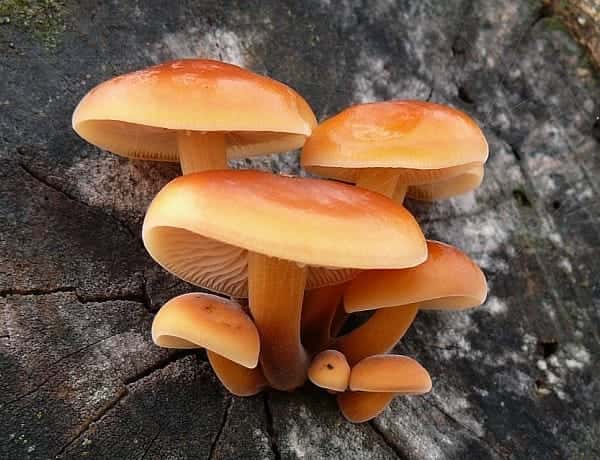
Velvet foot (Flammulina velutipes) is a small, cold-weather mushroom you can recognize by a sticky orange to tawny cap and a tough, dark velvety stem, growing in overlapping clusters straight out of dead hardwood. It is one of the few mushrooms that fruits in freezing weather, so a bright orange cluster on a bare winter trunk is often this species. The catch is a deadly look-alike that shares the same wood, so velvet foot is an identification-only mushroom, and the single feature that settles it is a spore print.
Most mushrooms vanish once hard frost arrives, but velvet foot is just getting started. In the United States, research-grade iNaturalist observations of Flammulina velutipes climb through fall and peak from October into January, then nearly disappear in midsummer, with roughly 12 July records against more than 1,100 in November. A Spotter identification this November turned one up on a decaying log, and the features the app keyed on were its shiny orange-brown caps, yellowish gills, and dark velvety stems emerging from the wood, a tidy summary of the whole mushroom. Here is how to read each of those marks, and how to separate velvet foot from the dangerous mushrooms it grows beside. You can run your own photo through the mushroom identifier for a first pass.
How to Identify Velvet Foot
Velvet foot is small and plain, so no single feature carries the identification. Check the cap, the stem, the gills, the spore print, and the season together.
Sticky orange cap
The cap is light orange to tawny or honey-brown, usually darker toward the center and paler at the edge, and runs roughly 1 to 3 inches across. It is smooth and distinctly sticky or slimy when fresh, with a slight shine in damp weather and a tacky feel when you touch it. Young caps are rounded and flatten out with age. A sticky orange cap in cold weather is the first thing that points toward velvet foot rather than one of the dry-capped little brown mushrooms.
Dark, velvety stem with no ring
The stem is where this mushroom earns its name. It is tough and fibrous, pale yellow near the cap, and turns brown to nearly black toward the base, coated in a fine, dense velvet that is easiest to see on a mature specimen. There is no ring or skirt anywhere on the stem. That detail matters, because the deadly Galerina marginata that grows in the same places does carry a faint ring, so a clean, ringless, velvety stem counts in velvet foot’s favor, though never as the only check you make.
White spore print and pale gills
The gills are white to pale yellow, fairly well spaced, and attached to the stem or running slightly down it. More telling is what they drop. Velvet foot leaves a white spore print, while the deadly Galerina leaves a rusty to brown one. To take a print, set a cap gill-side down on foil or on paper that is half white and half dark for a few hours. The color of that dust is the single most reliable way to tell the two apart, which is why careful identifiers insist on it for any small mushroom growing on wood.
Clustered on dead hardwood in the cold
Velvet foot is a wood-rotter. It fruits in tight, overlapping clusters from dead or dying hardwoods, especially elm, but also ash, willow, aspen, oak, and beech, sometimes from a buried root so the cluster looks like it is rising out of the ground. The species’ iNaturalist records run from fall through winter and into spring, and it famously pushes out fresh caps during thaws between freezes. A cluster of orange mushrooms on a hardwood log in November, December, or a January warm spell fits velvet foot better than almost anything else out at that time of year.
Velvet Foot vs. Its Look-Alikes
Three groups cause the most confusion: the lethal Galerina marginata, which is the one that can kill you; scaly Pholiota species that cluster on the same wood; and sulphur tuft, a common clustered wood mushroom. This table lines up the field marks that matter, but for the Galerina in particular the spore print is the decider.
| Mushroom | Cap | Stem | Spore print | Quick tell |
|---|---|---|---|---|
| Velvet foot (Flammulina velutipes) | Sticky, orange to tawny, 1–3 in | Velvety, dark brown-black base, no ring | White | Slimy orange cap and velvety ringless stem, out in the cold |
| Deadly Galerina (Galerina marginata) | Dry, brown to tan, fading as it dries | Thin ring present, no dark velvet | Rusty brown | Ring on stem and brown print; contains lethal amatoxins |
| Scaly Pholiota (Pholiota spp.) | Often scaly or slimy, yellow-brown | Usually scaly, may show a ring zone | Brown | Scales on cap and stem, brown print |
| Sulphur tuft (Hypholoma fasciculare) | Dry, sulphur-yellow to orange-brown | Yellow, no true ring | Purple-brown | Greenish-yellow gills and purple-brown print; toxic |
The one you cannot afford to miss is the deadly Galerina. It contains the same amatoxins as the death cap, grows on rotting wood of both hardwoods and conifers, and has sent foragers and pets to emergency care. The University of British Columbia’s Beaty Biodiversity Museum describes its small membranous ring and rusty-brown spore print, the two marks that separate it from velvet foot. For another small mushroom that clusters on wood and hides a deadly Galerina look-alike, see our guide to honey mushrooms, and for a larger shelving cluster on dead wood, oyster mushrooms.
Safety: Treat Every Small Wood Mushroom as a Galerina Until Proven Otherwise
Because velvet foot and the deadly Galerina can fruit side by side on the same log, color and growth habit alone are never enough. Make a spore print on anything small, brown-stemmed, and growing on wood before you do anything else with it, and when the print comes up rusty or brown, treat the mushroom as dangerous. If anyone swallows an unknown wild mushroom and then develops vomiting or diarrhea, especially if symptoms begin six or more hours later, call Poison Control at 1-800-222-1222 or emergency services right away, because amatoxin poisoning has a deceptive delay before it damages the liver. This guide is for identification only. For the wider set of fall and winter fungi in this region, see our Great Lakes mushroom guide.
Frequently Asked Questions
Is velvet foot the same as the enoki sold in stores?
Grocery-store enoki is a cultivated strain of Flammulina velutipes, but the two look nothing alike. Commercial enoki is grown in jars in the dark with added carbon dioxide, which forces long, thin, ghost-white stems and tiny pale caps. Wild velvet foot grows in open air, so it develops the short, dark, velvety stem and the sticky orange cap described above. Recognizing the wild form is still an identification exercise, because the deadly Galerina shares its habitat.
When does velvet foot appear?
Late fall through winter and into early spring. It is one of a small group of cold-weather mushrooms, and it tolerates freezing, often producing fresh caps during mild spells between hard frosts. Its iNaturalist observations peak from October through January and bottom out in midsummer, the reverse of most mushrooms.
How do I tell velvet foot from the deadly Galerina?
Take a spore print. Velvet foot drops white spores and has a ringless, dark velvety stem. The deadly Galerina drops rusty-brown spores and usually shows a thin ring on the stem. Habitat and color overlap too much to rely on, so when a small wood mushroom gives a brown print, assume Galerina and keep clear.
Why is it called velvet foot?
For the stem. Under a hand lens, the lower stem is coated in a dense layer of fine dark hairs that look and feel like velvet, darkening from brown to almost black at the base. The names velvet foot, velvet shank, and velvet stem all point to the same feature, which is one of the mushroom’s most useful field marks.
Try Spotter free on iPhone or Android
Plants, animals, fungi and rocks from one photo. 5 free identifications every day, no card required.