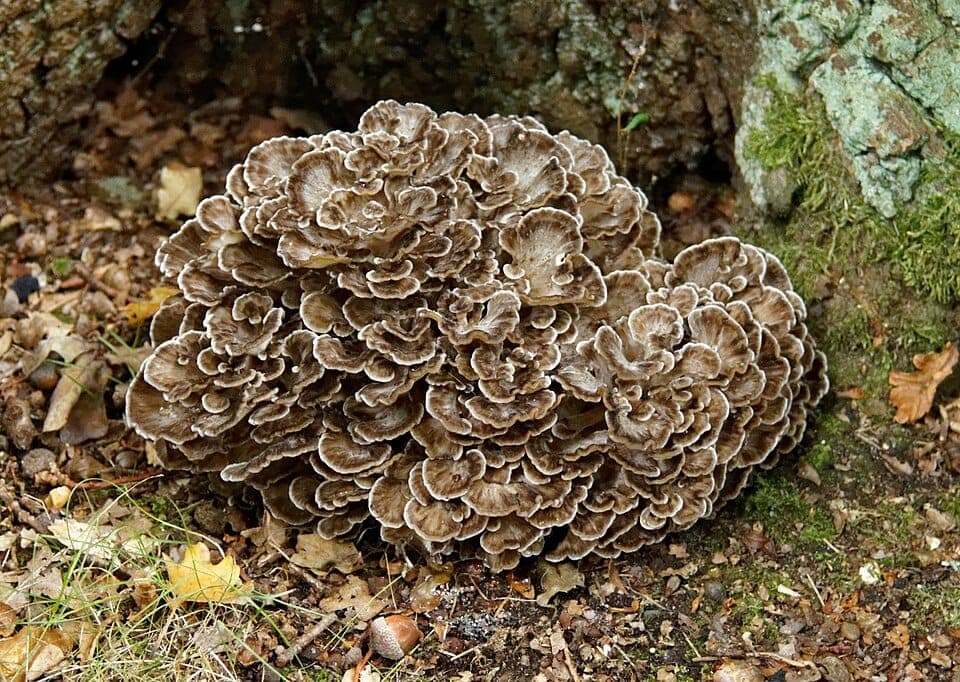
You are walking near an old oak in early fall when you notice a large, rounded mass hugging the base of the trunk — a soft, layered cluster of many small, gray-brown, fan- or spoon-shaped caps, ruffled and overlapping like the feathers of a fluffed-up sitting hen. It can be the size of a dinner plate or far bigger, and it seems to have swelled up out of the ground overnight. That impressive rosette is hen of the woods, also known by its Japanese name, maitake. It is one of the most celebrated fall mushrooms in North America, and one of the more recognizable. Here is how to identify it.
How to Identify Hen of the Woods
Hen of the woods (Grifola frondosa) grows as one big clustered body rather than as separate mushrooms, and it has a consistent set of features:
- Overall form: a large, rounded, cauliflower-like rosette made of many overlapping, fan- or spoon-shaped caps radiating from a shared branching base — often 6 inches to well over a foot across, and sometimes weighing several pounds
- Color: caps are grayish-brown to tan on top (often lighter at the wavy edges) and white to cream underneath
- Underside: no gills — instead the pale underside has tiny pores, and the pore surface runs a short way down the branched stalks
- Where it grows: at the base of trees and stumps, overwhelmingly oaks (especially old ones), occasionally maple, elm, or beech, emerging from the roots or root flare rather than high on the trunk
- Season: a fall mushroom, typically appearing from late summer through mid-fall, with peak fruiting from about late September into October
The combination of an old oak, a base-of-the-tree location, and a soft mass of many small gray-brown feathery caps with a pored underside is the classic hen-of-the-woods signature. A helpful bonus: it is a perennial. The fungus lives in the tree’s root system for years and tends to fruit in the same spot at the same tree each autumn, so a hen you find one year is often back the next.
The Safety Facts That Matter Most
Hen of the woods is famous as an edible and medicinal mushroom, which is exactly why it needs a clear safety note. This is an identification guide, not a foraging guide. Do not eat any wild mushroom based on a web article, a photo, or a phone app — including this one. Safe identification of a mushroom for eating requires an experienced local expert examining the actual specimen in person, and the consequences of a mistake with wild fungi can be severe.
While hen of the woods has no deadly poisonous look-alikes in the way some mushrooms do, it can be confused with other shelf and rosette fungi, and even genuine hen of the woods can cause digestive upset in some people or when eaten old or raw. None of that can be sorted out from a screen. Treat finding one as a satisfying identification, and leave any decision about eating to a knowledgeable person handling the real mushroom.
Try Spotter Free on iOS & Android
Plants, animals, fungi, and rocks — all from a photo. 5 free identifications every day, no credit card required.
Hen of the Woods Look-Alikes
A few other clustered, shelf-like fall fungi get mixed up with hen of the woods, which is another reason a hands-on expert check matters before anyone treats a wild fungus as food:
- Chicken of the woods: also grows on and around trees, but forms bright orange-and-yellow shelves rather than a gray-brown feathery rosette — a completely different color, though the similar name causes constant confusion
- Black-staining polypore (Meripilus): a similar large rosette that bruises and ages to black, unlike true hen of the woods
- Berkeley’s polypore: a big clustered polypore on oak that tends to be paler, thicker, and tougher, with larger individual caps
- Umbrella polypore: a related edible that grows from the ground with many small caps, but each cap has a central stalk rather than the shared, off-center branching base of hen of the woods
Is It a Problem for My Oak Tree?
Hen of the woods is a "butt rot" fungus — it slowly breaks down the heartwood in the roots and base of its host oak. In most cases it works on trees that are already old or declining, and a single autumn appearance is not a reason to panic. But because it is a sign that the tree’s root and lower-trunk wood is being decayed, a large or otherwise valued tree that is fruiting hen of the woods year after year is worth having an arborist look at, since internal base rot can eventually affect how solidly the tree stands.
Curious whether the frilly mass at the foot of your oak is really hen of the woods or one of its look-alikes? Snap a photo and let Spotter identify it as a starting point for learning the fungi in your woods — and remember that for anything you might eat, an in-person expert, never an app, is the only safe authority.
Try Spotter Free on iOS & Android
Plants, animals, fungi, and rocks — all from a photo. 5 free identifications every day, no credit card required.