
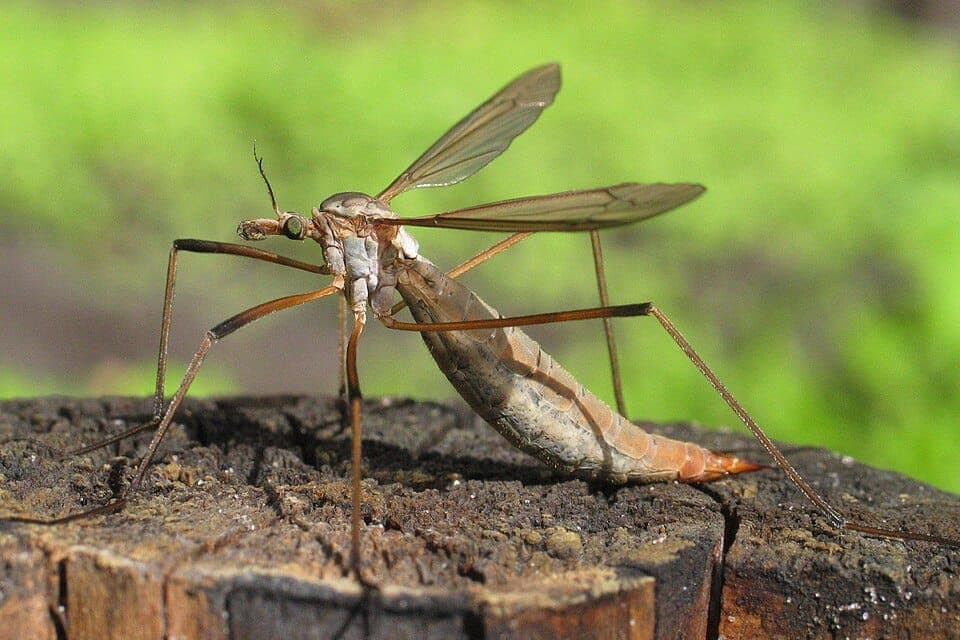
Every year, as summer slides toward fall, the same alarmed question rolls in: "There is a giant mosquito on my wall — is it going to bite?" The insect in question is usually enormous by mosquito standards, with spindly legs that seem far too long for its body and a wobbly, bumbling way of flying into lights and windows. Despite the resemblance and the scary nicknames, it is not a mosquito, it is not a mosquito predator, and it is completely harmless. It is a crane fly, and knowing what it is takes all the menace out of it.
It Is a Crane Fly, Not a Mosquito
Crane flies are true flies with a single pair of wings, and while some are only mosquito-sized, the ones that startle people can have a body an inch or more long — and with those trailing legs they look even bigger. A few features separate them from an actual mosquito at a glance:
- Size: if it is clearly bigger than a normal mosquito — dime-sized or larger — it is far too big to be one
- No biting beak: a mosquito has a needle-like proboscis for piercing skin, while a crane fly has nothing of the sort and cannot bite
- Extremely long, fragile legs that dangle in flight and snap off at the slightest touch
- A clumsy, bobbing, almost drunken flight — nothing like the fast, whining zip of a mosquito
Try Spotter Free on iOS & Android
Plants, animals, fungi, and rocks — all from a photo. 5 free identifications every day, no credit card required.
The Mosquito-Eater Myth
You may have heard crane flies called "mosquito hawks," "mosquito eaters," or "skeeter eaters," with the comforting idea that they patrol your yard devouring mosquitoes. It is a myth. Adult crane flies do not hunt or eat mosquitoes at all. In fact most adults barely eat anything — many have only weak or nonfunctional mouthparts and live just a week or two, spending their entire short adult lives trying to mate and lay eggs. Some sip a little nectar or water, but none of them are the mosquito-control heroes their nickname suggests.
Are They Dangerous?
Not in the slightest. Crane flies do not bite, do not sting, carry no venom, and pose no threat to you, your kids, or your pets. If one gets indoors, you can cup it in your hands or gently guide it back out a window without any worry. The one situation where crane flies matter is underground: their larvae, sometimes called "leatherjackets," live in moist soil and feed on roots and decaying plant matter. In very large numbers they can thin out patches of lawn, which is the only real downside anyone attributes to them — and it has nothing to do with the harmless adults on your wall.
Why Are There So Many Right Now?
Crane flies emerge in flushes, and late summer into early fall is one of the big ones (spring is the other), especially after wet weather that keeps the soil their larvae live in nice and damp. Like many insects they are drawn to light, so they gather on porch walls, around outdoor fixtures, and at bright windows after dark, then slip inside whenever a door opens. Because each adult lives only a matter of days, a wave of them passes quickly — you do not need to spray anything or call anyone. Reducing outdoor lighting at night and sealing gaps around doors is more than enough to keep them from wandering in.
Staring at a giant "mosquito" and not quite convinced it is as harmless as it looks? Snap a photo and let Spotter identify it, so you can confirm it is a gentle crane fly and put the wall down without a second thought.
Try Spotter Free on iOS & Android
Plants, animals, fungi, and rocks — all from a photo. 5 free identifications every day, no credit card required.