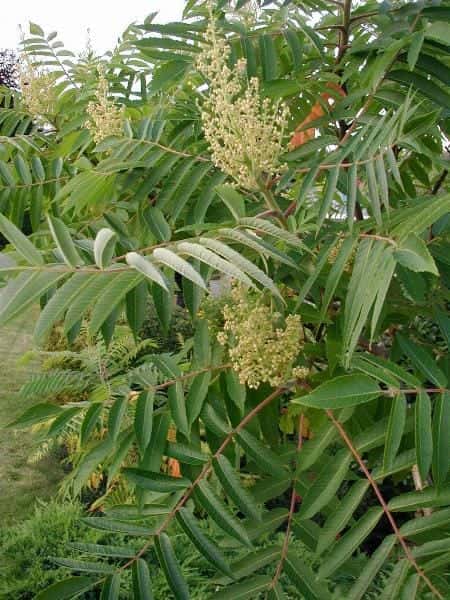
Drive a country road, walk a fence line, or scan the sunny brushy edge of a field in late summer and you will see it: a spreading shrub or small, gangly tree, often growing in a thicket of many stems, holding up dozens of dense, upright cones of deep-red fuzzy berries. The leaves are long and fern-like, divided into many narrow leaflets, and by late August they are already starting to flush orange and scarlet — one of the first plants of the year to turn. Break off a young twig and it is covered in soft, velvety hairs, like the fuzz on a deer’s growing antlers. This is staghorn sumac, one of the most recognizable native shrubs of late summer and fall. The name understandably worries people who have heard of "poison sumac," so the most useful thing to know up front is that staghorn sumac is not that plant. Here is how to identify it.
How to Identify Staghorn Sumac
Staghorn sumac (Rhus typhina) is the largest of the North American sumacs, common across the eastern and central states in old fields, along roadsides, and on disturbed sunny ground where it spreads by root suckers into dense colonies. Look for this combination of traits:
- The berry clusters: tight, upright, cone- or spike-shaped clusters at the branch tips, packed with small round fruits (drupes) that are a deep crimson to burgundy red and covered in fine hairs, giving the whole cone a fuzzy, velvety look
- The velvet branches: young twigs and stalks are thickly coated in soft reddish-brown hairs, resembling the velvet on a stag’s antlers — the trait that gives the plant its name and the single easiest way to separate it from smooth sumac
- The leaves: large and pinnately compound, up to two feet long, divided into roughly 11 to 31 narrow, toothed, lance-shaped leaflets arranged in pairs along a central stalk, turning brilliant orange, red, and scarlet early in the fall
- The growth habit: a shrub or small tree, typically 10 to 25 feet tall, often multi-stemmed and forming spreading clumps or thickets from a single root system
- The winter clue: the red seed cones are persistent, staying on the bare branches well into winter, where they are a familiar sight against the snow and a food source for birds
A close relative, smooth sumac (Rhus glabra), looks almost identical and grows in the same places, but its twigs are hairless and smooth rather than velvety. Both share the same upright red cones and fiery fall color, so either one is easy to place as a true, harmless sumac.
Try Spotter free on iPhone or Android
Plants, animals, fungi and rocks from one photo. 5 free identifications every day, no card required.


Staghorn Sumac Is Not Poison Sumac
This is the confusion worth clearing up, because the two plants share a name but almost nothing else. Poison sumac (Toxicodendron vernix) is a different plant entirely, and the differences are dramatic once you know them. Poison sumac produces loose, drooping clusters of small whitish-gray or pale-green berries that hang down — nothing like the tight, upright, fuzzy red cones of staghorn sumac. Poison sumac has smooth-edged leaflets with no teeth, while staghorn’s leaflets are clearly toothed. Most tellingly, poison sumac grows only in very wet ground — swamps, bogs, and standing-water wetlands — whereas staghorn sumac grows on dry, sunny, disturbed uplands like roadsides and old fields. If you are looking at a shrub with upright red cones on dry ground, you are almost certainly looking at harmless staghorn sumac, not the poison kind.
The simplest rule: red, upright, fuzzy cones on dry ground means the good sumac; drooping white or pale berries in a swamp means stay away. When berry color and habitat both point the same way, you can be confident.
Where and When You See It
Staghorn sumac is a pioneer of open, disturbed, sunny places. It colonizes roadsides, railroad embankments, fence rows, abandoned fields, and the bright edges of woods, quickly forming spreading clumps that provide cover and food for wildlife. The greenish flower clusters appear in early summer, and the fruit ripens into those signature red cones from roughly August into September — which is exactly when the plant is most eye-catching, its scarlet cones standing above leaves that are among the first to turn fall colors. Because the seed heads persist through winter, staghorn sumac is one of the few plants you can confidently identify in any season, and its early, intense fall color makes it a standout in late-summer and autumn landscapes.
The red berry cones are an important late-season food for many birds and small mammals, which is part of why the plant spreads so readily along field edges. You may have also heard that the tart red drupes are used to make a lemonade-like drink; because this is an identification guide and not a foraging one, the safe approach is simply to enjoy identifying the plant. Never eat any wild plant based on an app, a photo, or an article, and given how easily sumacs and their name cause confusion, correct identification always comes first.
Not sure whether the shrub with red cones along your road is staghorn sumac — or worried it might be the poison kind? Snap a photo and let Spotter identify the plant as a starting point, so you can tell the harmless native from its notorious namesake with confidence.
Try Spotter free on iPhone or Android
Plants, animals, fungi and rocks from one photo. 5 free identifications every day, no card required.