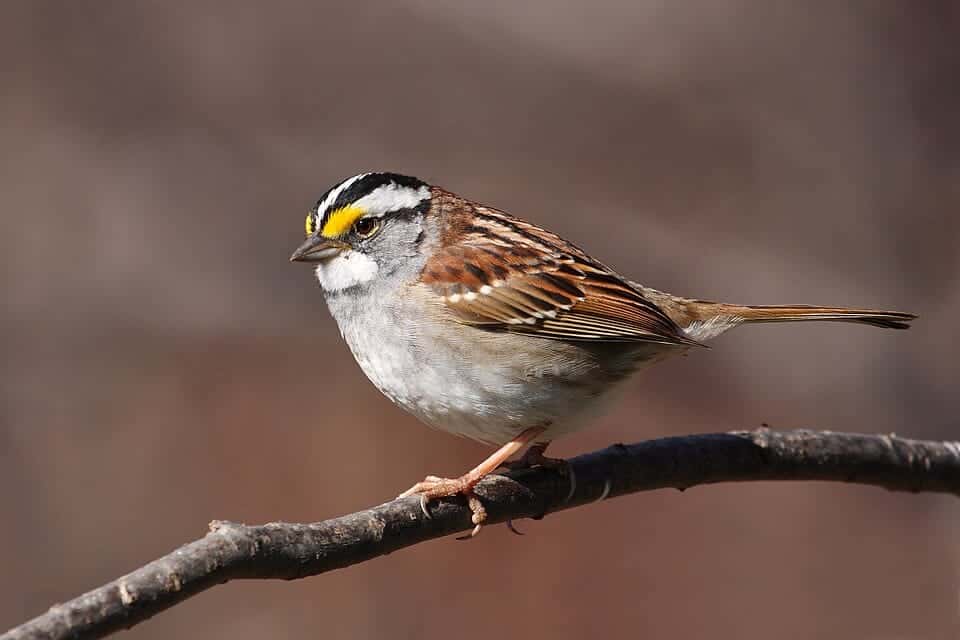
As the first cool mornings of fall arrive, a new brown bird often turns up beneath the feeder or along a brushy edge, scratching backward through the fallen leaves with a quick double-footed hop. At a glance it is "just a sparrow," but a closer look reveals a surprisingly sharp-looking bird: a clean white throat patch set off from a gray breast, bold stripes over the crown, and — the clincher — a small dab of bright yellow tucked right in front of each eye. This is the white-throated sparrow (Zonotrichia albicollis), one of the most dependable and welcome arrivals of fall across much of the United States, moving down from northern breeding forests to spend the colder months. Here is how to identify it with confidence.
How to Identify a White-Throated Sparrow
The white-throated sparrow is a large, boldly marked sparrow, and a few features together make it one of the easier "little brown birds" to name:
- The throat: a neat, clearly outlined white throat patch that stands out against a plain gray face and breast — the feature the bird is named for
- The yellow spot: a small patch of yellow between the eye and the bill (the "lores") — subtle but diagnostic, and present on every white-throated sparrow
- The head stripes: a boldly striped crown, with either black-and-white stripes or, in the other common form, tan-and-brown stripes
- The overall look: a plump, fairly large sparrow with a rounded body, streaked brown back, and unstreaked grayish underparts
- The behavior: a ground feeder that scratches through leaf litter with a distinctive two-footed backward hop, usually staying near cover in brush, thickets, and shrubby edges
A plump sparrow with a crisp white throat, striped crown, and a small yellow spot in front of the eye, scratching under the feeder in fall, is a white-throated sparrow. The yellow lores plus the sharp white throat are the combination that seals it.
Try Spotter free on iPhone or Android
Plants, animals, fungi and rocks from one photo. 5 free identifications every day, no card required.


Two Forms of the Same Bird
One thing that trips people up is that white-throated sparrows come in two color forms, or morphs, that look different enough to seem like separate species. The "white-striped" form has bold black-and-white crown stripes and a bright, clean look; the "tan-striped" form has softer tan-and-brown stripes and a more muted face. Both morphs show the white throat and the yellow spot in front of the eye, though the yellow is usually more obvious on the white-striped birds. Remarkably, the species almost always pairs a bird of one morph with a bird of the other, so a nesting pair typically includes one white-striped and one tan-striped individual. Seeing both forms at your feeder in the same flock is completely normal.
When and Where You Will See Them
White-throated sparrows breed across Canada and the northern edge of the United States, then move south in fall to spend winter across much of the eastern and central states. In the northern states the first arrivals often appear from late September onward, with numbers building through October; farther south they are winter residents. They readily visit backyards, especially where there is a brush pile, hedge, or shrubby corner to duck into, and they favor seed scattered on the ground beneath feeders rather than perching at the feeder ports. Listen, too, for their clear, whistled song — often written as "Oh-sweet-Canada-Canada-Canada" — which many people hear on migration and in early spring.
Sparrows It Is Confused With
A couple of look-alikes share the same brushy fall habitat. The white-crowned sparrow, a close relative, also has a boldly striped crown but shows a clean gray throat and breast with no white throat patch and no yellow spot, plus a pink or orange bill. The song sparrow is browner and heavily streaked underneath, with a central breast spot, and lacks both the clean white throat and the yellow lores. When you see the sharply outlined white throat combined with that little yellow mark by the eye, you are looking at a white-throated sparrow and not one of its cousins.
Noticed a new striped sparrow scratching under your feeder this fall and want to be sure it is a white-throated sparrow? Snap a photo that shows the head and throat and let Spotter help you identify it — a great way to start telling apart the wave of sparrows that arrives every autumn.
Try Spotter free on iPhone or Android
Plants, animals, fungi and rocks from one photo. 5 free identifications every day, no card required.