You are walking past a tree in the yard — often a birch, maple, apple, or pine — and something on the trunk stops you: neat horizontal rows of small, round holes drilled into the bark, spaced out evenly like the perforations on a sheet of stamps, sometimes ringing the trunk in tidy bands and occasionally glistening with beads of sap. It looks far too orderly to be an accident, and the first fear is usually insects or disease killing the tree. The real answer is a bird. Those rows are the work of the yellow-bellied sapsucker, a migratory woodpecker that drills lines of shallow wells and returns to drink the sap that flows out, along with the insects the sap traps. Early fall is a prime time to notice fresh drilling as these birds move through on migration. Here is how to identify the holes, the bird behind them, and whether your tree is actually at risk.
How to Identify Sapsucker Holes
Sapsucker damage is one of the most distinctive signs any animal leaves on a tree, and once you know the pattern you will spot it everywhere:
- The arrangement: shallow, roughly square or round holes drilled in tidy horizontal rows and neat vertical columns, forming an orderly grid across the bark — the single most telling feature
- The size: each hole is small, roughly a quarter-inch across, far more uniform and evenly spaced than the ragged, random holes other woodpeckers leave when digging for insects
- The sap: fresh wells often ooze and bead with sap, and you may see sticky, darkened streaks running down the bark below the rows
- The favorites: sapsuckers return to the same trees and even the same patch of bark, so the rows build up over years — birch, maple, and fruit trees like apple are especially popular, along with pines and hemlocks
- The visitors: because the sap wells attract insects and other sap-drinkers, you may notice hummingbirds, wasps, butterflies, and other birds feeding at an active set of holes
Orderly rows and columns of small, evenly spaced holes — as opposed to scattered, irregular gouges — are the sapsucker signature. The neatness is the clue: a bird digging for grubs makes messy, random excavations, while a sapsucker tends a plantation of tidy wells and comes back to work the same lines again and again.
Try Spotter free on iPhone or Android
Plants, animals, fungi and rocks from one photo. 5 free identifications every day, no card required.


Meet the Bird: The Yellow-Bellied Sapsucker
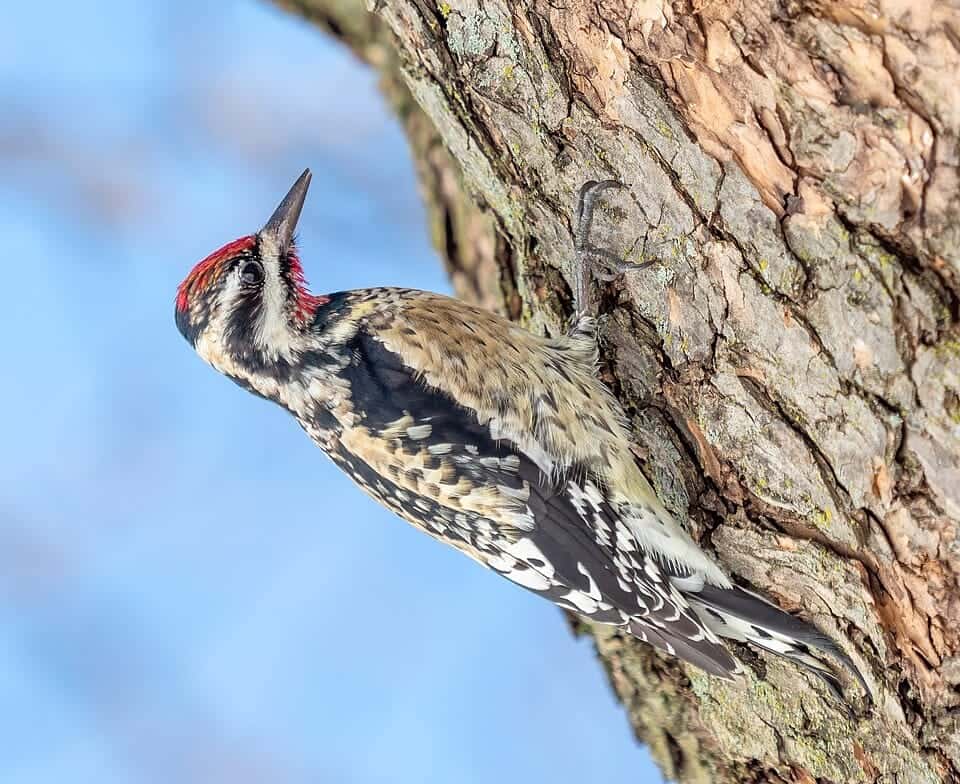
The yellow-bellied sapsucker is a medium-sized woodpecker of eastern and northern North America, and despite the name the "yellow belly" is a faint wash that is often hard to see in the field. The features that actually help are elsewhere: a long white stripe down the folded wing (a bold white "shoulder" patch that separates it from most other woodpeckers), black-and-white barring on the back, and a red forehead. Males add a red throat; females usually show a white throat instead. Like other woodpeckers it flies in a bounding, up-and-down path and clings upright to trunks and branches. Sapsuckers breed across Canada and the northern and Appalachian United States and winter in the southeastern states, Mexico, and Central America, which means much of the country sees them mainly as they pass through in spring and fall — and fall migration, right about now, is when a lot of people first notice fresh rows appearing on a familiar tree.
Sapsucker or Another Woodpecker?
A few common woodpeckers get blamed for sapsucker work, and the holes themselves usually settle it. Downy and hairy woodpeckers are the little black-and-white birds most people know; they hitch along branches hunting insects and leave irregular pecking rather than tidy grids. The much larger pileated woodpecker — crow-sized, with a flaming red crest — chisels big, oblong, rectangular holes deep into dead wood to reach carpenter ants, nothing like the shallow rows of a sapsucker. Northern flickers spend a lot of time on the ground eating ants and rarely drill trunks in rows at all. If the damage is a neat, repeating grid of small shallow wells that weep sap, it is sapsucker work; if it is a few random holes or a deep rectangular excavation, look to one of the others.
Is Your Tree in Danger?
For most healthy, established trees, a set of sapsucker rows is cosmetic rather than fatal, and the tree will wall off and heal the shallow wounds over time. The concern comes when a bird drills heavily in the same narrow band year after year: a dense ring of wells that fully encircles a trunk or limb can, in the worst cases, girdle it and cut off the flow above, and the fresh wounds can occasionally invite fungal infection or insect pests. If you want to protect a favored specimen, the humane and effective approaches are physical: loosely wrap the actively drilled section of trunk with burlap or hardware cloth for the season to discourage feeding, or hang bright, moving deterrents like flashing tape nearby. Avoid sticky substances on the bark, which can harm birds and the tree alike. It is also worth knowing that the yellow-bellied sapsucker, like all native migratory birds, is federally protected, so the birds themselves cannot legally be harmed — deterrence, not removal, is the right and lawful path. In most yards, though, the best response is simply to appreciate that your tree has become a well-tended feeding station for one of the more industrious birds in the neighborhood.
Found neat rows of holes marching up a tree trunk and want to confirm what made them — or catch the striped woodpecker in the act? Snap a photo of the pattern or the bird and let Spotter help you identify it as a starting point, so you can tell a harmless sapsucker feeding station from something that actually needs attention.
Try Spotter free on iPhone or Android
Plants, animals, fungi and rocks from one photo. 5 free identifications every day, no card required.