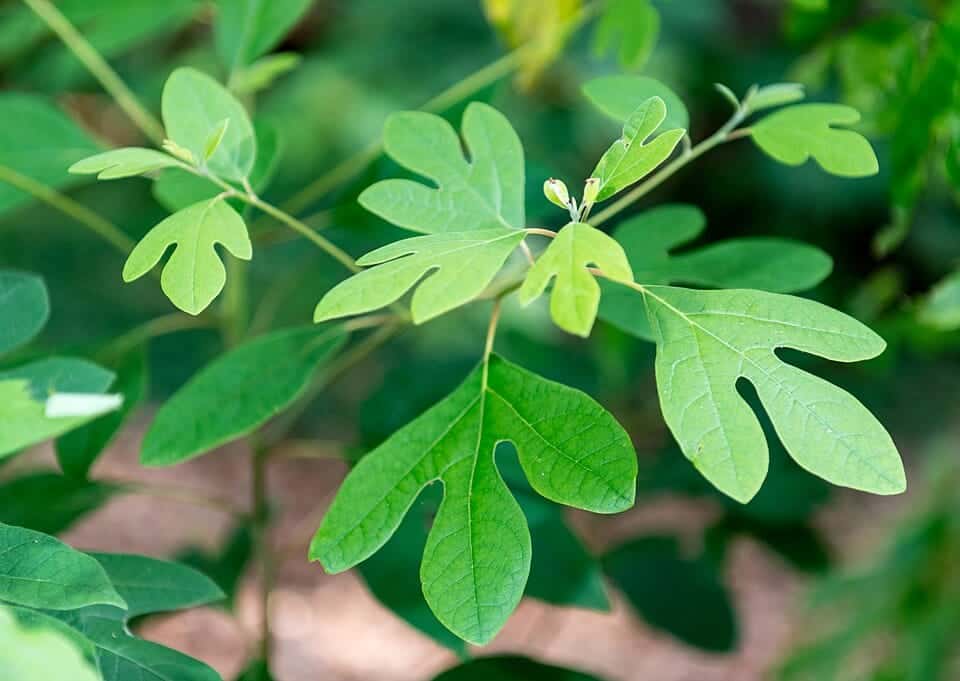
You are walking a trail, fence line, or the edge of the woods in early fall when a fallen leaf stops you: it is shaped like a mitten, a rounded blade with a single lobe jutting off one side exactly where a thumb would go. Then you notice the tree it fell from is doing something strange — the same branch carries three completely different leaf shapes at once: plain oval leaves, the mitten leaves, and leaves with a lobe on each side like a little ghost or a two-thumbed mitten. As fall deepens, that tree lights up in gold, orange, scarlet, and even purple. This is sassafras (Sassafras albidum), a native tree of the eastern and midwestern United States and one of the most fun trees to learn precisely because of those puzzle-piece leaves. Here is how to identify it with confidence.
How to Identify a Sassafras Tree
The mixed leaf shapes alone are close to diagnostic, but a few features together make sassafras unmistakable:
- The leaves: bright green and smooth-edged, growing in three shapes on the same tree — an unlobed oval, a one-lobed "mitten," and a three-lobed leaf — usually 3 to 7 inches long and arranged alternately along the twig
- The smell: crush or scratch a leaf or a twig and it gives off a sweet, spicy, citrus-and-root-beer scent — one of the most reliable clues and hard to mistake once you know it
- The fall color: a spectacular mix of yellow, orange, scarlet, and deep red to purple, often on one tree at once, making sassafras one of the standout trees of autumn
- The twigs and bark: young twigs are bright yellow-green and stay green through winter; older bark is reddish-brown to gray with deep furrows between firm, flat-topped ridges
- The habit: often a small-to-medium tree, frequently forming thickets or colonies from root sprouts along field edges, roadsides, fencerows, and disturbed woods
- The fruit (late summer to fall, on some trees): small dark-blue, cherry-like berries each sitting in a bright red, cup-and-stalk base shaped a bit like a golf tee
A shrubby tree or thicket with three different leaf shapes, green twigs, and a root-beer smell when you scratch a stem is sassafras. No other common tree in its range mixes mitten, oval, and three-lobed leaves the way sassafras does, and the scent seals it.
Try Spotter free on iPhone or Android
Plants, animals, fungi and rocks from one photo. 5 free identifications every day, no card required.


Why One Tree Grows Three Different Leaves
The mixed leaf shapes are what throw people, but they are completely normal for sassafras — a single tree, even a single branch, routinely carries all three forms. There is no perfect agreement on why, but the variation is a built-in trait of the species rather than a sign of disease or a graft. It makes for a useful teaching tree: kids and new naturalists remember "the mitten tree" long after they forget other species, because collecting all three leaf shapes off one plant feels like a small treasure hunt. Sassafras is also a keystone plant for wildlife — its berries are eaten by many songbirds and small mammals in fall, and it is one of the main host plants for the caterpillars of the spicebush swallowtail butterfly.
Sassafras Look-Alikes
A couple of other plants can cause a moment of doubt, but the differences are quick to check. Red mulberry also has variably lobed leaves, including mitten shapes, but its leaves have toothed (serrated) edges and a rougher, sandpapery feel, and it lacks the sweet root-beer smell. White mulberry is similar. The unrelated white oak has lobed leaves too, but its lobes are rounded fingers around the whole leaf rather than one or two thumbs, and it never smells spicy. When the leaf edges are smooth, three shapes appear on one tree, and a scratched twig smells like root beer, you are looking at sassafras and not a mulberry or oak.
A Note on Sassafras and Safety
Sassafras has a long history as the original flavoring in traditional root beer and as a folk tea, so people often ask about using it. This article is about identifying the tree, not consuming it — and there is an important caution worth knowing. Sassafras roots and bark contain safrole, a compound that regulators have restricted because of health concerns, and safrole-containing sassafras is not used in commercial food or drink today. Because of that, do not brew or eat parts of a wild sassafras based on a photo, a blog, or tradition; if you want to use any wild plant, confirm its identity and its specific safety cautions with an expert or a trusted regional guide first. For nearly everyone, the real reward here is simpler and completely safe: recognizing the mitten tree on sight and enjoying one of the best fall shows in the eastern woods.
Found a tree dropping mitten-shaped leaves in three different patterns and want to be sure it is sassafras? Snap a clear photo of a few leaves and the twig and let Spotter help you identify it as a starting point for getting to know one of the most charming native trees of fall.
Try Spotter free on iPhone or Android
Plants, animals, fungi and rocks from one photo. 5 free identifications every day, no card required.