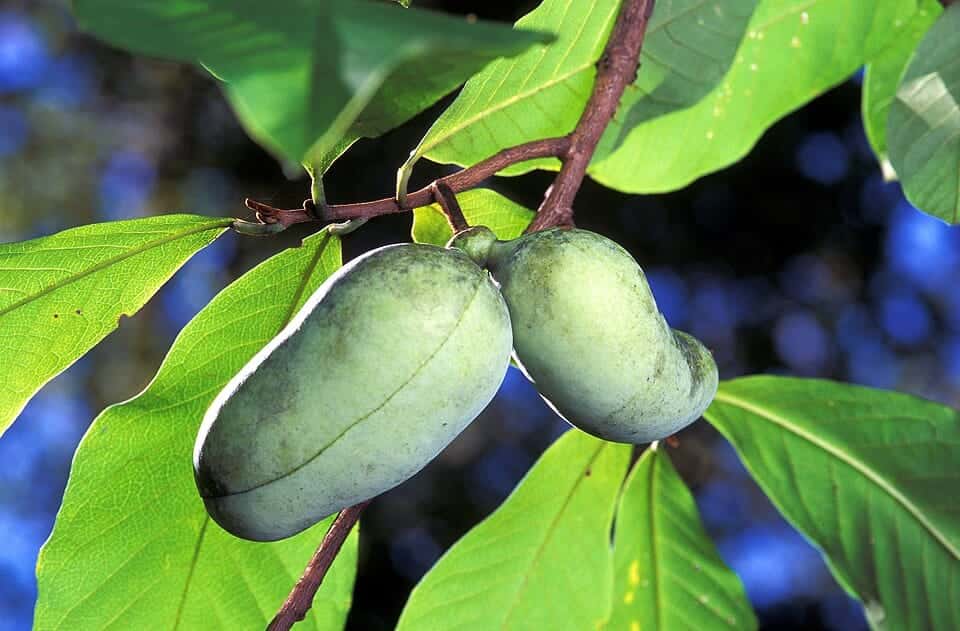
You are walking a shady trail near a creek or river bottom in late summer or early fall when something overhead stops you: fat, green, oblong fruits — shaped a bit like a stubby mango or a fat banana — hanging in small clusters from a stand of slender trees. The trees themselves look strangely tropical for a temperate forest, with large, drooping, paddle-shaped leaves that give the understory a lush, jungle-like feel. That out-of-place, tropical impression is the first clue. This is the pawpaw (Asimina triloba), the largest edible fruit native to North America and the northernmost member of a mostly tropical plant family. Pawpaws ripen from late summer into fall — early September is prime time across much of their range — which is exactly why so many people notice the fruit for the first time right about now. Here is how to identify a pawpaw with confidence and what to keep in mind before handling it.
How to Identify a Pawpaw Tree
Pawpaws grow in a distinctive way and carry an unmistakable fruit, and a few features together make the identification clear:
- The fruit: green, oblong, and mango- or banana-shaped, roughly 3 to 6 inches long, hanging singly or in small clusters; it stays green through summer and softens to a yellowish or brownish tone as it ripens in fall, giving off a sweet, fruity smell
- The leaves: large, drooping, teardrop-shaped leaves 6 to 12 inches long, widest past the middle and tapering to the stem, hanging in a way that gives the whole tree a tropical, wilted look
- The growth habit: a small understory tree, usually 12 to 20 feet tall, that spreads by root suckers to form dense colonies or "patches" of clonal trees, so you rarely find just one
- The habitat: rich, moist soils of shady bottomlands, creek and river banks, ravines, and floodplains across the eastern and midwestern United States
- The flowers (in spring): dark maroon, downward-facing, cup-shaped blooms about an inch across that appear before or with the leaves — long gone by fall but a useful memory if you have watched the patch
A colony of small understory trees with large drooping leaves and green, mango-shaped fruit along a shady stream is almost certainly a pawpaw patch. Nothing else in an eastern North American forest combines that tropical leaf, the clustered clonal growth, and a fruit that large.
Try Spotter free on iPhone or Android
Plants, animals, fungi and rocks from one photo. 5 free identifications every day, no card required.


Why a Tropical-Looking Fruit Grows in a Temperate Forest
The pawpaw belongs to the custard-apple family (Annonaceae), a group best known from the tropics — relatives include the cherimoya and soursop — which is why the tree looks and, to many people, tastes so out of place in a Kentucky or Ohio woodland. The pawpaw is the family’s cold-hardy outlier, ranging north into the Great Lakes and southern Ontario. Its ecology is full of tropical echoes, too. The dull maroon spring flowers smell faintly of fermentation or rotting meat and are pollinated not by bees but by flies and beetles. The fruit is thought to have been a favorite of large Ice Age mammals like mastodons that would have swallowed it whole and spread the big seeds; today it is prized by raccoons, opossums, foxes, and box turtles. The leaves are also the only food of the zebra swallowtail butterfly’s caterpillars, so a healthy pawpaw patch often comes with those striped butterflies drifting nearby in season.
Pawpaw or a Lookalike?
A few trees get confused with pawpaw, but the differences are easy once you look. Young pawpaws are sometimes mistaken for other smooth-leaved understory saplings, but the sheer size and droop of the leaves and the clonal patch habit set them apart. The unrelated common persimmon also drops orange-ripening fruit in fall, but persimmon fruit is round and tomato-like, its leaves are much smaller, and its bark is dark and broken into blocky "alligator" plates — nothing like the smooth, thin bark and giant leaves of a pawpaw. And the fruit should never be confused with anything you cannot positively identify: some wild fruits are toxic, so the shape, leaf, and growth habit all need to agree before you call it a pawpaw.
A Safety Note Before You Touch It
Pawpaw is a famous native wild food, but this article is about identifying the tree, not harvesting or eating from it — and there are real cautions worth knowing. Only the soft ripe pulp is traditionally eaten; the seeds and skin contain compounds that are not meant to be consumed, and some people react to the fruit or to handling the plant with stomach upset or a skin rash. There are also ongoing scientific questions about naturally occurring neurotoxins in the plant family. Because of all that, never eat anything gathered from the wild based on a photo, a blog, or a passing resemblance — confirm identity with an expert or a trusted regional guide, understand the specific cautions for that species, and when in doubt, leave it be. For most people the reward here is simply the fun of recognizing North America’s biggest — and strangest — native fruit hanging in the woods.
Found a patch of tropical-looking trees dripping with green, mango-shaped fruit and want to confirm it is a pawpaw? Snap a clear photo of a leaf, the fruit, and the overall tree and let Spotter help you identify it as a starting point for getting to know one of the most remarkable native trees in the eastern woods.
Try Spotter free on iPhone or Android
Plants, animals, fungi and rocks from one photo. 5 free identifications every day, no card required.