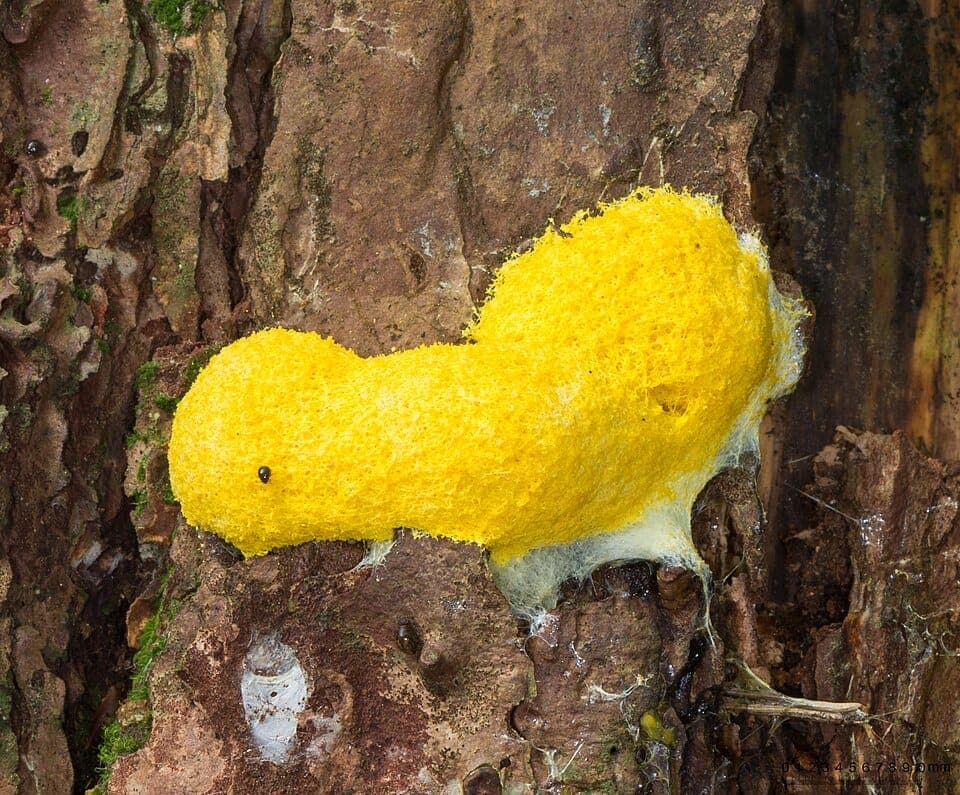
It shows up overnight, usually after a warm, humid, rainy stretch in summer: a frothy, vivid-yellow or orange mass spreading across the bark mulch, wood chips, or the base of a garden bed, looking uncannily like a pet got sick in the flower bed. People find it startling — it is bright, it seems to appear from nowhere, and it can be a foot or more across. The good news is that this is almost certainly dog vomit slime mold (Fuligo septica), sometimes called scrambled-egg slime, and despite the unappealing nickname it is completely harmless. It is not a disease, it is not hurting your plants, and it is one of the more fascinating living things you will find in a suburban yard.
What It Actually Is
Despite the "mold" in its name, a slime mold is not a fungus and not a plant. Slime molds are strange single-celled organisms (myxomycetes) that spend part of their life as a creeping, blob-like mass. That mass slowly moves — genuinely creeps, a few inches over hours — across mulch and soil, engulfing and feeding on bacteria, spores, and decaying organic matter. When conditions dry out or the organism is ready to reproduce, it hardens, changes color, and turns to a dusty mass of spores that blows away. What you are seeing is not decay or rot in your mulch; it is a living organism using the mulch as a feeding ground.
How to Identify Dog Vomit Slime Mold
- A soft, frothy, or foamy texture — like whipped or scrambled eggs — rather than a firm mushroom shape
- Bright yellow or orange when fresh, fading to tan, beige, or dull brown as it ages and dries
- Appears on mulch, wood chips, bark, rotting logs, or occasionally in lawns, especially after warm rain
- Can spread from a few inches to a foot or more across, sometimes seeming to grow or move over a day or two
- Eventually crusts over and, if disturbed when mature, puffs out a cloud of dark, powdery spores
The frothy, spilled-scrambled-egg look on mulch after rain is the giveaway. It is quite different from a true mushroom, which has a defined cap and stem, and from the white deadly Amanitas or shelf fungi you might find nearby.
Try Spotter Free on iOS & Android
Plants, animals, fungi, and rocks — all from a photo. 5 free identifications every day, no credit card required.
Is It Harmful? Do You Need to Remove It?
Dog vomit slime mold does not infect or kill plants, it does not damage healthy trees or shrubs, and it is not considered toxic to touch. It is generally regarded as harmless to people and pets, though as with any spore-producing organism it is sensible not to eat it and to avoid inhaling the spore dust from a dried, mature mass — so there is no reason for a pet or child to be munching on it. If you simply leave it alone, it will typically finish its life cycle within days to a couple of weeks, dry up, release its spores, and vanish on its own.
If the look bothers you or it is somewhere high-traffic, you can scoop it up with a trowel and discard it, or break it up and let the mulch dry out — slime molds thrive on moisture, so raking the mulch to help it dry discourages a return. Spraying fungicide is pointless: it is not a fungus, and the treatment does nothing. Mostly, this is a harmless curiosity worth a closer look before you clean it up.
Found something strange in the yard and not sure whether it is a harmless slime mold, a fungus, or something you should keep the dog away from? Snap a photo and let Spotter help you figure out what you are actually looking at — sometimes the answer is "relax, it is one of the coolest things in your garden."
Try Spotter Free on iOS & Android
Plants, animals, fungi, and rocks — all from a photo. 5 free identifications every day, no credit card required.