For months the American robin was the reliable face of your lawn — an orange-breasted bird standing bolt upright on the grass, cocking its head, then yanking up a worm. Then fall arrives and the lawn robins quietly disappear, and people assume they have all headed south. But a few weeks later a loud, restless flock of dozens or even hundreds of robins descends on a crabapple or holly and strips it bare in an afternoon, then moves on. So which is it — did the robins leave or not? The answer is one of the more surprising stories in backyard birding, and it explains why robins seem to vanish and reappear. Here is what is really going on.
Robins Do Not Just Fly South — They Change Their Whole Lifestyle
American robins are only partly migratory, and their movements are far more complicated than a simple trip south. What changes most dramatically in fall is not where they are but how they live:
- They switch foods: in spring and summer robins eat earthworms and insects on open lawns; in fall and winter they shift to fruits and berries — crabapples, holly, hawthorn, sumac, juniper, and wild grapes
- They abandon lawns: because their food moved from the ground to the trees and shrubs, they leave the open grass and move into wooded edges and fruiting thickets, so it looks like they left town
- They flock: the fiercely territorial birds of summer band together into large nomadic flocks — safety in numbers for spotting food and predators
- They wander: fruit is patchy, so flocks roam widely, appearing suddenly to strip a loaded tree and then vanishing for weeks
- Only some go south: many robins stay through winter, even in northern states, wherever fruit holds out — which is why a winter robin is normal, not a lost or confused bird
So your summer lawn robins did not necessarily leave — the ones you are missing largely traded worms for berries and joined the wandering fruit-eating crowd.
Try Spotter free on iPhone or Android
Plants, animals, fungi and rocks from one photo. 5 free identifications every day, no card required.


Why the "First Robin of Spring" Is a Bit of a Myth
Because robins go quiet and drop out of sight in winter — tucked in the woods eating fruit instead of hopping across snowy lawns — their return to the open grass in spring feels like an arrival, and they became the classic sign of spring. But in much of the country the robins never actually left; they were just living a different, less visible life nearby. What really happens in late winter is that the flocks break up, the birds spread back out to defend territories, and males start singing again on the lawns and rooftops. The robins you cheer as spring newcomers may well be the same ones that quietly wintered a few miles away.
Robins are less a "goodbye in fall, hello in spring" bird than a "hidden all winter, loud again in spring" one — the flock never went as far as you thought.
How to Recognize the American Robin Year-Round
Whether it is alone on the grass or swarming a berry tree, the robin is easy to know once you fix a few marks:
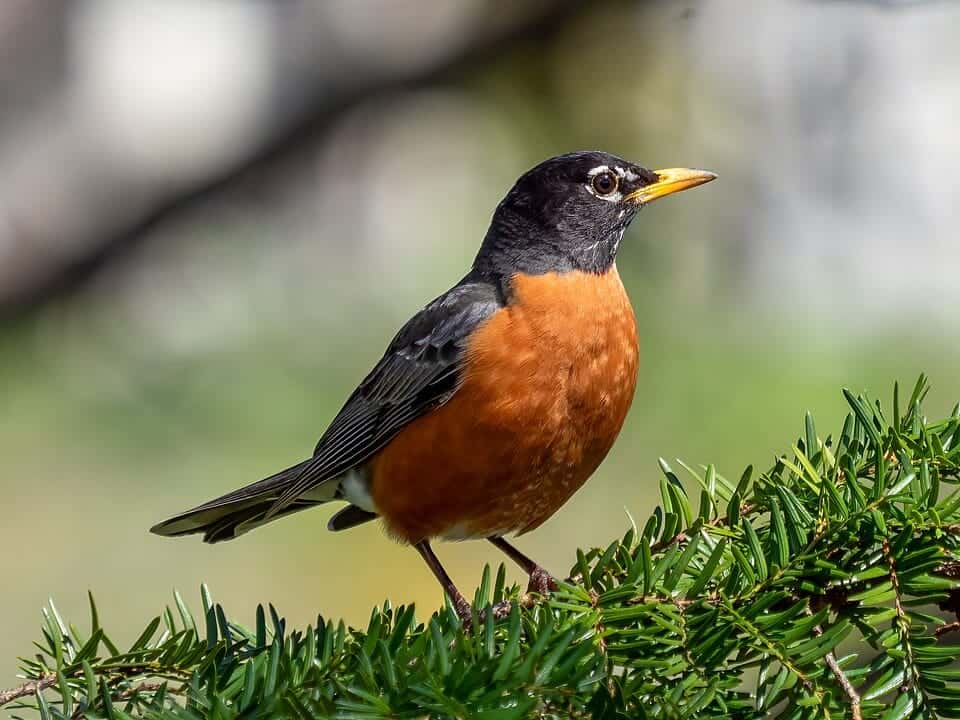
- The breast: a warm brick-orange to rusty-red breast and belly — the feature everyone recognizes
- The head and back: dark gray-to-blackish head and slate-gray back, with white crescents around the eyes and white streaks on the throat
- The size and shape: a plump, upright, medium-large songbird with a straight yellow bill, bigger than a sparrow and long-legged
- The behavior: on lawns it does the classic run-stop-cock-and-tug for worms; in fall and winter it gorges on berries in noisy flocks high in the trees
- The voice: a rich, caroling "cheerily, cheer-up, cheerio" song in the warmer months and sharp "tut-tut" calls from the flock
Not sure whether that big flock stripping your crabapple is robins, or whether the orange-breasted bird in winter is really the same robin from summer? Snap a photo and let Spotter help you confirm it — once you know the robin’s fall and winter habits, its yearly disappearing act stops being a mystery.
Try Spotter free on iPhone or Android
Plants, animals, fungi and rocks from one photo. 5 free identifications every day, no card required.