
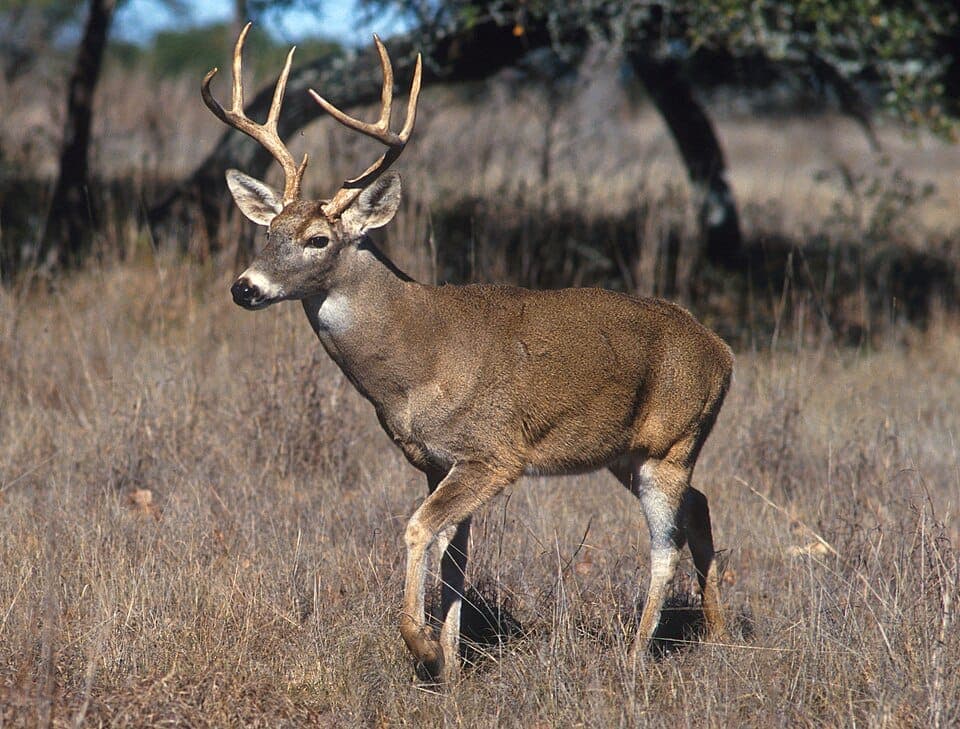
White-tailed deer and mule deer are easiest to tell apart by their ears, their tails, and their antlers. A mule deer has huge, mule-like ears, a thin white rope of a tail with a black tip, a large pale rump patch, and antlers that fork and then fork again; a white-tailed deer has smaller ears, a broad brown tail with a bright white underside it raises like a flag when it bolts, and antlers with single points rising off one main beam. Range is a strong clue too: whitetails blanket most of the country east of the Rockies, while mule deer own the open and mountainous West. Here is how to identify each one and tell them apart for certain, including the places where their territories overlap.
How to Tell a White-Tailed Deer From a Mule Deer
The two are closely related and roughly similar in size and color — tan to reddish-brown in summer, grayer in winter — so a quick glance is not always enough. Four features do almost all the work: the ears, the tail and rump, the antlers on bucks, and the way the animal moves when it is startled. Any one of them is usually decisive; together they are conclusive.
Ears
The mule deer is named for its ears, and they are the quickest tell. A mule deer’s ears are large and broad — proportionally about a third longer than a whitetail’s — and they swivel like a mule’s, standing out prominently from the head. A white-tailed deer has noticeably smaller, more rounded ears that sit higher and look more in proportion to its head. If the ears look oversized and mule-like, you are almost certainly looking at a mule deer.
Tail and rump
The tail is the feature the whitetail is named for and the most reliable single clue. A white-tailed deer has a wide, bushy tail that is brown on top and pure white underneath; when the deer is alarmed it raises or "flags" the tail straight up, flashing the bright white underside as it bounds away. A mule deer has a narrow, rope-like white tail with a distinct black tip, and it usually holds the tail down rather than flagging it. The mule deer also shows a large, conspicuous white or cream rump patch around the tail that is visible even when the tail is down; the whitetail’s rump looks brown until the tail flips up.
Antlers (on bucks)
On antlered bucks the branching pattern separates them cleanly. A mule deer’s antlers are bifurcated — the main beam forks into two, and each of those forks again, so the points grow in a series of Y-shaped splits. A white-tailed buck’s antlers have a single main beam on each side with individual unbranched points (tines) rising straight up off it, like a row of fingers off one bar. Forked-and-forked-again means mule deer; separate tines off one beam means whitetail.
Face and color
The face offers a supporting clue. Mule deer often have a lighter, grayer face with a whitish muzzle and throat, and mature bucks can show a dark, almost blackish forehead patch. White-tailed deer tend to have a browner face with clean white rings around the eyes and muzzle and a white throat patch and chin. Overall body color overlaps too much to rely on, especially between the gray coats of winter, so treat the face as a tiebreaker behind the ears, tail, and antlers.
How they move
Watch a startled deer run and it often names itself. A frightened mule deer frequently "stots" — a stiff-legged, bouncing gait in which all four feet leave and hit the ground together, like a pogo stick, which lets it bound efficiently over broken, rocky terrain. A white-tailed deer instead breaks into a smooth, fast gallop, head low and white tail flagged high, and vanishes into cover. Pogo-stick bounding points to mule deer; a flat-out run with a waving white flag points to whitetail.
Quick checks
- 1Ears: oversized and mule-like means mule deer; smaller and in proportion means whitetail.
- 2Tail: a thin, black-tipped white tail held down with a big pale rump patch means mule deer; a broad tail flagged white-side-up means whitetail.
- 3Antlers: forked and forked again means mule deer; single tines off one main beam means whitetail.
- 4Escape: stiff-legged, four-footed bounding means mule deer; a low galloping run with the tail flagged means whitetail.
Try Spotter Free on iOS & Android
Plants, animals, fungi, and rocks — all from a photo. 5 free identifications every day, no credit card required.
Quick Comparison
- Mule deer — large ears, thin black-tipped tail, big pale rump patch, forked-and-forked antlers, stotting gait; open and mountainous country of the West.
- White-tailed deer — smaller ears, broad brown tail flashed bright white when alarmed, single tines off one beam, galloping escape; woods, farmland, and edges across most of the East, Midwest, and South.
- Overlap — in parts of the Great Plains, the Southwest, and the Rocky Mountain foothills both species share ground, so lean on the tail and antlers rather than range.
Other Deer and Relatives You Might See
A few other members of the deer family get mixed into the comparison:
- Black-tailed deer — a coastal subspecies of the mule deer found along the Pacific Northwest; essentially a mule deer with a broader, mostly black tail.
- Elk — far larger than either deer, with a shaggy dark neck mane, a pale rump, and bulls carrying long, backward-sweeping, many-tined antlers; a bull elk can weigh several times what a buck deer does.
- Moose — enormous, dark, and long-legged with a shoulder hump, a dangling throat "bell," and broad palmate (flattened) antlers; unmistakable once seen.
- Exotic deer — in some regions introduced fallow and axis deer show spotted coats or palmate antlers and are neither whitetail nor mule deer.
Where Their Ranges Meet
White-tailed and mule deer ranges overlap across a broad band of the central and western United States — parts of the Great Plains, the Southwest, Texas, and the Rocky Mountain foothills — where the two can be seen in the same country. The two species occasionally interbreed where they overlap, producing hybrids, though this is uncommon and the hybrids tend to fare poorly because their confused mix of escape behaviors works against them. In overlap zones, do not rely on location alone: read the tail, the ears, and the antlers, and watch how the animal moves off.
Frequently Asked Questions
What is the easiest way to tell a mule deer from a whitetail?
The tail and ears. A mule deer has huge mule-like ears and a thin, black-tipped white tail held down over a large pale rump patch; a white-tailed deer has smaller ears and a broad tail it flips up to flash a bright white underside when it runs.
Can mule deer and white-tailed deer breed together?
Yes, the two species can interbreed where their ranges overlap, and hybrids do occur in the wild. They are uncommon, though, partly because hybrid fawns inherit a muddled mix of the two species’ escape behaviors, which leaves them more vulnerable to predators.
Do mule deer and whitetails live in the same places?
They overlap across much of the central and western US — the Great Plains, the Southwest, Texas, and the Rocky Mountain foothills. Broadly, though, mule deer dominate the open and mountainous West while white-tailed deer dominate the East, Midwest, and South, so range is a strong first clue outside the overlap zone.
Which is bigger, a mule deer or a white-tailed deer?
On average a mature mule deer is slightly larger and stockier than a typical white-tailed deer, but the two overlap enough in size that body size alone is not a reliable way to tell them apart. Use the ears, tail, and antlers instead.
Spotted a deer and not sure whether it is a whitetail, a mule deer, or something bigger like an elk? Snap a photo and let Spotter help you identify it as a starting point, then confirm it with the ears, the tail, and the antlers.
Try Spotter Free on iOS & Android
Plants, animals, fungi, and rocks — all from a photo. 5 free identifications every day, no credit card required.