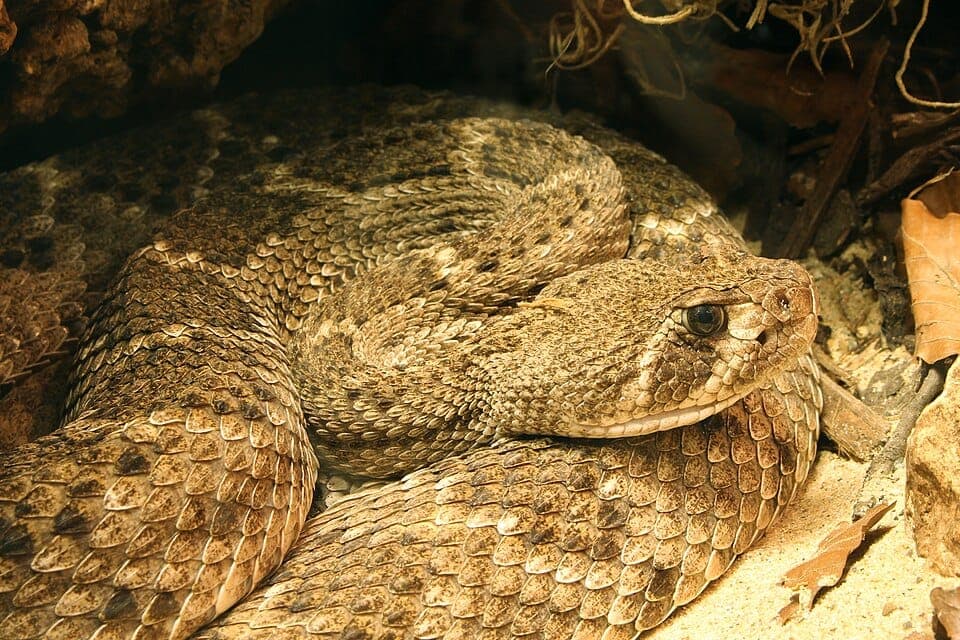
The surest way to identify a rattlesnake is the rattle at the tip of its tail — a segmented, interlocking button of keratin that it buzzes as a warning — paired with a broad, blocky, triangular head set on a neck that is noticeably thinner than the body, and a thick, heavy-bodied build. If you can safely see or hear that rattle, you have your answer. Rattlesnakes are venomous pit vipers, so the single most important rule comes before any field mark: keep your distance, identify the snake from several feet away by eye and ear, and back slowly away. Here is how to identify a rattlesnake safely and tell it from the harmless snakes — especially gopher and bull snakes — that mimic it.
How to Identify a Rattlesnake
You never need to get close to identify a rattlesnake — and you should not. Every feature below can be read from a safe distance of several feet, and a camera zoom or binoculars let you check details without approaching. Work through the tail, the head, the body, and the behavior, and a rattlesnake stands out from the harmless snakes it shares the landscape with.
The rattle and the tail
The namesake rattle is the definitive mark: a stack of loosely interlocking, dry keratin segments at the very tip of the tail that clatter into a buzzing, insect-like hiss when the snake vibrates them. Even when silent, the tail looks blunt and stubby, as if the tip were snipped off, rather than tapering to a fine point like most snakes. A newborn rattlesnake has only a single "button" and cannot yet make much sound, and rattles sometimes break off — so a missing or quiet rattle never rules a rattlesnake out. Use the blunt, segmented tail as a strong positive clue, not the absence of one as an all-clear.
The head and neck
Rattlesnakes have a large, flattened, roughly triangular or arrowhead-shaped head that is distinctly wider than the neck behind it, because of the venom glands at the back of the jaw. As pit vipers, they also have a heat-sensing pit between each eye and nostril and vertically slit "cat-eye" pupils — but never move close to inspect pupils or pits; judge the head by its blocky, wide-at-the-back shape from a distance. Be aware that some harmless snakes flatten and flare their heads to look triangular when threatened, so head shape alone is a clue, not proof.
Body shape and scales
Rattlesnakes are heavy-bodied and thick through the middle relative to their length, tapering abruptly to that stubby tail, rather than the long, evenly tapered rope shape of many non-venomous snakes. Their scales are keeled — each has a raised ridge down the center — giving the skin a rough, matte, non-glossy look. The thick body and dull, keeled texture together help separate a rattlesnake from slender, shiny racers and whipsnakes.
Color and pattern
Color varies by species and region, but most rattlesnakes wear an earthy base of tan, gray, brown, olive, or pinkish ground marked with a bold repeating pattern of dark blotches, diamonds, or crossbands edged in lighter scales. Western and eastern diamondbacks show the classic diamond chain; timber rattlesnakes wear dark chevron bands; prairie and other rattlers carry rounded blotches. Many species also have bold black-and-white or "coontail" banding just before the rattle. The pattern is camouflage, which is exactly why watching where you step and reach matters so much.
Sound and behavior
A threatened rattlesnake often pulls into a raised, S-shaped defensive coil with its head up and tail buzzing — an unmistakable warning to stop and back off. That said, rattlesnakes do not always rattle: many stay still and rely on camouflage, and some will move off quietly, so silence is not safety. If you hear a dry, steady buzz from the brush, freeze, locate the sound, and retreat the way you came.
Try Spotter Free on iOS & Android
Plants, animals, fungi, and rocks — all from a photo. 5 free identifications every day, no credit card required.
Rattlesnake vs. Harmless Look-Alikes
Several harmless snakes are mistaken for rattlesnakes — some actively imitate them. Here is how to tell them apart, always from a safe distance:
- Gopher snake and bull snake — the most convincing mimics: they hiss loudly, flatten their heads, and vibrate their tails in dry leaves to fake a rattle, but they have no true rattle, a tail that tapers to a point, a narrower head, and round pupils; their blotches are usually more rectangular.
- Rat snakes and corn snakes — slender, often glossy, with narrow heads and pointed tails; corn snakes have bold orange-red saddles but no rattle and a gentle disposition.
- Eastern hognose — flattens its neck like a tiny cobra and may play dead, but has an upturned pig-like snout, a pointed tail, and no rattle.
- Water snakes — thick-bodied and often banded, so they are frequently killed as "cottonmouths," but they have rounder heads, pointed tails, round pupils, and no rattle.
- Kingsnakes and milk snakes — smooth, shiny, and banded or blotched, with narrow heads and pointed tails; harmless and actually eat other snakes.
The reliable logic is additive: a blunt tail with a true rattle, a heavy body, and a blocky head that is much wider than the neck points to a rattlesnake, while a finely pointed tail with no rattle usually means a harmless species. But a tail buzzing in dry leaves can be faked, so when any doubt remains, treat the snake as venomous and give it room.
Rattlesnake Safety: What to Do
Rattlesnakes are not aggressive and bite people mainly when they are stepped on, cornered, or handled — most bites happen when someone tries to catch or kill one. Stay safe by giving any snake a wide berth of at least several feet, never reaching or stepping where you cannot see, keeping dogs leashed on trails, and wearing closed shoes in snake country. If a rattlesnake is in your yard, do not try to remove or kill it yourself; call a local wildlife or animal-control service. If someone is bitten, the recommended response is to stay calm, keep the bitten limb still and below heart level, remove rings and tight clothing, and get to emergency medical care immediately — do not cut the wound, try to suck out venom, apply a tourniquet, or ice it, and call your regional poison control center for guidance on the way.
Frequently Asked Questions
How can I tell a rattlesnake from a gopher or bull snake?
Check the tail and head from a distance. A rattlesnake has a blunt tail tipped with a segmented rattle, a heavy body, and a head much wider than its neck. A gopher or bull snake fakes the buzz by shaking its pointed, rattle-less tail in leaves and flattening its head, but the tail tapers to a fine point and the head is narrower.
Do all rattlesnakes rattle before they strike?
No — never rely on hearing a rattle. Many rattlesnakes stay silent and motionless to avoid detection, young ones can barely sound, and some rattles are broken off. Watch where you step and reach rather than listening for a warning.
Is a snake with a triangular head always venomous?
No. A broad, triangular head is a clue, not proof, because several harmless snakes — hognose and water snakes among them — flatten and flare their heads to look dangerous when threatened. Use head shape alongside the tail, rattle, and body, and when unsure, keep your distance.
What should I do if I see a rattlesnake?
Stop, keep at least several feet away, and back slowly out of its space — it wants to avoid you. Do not throw things at it, try to move it, or kill it; most bites happen during exactly those attempts. If it is somewhere it cannot stay, call a wildlife or animal-control professional.
Spotted a snake and want to know what it is without getting close? Take a zoomed-in photo from a safe distance and let Spotter help you identify it — and always treat an unknown snake as if it could be venomous until you are sure.
Try Spotter Free on iOS & Android
Plants, animals, fungi, and rocks — all from a photo. 5 free identifications every day, no credit card required.