
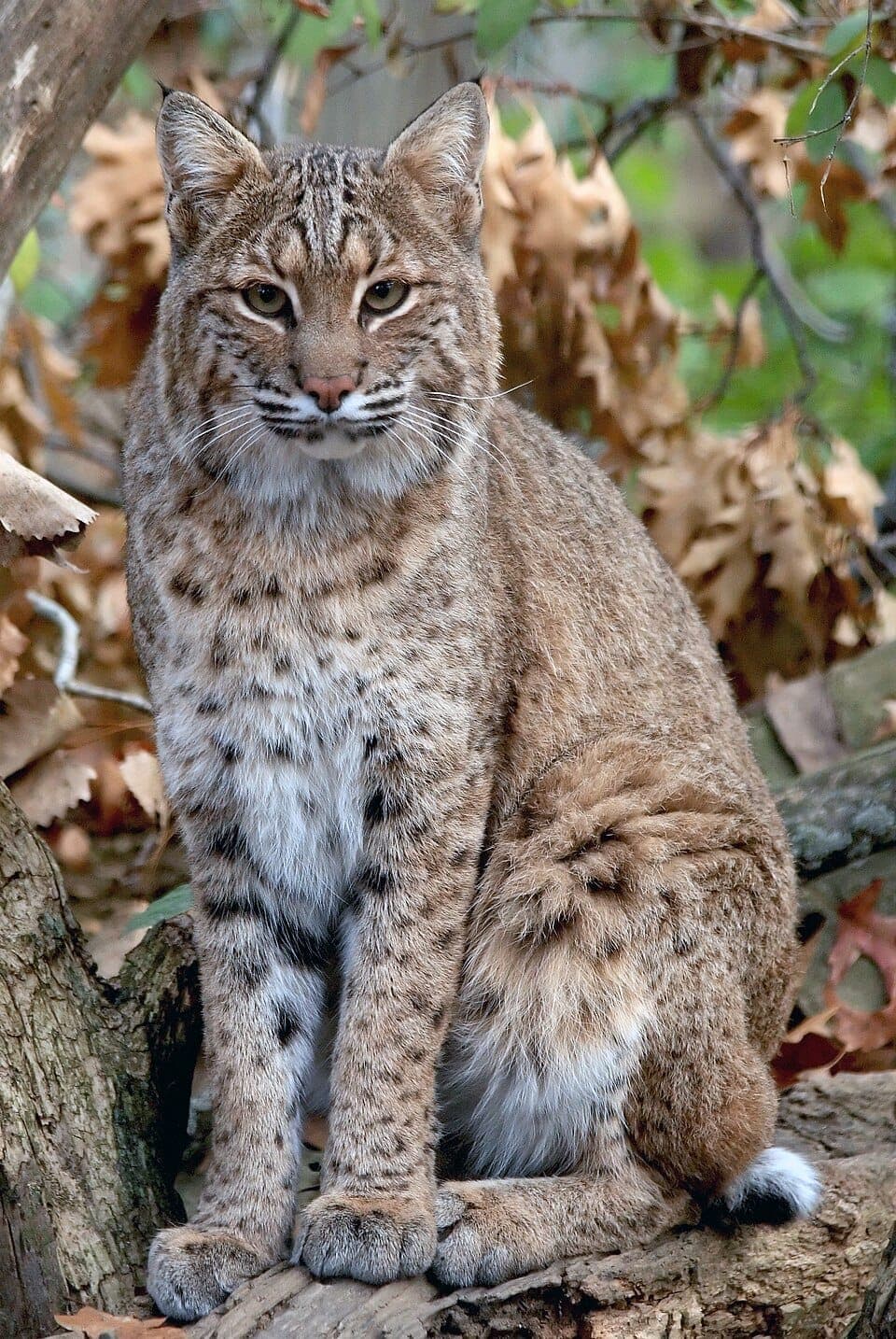
The quickest way to identify a bobcat is its size and its tail: a bobcat is a stocky wild cat about twice the size of a house cat — roughly 15 to 35 pounds and knee-high — with a short, "bobbed" tail only 4 to 7 inches long, tipped in black on top and white underneath. Add tufted, black-backed ears, a spotted or streaked tan-to-gray coat, and long legs with big feet, and you have the animal. That stubby tail is the single most reliable field mark: a long, rope-like tail means a mountain lion or a house cat, never a bobcat. Here is how to identify a bobcat for certain and tell it from the mountain lion and the large domestic cats it is most often confused with.
How to Identify a Bobcat
Bobcats are elusive and mostly active at dawn and dusk, so most sightings are brief — a cat-shaped animal trotting across a road or caught on a trail camera. A handful of features confirm it fast: size, that unmistakable short tail, the ears, and the coat. Run through them and a bobcat is easy to separate from both the mountain lion and the neighborhood cat.
Size and build
A bobcat is noticeably bigger than a house cat but far smaller than a mountain lion — usually 15 to 35 pounds, about two feet tall at the shoulder, and roughly twice the bulk of a domestic cat. It has a compact, muscular body, long legs (the hind legs longer than the front, giving it a slightly tilted-forward, bob-tailed look), and large feet. If an animal is the size of a Labrador with a long tail, it is not a bobcat; bobcats are mid-sized.
The short, black-tipped tail
This is the single most reliable field mark. A bobcat’s tail is short and stubby — only about 4 to 7 inches long, hence "bobcat" — with dark bars and a black tip on the upper side that is white underneath. A long, thick, rope-like tail nearly as long as the body means a mountain lion or a house cat, never a bobcat. If you can clearly see a short bobtail, most of the identification is already done.
Ears, face, and cheek ruff
Bobcats have tall, pointed ears tipped with short black tufts and marked on the back with a bold white spot ringed in black. The face is framed by a flared ruff of longer fur on the cheeks, giving it a wide, bearded look, and dark streaks run back from the eyes and across the cheeks. These facial details are usually clear in photos and separate a bobcat from the plain, rounded face of a house cat and the uniform face of a cougar.
Coat and spotting
The coat ranges from tan and reddish-brown to gray, always paler to white on the belly, and is marked with dark spots, bars, and streaks that are boldest on the legs and underside. This spotting is a key difference from the mountain lion, whose adult coat is a uniform, unspotted tan. Coat color varies with region and season — grayer in winter, redder in summer — but the dark spotting and barred legs stay.
Tracks and sign
Bobcat tracks are round and compact, about 1.5 to 2.5 inches across, with four toes and — like all cats — usually no claw marks, because the claws retract. That roundness and the missing claw marks separate cat tracks from the more oval dog and coyote prints, which show claws. Bobcat tracks are larger and more robust than a house cat’s (about 1 inch) and much smaller than a mountain lion’s (3 to 4 inches).
Try Spotter Free on iOS & Android
Plants, animals, fungi, and rocks — all from a photo. 5 free identifications every day, no credit card required.
Bobcat vs. Mountain Lion, House Cat, and Lynx
Four cats get confused with one another. Here is how a bobcat differs from each:
- Mountain lion (cougar) — far larger (80 to 200 pounds) with a long, thick, black-tipped tail 2.5 to 3 feet long and a uniform, unspotted tan coat; if the tail is long, it is a cougar, not a bobcat, and true cougars are rare across most of the eastern U.S.
- House cat — much smaller (8 to 12 pounds) with a long full tail, small even ears without prominent tufts, and no cheek ruff; a big tabby is often mistaken for a bobcat, but the long tail gives it away every time.
- Canada lynx — a close northern relative with longer black ear tufts, huge snowshoe-like feet, longer legs, a grayer and less-spotted coat, and a fully black tail tip; lynx live in far-northern boreal forests, while bobcats range across most of the U.S.
- Coyote or fox — sometimes guessed at from a distance, but these are dogs: longer muzzles, bushy long tails, and tracks that show claw marks, unlike a cat’s round, clawless prints.
The decision tree is short: a long tail rules out a bobcat; a short bobtail plus spotting, ear tufts, and a size bigger than a house cat rules it in.
Are Bobcats Dangerous? Safety and Coexistence
Bobcats are shy and pose very little danger to people. Attacks on humans are extremely rare and are almost always linked to a rabid animal; a healthy bobcat will nearly always flee rather than confront you. They can, however, take small pets and backyard poultry, so the sensible precautions are about protection, not fear: keep cats and small dogs indoors or supervised, secure chickens in a sturdy coop, and do not leave pet food out. Never feed or corner a bobcat, and give a wide berth to any wild cat that seems unafraid or is active and aggressive in daylight — that can be a sign of rabies — and report it to animal control. As with any wildlife, enjoy the sighting from a distance and let the animal move on.
Frequently Asked Questions
How can I tell a bobcat from a mountain lion?
The tail and size settle it. A bobcat is house-cat-plus sized (15 to 35 pounds) with a short 4-to-7-inch bobtail and a spotted coat; a mountain lion is dog-sized or bigger (80 to 200 pounds) with a long 2.5-to-3-foot tail and a uniform tan coat. A long tail always means cougar, not bobcat.
Is that a bobcat or just a big house cat?
Check the tail, ears, and size. Bobcats have a stubby black-tipped tail, tufted ears with white spots on the back, a flared cheek ruff, spotted legs, and are roughly twice a house cat’s size. A big domestic cat keeps its long tail and lacks the ear tufts and cheek ruff.
Do bobcats attack humans or pets?
People, almost never — healthy bobcats avoid us, and attacks are rare and usually tied to rabies. Small pets and poultry are a real but manageable risk, so supervise small animals outdoors and secure chickens; a bobcat active and unafraid in daylight is worth reporting to animal control.
Where do bobcats live?
Almost everywhere in North America. Bobcats are the most widespread wild cat on the continent, ranging from southern Canada through the U.S. into Mexico, and they thrive in forests, deserts, swamps, mountains, and increasingly the brushy edges of suburbs, as long as there is cover and prey.
Caught a short-tailed cat on a trail camera or crossing the yard and not sure if it’s a bobcat? Snap a photo and let Spotter help you identify it.
Try Spotter Free on iOS & Android
Plants, animals, fungi, and rocks — all from a photo. 5 free identifications every day, no credit card required.