
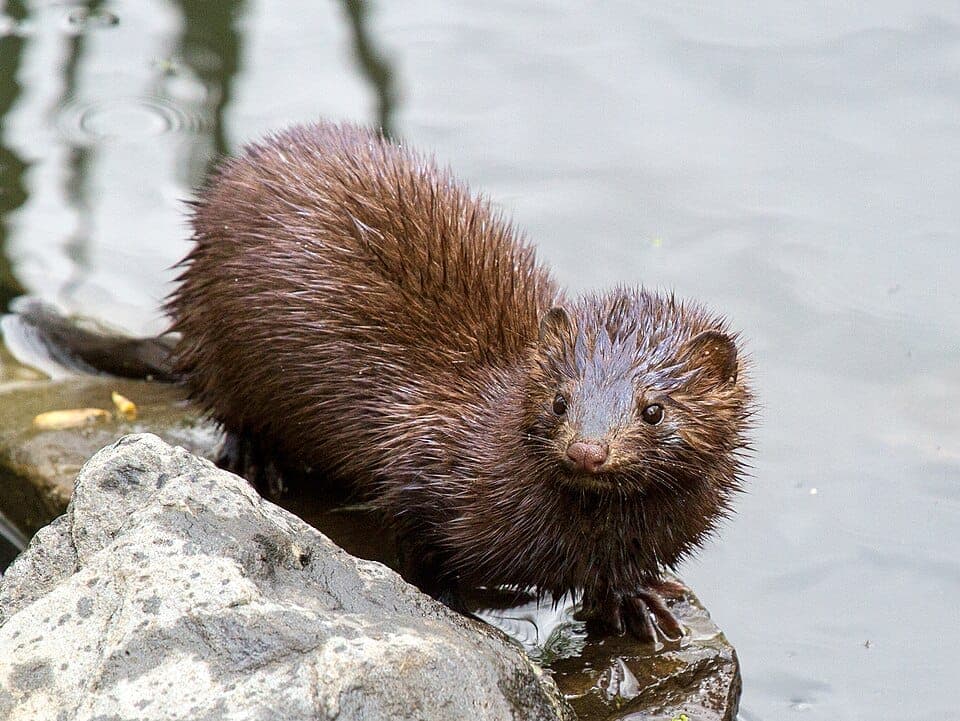
If you have spotted a sleek, dark, almost-black animal slipping along a stream bank or bounding across a trail near water, you are most likely looking at an American mink. A mink is a long, low-slung member of the weasel family — about the size of a slim house cat stretched out — with rich chocolate-brown to near-black fur, a small white patch under the chin, and a bushy, black-tipped tail. It lives near water across most of North America, hunts along the edges of streams, ponds, and marshes, and moves with the humped, bounding gallop that gives the weasel family away. Here is how to identify a mink for certain, and how to tell it from the weasels, otters, and muskrats people so often confuse it with.
How to Identify a Mink
Mink are shy, fast, and usually seen for only a few seconds, so it helps to know the handful of features that set them apart from every other animal near the water. Run through size, color, habitat, and the way it moves, and a mink is hard to mistake.
Size and body shape
A mink is built like a furry tube: long and slender, with short legs, a small flattened head, little rounded ears, and a bushy tail. Adults run roughly 18 to 28 inches from nose to tail tip — the tail alone is about a third of that — and weigh only about one and a half to three pounds, with males noticeably larger than females. In silhouette a mink looks low to the ground and stretched out, nothing like the compact, upright posture of a squirrel or the chunky build of a muskrat.
Color and fur
Fur is the giveaway. A mink’s coat is a deep, glossy chocolate brown that often looks solid black when wet or in low light, and it is remarkably uniform from head to tail. Look for a small, clean white patch on the chin and lower lip, and sometimes a few irregular white blotches on the throat or chest — those white marks on an otherwise dark animal are a classic mink signature. The tail darkens toward a black tip, and the dense underfur sheds water so well that the coat stays sleek and oiled rather than matting down when the animal climbs out of a stream.
Where and when you’ll see one
Mink are semi-aquatic and rarely stray far from water. Streams, river edges, lake shores, freshwater and saltwater marshes, and wooded wetlands are all prime mink country, and they den in bank burrows, hollow logs, and under tree roots along the shoreline — often in a den taken over from a muskrat. They hunt day or night but are seen most at dawn and dusk, swimming confidently, diving after fish, and slipping in and out of the water. If the dark animal you saw was hunting the water’s edge, swam well, and vanished into a bank hole, mink should be your first guess.
How it moves
Watch the gait. Like other weasels, a mink travels in a bounding, humped gallop, arching its back and landing its hind feet near where its front feet were, so it seems to flow forward in a series of low loops. On land it is quick and restless; in the water it swims with just the head and part of the back showing. That rolling, arched bound looks nothing like the straight-backed trot of a cat or the slow waddle of a muskrat.
Tracks and sign
Mink tracks show five toes on each foot (though the inner toe often fails to register), arranged in a roughly star-shaped or slightly splayed pattern with small claw marks, usually about an inch to an inch and a quarter wide. Because mink bound, the prints frequently appear in paired clusters. Other signs include narrow trails worn into stream banks, slick den entrances near the waterline, and dark, twisted, tapering droppings full of fish scales, fur, and bone, often left on a prominent rock or log.
Try Spotter Free on iOS & Android
Plants, animals, fungi, and rocks — all from a photo. 5 free identifications every day, no credit card required.
How to Tell a Mink From Its Look-Alikes
Several dark, water-loving animals get mistaken for mink. Here is how to separate them at a glance:
- Weasels (long-tailed, short-tailed, and least) — smaller and more slender than a mink, usually brown above with a pale cream or white belly rather than a uniform dark coat, and often found away from water. In the north, weasels turn white in winter (the ermine stage) with a black tail tip; mink never turn white.
- River otter — far bigger and bulkier, three to four times a mink’s weight, with a thick, tapering, muscular tail, webbed feet, and a broad, whiskery face. An otter rides low in the water with mostly just its head showing and often travels in family groups; a lone, slim, dark animal the size of a small cat is a mink, not an otter.
- Muskrat — similar in length but chunky and rounded, with coarse rusty-brown fur, a blunt face, and a distinctive thin, scaly, vertically flattened tail that trails behind it in the water. Muskrats are slow-swimming plant-eaters; mink are sleek predators that move with purpose.
- American marten and fisher — forest weasels of the northern woods, browner and bushier than mink, with larger ears and a preference for trees rather than water. Range and habitat usually settle it.
- A house cat or small dog glimpsed briefly — the low, stretched, bounding body of a mink and its habit of hugging the water’s edge rule out a pet once you get a clear look.
Are Minks Dangerous?
Mink are not a threat to people. They are small, shy, and far more likely to disappear than to stand their ground, and they are not venomous. They can, however, be fierce and determined predators of anything smaller than themselves — a single mink can raid a chicken coop or a backyard pond and kill fish, poultry, or waterfowl, which is often how people first discover one lives nearby. As with any wild animal, never try to corner, handle, or feed a mink: cornered, it can deliver a sharp bite, and it should be watched from a respectful distance. If a mink is getting into poultry or a pond, the fix is exclusion — secure fencing and hardware cloth — not handling the animal.
Frequently Asked Questions
What’s the difference between a mink and a weasel?
A mink is essentially a large, dark, water-loving weasel. True weasels are smaller and more slender, usually brown with a pale or white belly, often live away from water, and in northern winters turn white. A mink keeps its uniform dark chocolate coat year-round and sticks close to streams, ponds, and marshes.
Is it a mink or an otter?
Size is the quickest answer. An otter is three to four times heavier than a mink, with a thick tapering tail and a broad face, and it rides low in the water. A mink is slim, about the length of a stretched-out house cat, and swims with its head and back showing. Otters also often travel in groups, while a lone slim swimmer is usually a mink.
Do minks live near people?
Often, yes. Almost any stream, pond, drainage, or marsh — including those in parks, suburbs, and farmland — can support mink, and they readily take over muskrat burrows and hunt backyard ponds. Many people never notice them because mink are secretive and most active at dawn and dusk.
What sign does a mink leave behind?
Look for dark, twisted, tapering droppings full of fish scales and fur left on rocks or logs near water, five-toed tracks in mud or snow (often in bounding pairs), and worn trails and den holes along the bank. A raided chicken coop or fish pond can be a sign too.
Caught a glimpse of a dark, low-slung animal darting along the water’s edge and not sure whether it was a mink, a weasel, an otter, or a muskrat? Snap a photo and let Spotter help you identify it as a starting point — so you can put a name to the sleek hunter patrolling your local stream.
Try Spotter Free on iOS & Android
Plants, animals, fungi, and rocks — all from a photo. 5 free identifications every day, no credit card required.