
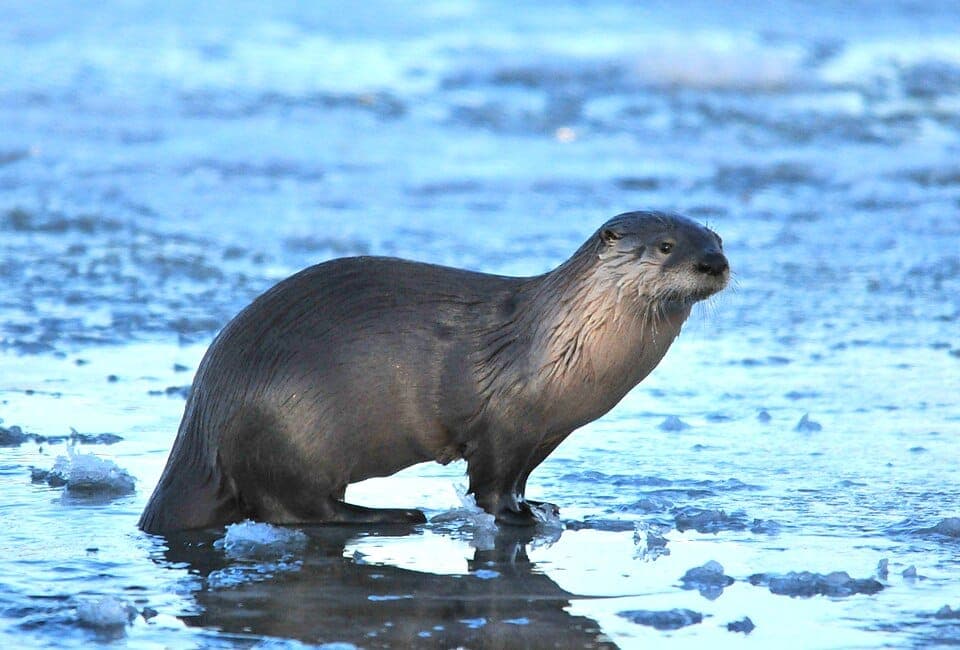
A North American river otter is a long, sleek, dark-brown member of the weasel family built for swimming — picture an animal about the size of a medium dog stretched out low and muscular, with a thick tapering tail, webbed feet, short legs, and a broad, whiskered, almost dog-like face. If you spot a glossy brown animal porpoising through the water in a family group, sliding down a muddy riverbank, or loping across a trail near water with a humped, bounding gait, you are almost certainly looking at a river otter rather than the mink or muskrat it is most often confused with. Here is how to identify a river otter for certain, read the signs it leaves behind, and tell it apart from its look-alikes.
How to Identify a River Otter
Otters give themselves away by a combination of size, body shape, and behavior that nothing else along the water quite matches. Start with overall size and the shape of the tail, then confirm with the fur, the face, and the unmistakable way an otter moves and plays.
Size and shape
A river otter is a big animal by waterside standards: roughly 3 to 4 feet long including the tail, and typically 10 to 30 pounds, with males larger than females. The body is long, low, and streamlined, with a flexible back, short legs, and a thick neck that flows into a flattened head. On land it looks almost serpentine, humping its back as it bounds. That substantial size is the quickest way to separate an otter from the much smaller mink and muskrat, which are closer to the size of a rabbit.
Tail and feet
The tail is one of the best field marks. An otter’s tail is thick, muscular, and furred, making up roughly a third of its total length, and it tapers from a broad base to a point — nothing like the thin, scaly, rat-like tail of a muskrat or the flat paddle of a beaver. All four feet are webbed for swimming and tipped with claws, leaving five-toed tracks that often show webbing in soft mud.
Fur and color
River otters are rich, dark brown over most of the body, often looking almost black when wet, and noticeably paler — silvery gray to tan — on the throat, chin, and belly. The fur is dense, sleek, and water-repellent, so a wet otter looks slicked-down and shiny. There is no white chin spot or sharply two-toned look; the paler throat simply blends up into the darker back.
Face and whiskers
Up close the head is broad and rounded with a blunt muzzle, small rounded ears set low on the head, a large black nose, and a thick fan of prominent whiskers used to detect prey in murky water. The eyes sit fairly high on the face, an adaptation for watching above the surface while the body stays submerged. The overall impression is friendly and dog-like rather than rodent-like.
Behavior and sound
Behavior is often the giveaway before you ever see the details. River otters are famously playful and social, traveling and hunting in family groups, repeatedly sliding down mud or snow banks, wrestling, and rolling. In the water they porpoise — arcing up and diving — and float on their backs. They are vocal, too, producing chirps, chuckles, whistles, and sharp snorts or hisses when alarmed. Muskrats and mink, by contrast, are usually quiet and travel alone.
Habitat, range, and season
River otters live across most of North America — along rivers, streams, lakes, marshes, and coastal estuaries wherever the water is reasonably clean and fish are plentiful. They are active year-round and do not hibernate, staying busy through winter and often using holes in the ice; a line of tracks interrupted by long belly-slides in fresh snow is a classic winter sign. They are most active around dawn and dusk but are frequently seen by day, especially in quiet areas.
Try Spotter Free on iOS & Android
Plants, animals, fungi, and rocks — all from a photo. 5 free identifications every day, no credit card required.
River Otter vs. Mink, Muskrat, and Beaver
Four brown, water-loving mammals get mixed up constantly. Size and tail shape sort them out almost every time:
- Mink — a much smaller weasel relative, only 1.5 to 2 feet long and 1 to 3 pounds, with a slim body, a thin furred tail, and darker chocolate-brown fur that often has a small white chin or throat patch. A mink swims high in the water with much of its back showing and travels alone; an otter is far larger, rides lower, and travels in groups.
- Muskrat — about the size of a mink but rat-like, with a thin, nearly hairless tail flattened side-to-side that it sculls behind it, and it often swims with its head up carrying vegetation. Muskrats are plant-eaters; an otter’s thick furred tail and fish diet set it apart.
- Beaver — much larger and heavier than an otter, with a broad, flat, scaly paddle tail and a blunt head. A beaver swims slowly with just its head and a wake showing; it never porpoises or slides for play.
- Nutria — an invasive, beaver-sized rodent of the South with a round, rat-like tail and distinctive orange front teeth, unlike the otter’s tapered furred tail and dark teeth.
Signs a River Otter Leaves Behind
You will often find otter sign before you see the animal. Watch for these clues along the water:
- Slides — smooth, chuted troughs down muddy or snowy banks into the water, worn by otters sliding on their bellies.
- Latrines — communal toilet sites on banks, logs, or points, marked with dark scat full of fish scales and crayfish parts, often with a musky smell.
- Tracks — rounded five-toed prints up to about 3 inches wide, sometimes showing webbing, frequently alternating with long belly-slide marks in snow.
- Rolling spots — matted, trampled patches of grass where otters groom and dry their fur.
Are River Otters Dangerous?
River otters are not aggressive toward people and pose little threat; they are curious but wary and will usually slip into the water long before you get close. They can, however, bite hard if cornered, handled, or if a dog harasses them, and a mother otter will defend her pups, so give any otter plenty of room and keep dogs leashed near water where otters are active. As with any wild mammal, never try to touch, feed, or corner one, and treat an otter that appears unusually tame, disoriented, or aggressive as a sick animal to report to local wildlife officials rather than approach.
Frequently Asked Questions
How do I tell a river otter from a mink?
Size and company. A river otter is dog-sized, 3 to 4 feet long, with a thick tapered tail, and usually travels in family groups; a mink is much smaller, about rabbit-sized, with a slim body and thin tail, and travels alone. If it is big and social, it is an otter.
Are river otters and sea otters the same animal?
No. The North American river otter lives in and along fresh water and coasts across the continent, while the sea otter is a larger, exclusively marine species of the Pacific coast that floats on its back in kelp beds. A playful otter in a river, lake, or marsh anywhere inland is a river otter.
Do river otters live in saltwater?
Yes. River otters readily use coastal bays, estuaries, and shorelines in addition to rivers and lakes, as long as they have access to fresh water for drinking and grooming. A brown otter along a saltwater coast is still a river otter, not a sea otter, in most of the country.
Are river otters dangerous to pets?
An otter will usually flee a dog, but a cornered or defensive otter can injure a pet, and otters in a group are powerful. Keep dogs leashed near otter habitat and do not let them chase one into the water, where the otter has every advantage.
Caught a sleek brown animal swimming, sliding, or crossing a trail near water and not sure whether it is an otter, a mink, or a muskrat? Snap a photo and let Spotter help you identify it as a starting point, then confirm it with the size, the shape of the tail, and the way it moves.
Try Spotter Free on iOS & Android
Plants, animals, fungi, and rocks — all from a photo. 5 free identifications every day, no credit card required.