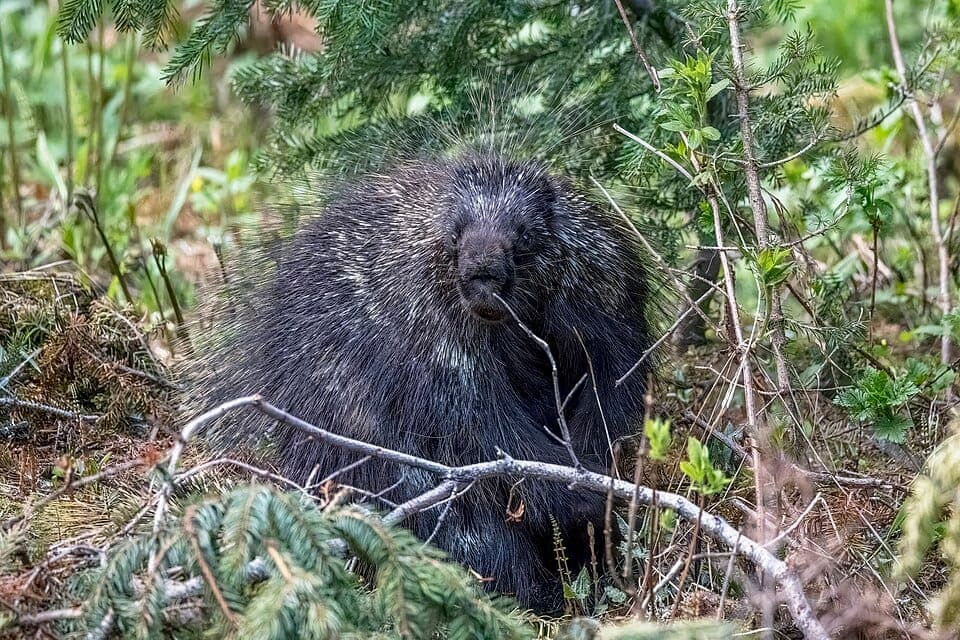
A porcupine is the big, slow-moving rodent covered in sharp quills — a round, dark, hunched animal roughly the size of a medium dog that you will most often spot high in a tree or waddling across a road at dusk. North of Mexico there is only one kind, the North American porcupine (Erethizon dorsatum), so if you are looking at a quill-covered mammal the size of a fat house cat or bigger, you have almost certainly found it. The quills are the giveaway, but they are also the source of nearly every myth about the animal: porcupines cannot throw their quills, and those barbed spines are a defense, not a weapon they aim at you. Here is how to identify a porcupine for certain, read the signs it leaves behind, and tell it apart from the hedgehogs, beavers, and groundhogs it gets confused with.
How to Identify a Porcupine
Almost nothing else in the woods looks like a porcupine once you see it well. Start with the overall impression — a large, dark, rounded animal with a humped back and a spiny coat — then confirm with size, the quills themselves, and the way it moves. The signs it leaves on trees are often the first clue that one is around.
Size and shape
The porcupine is the second-largest rodent in North America, after the beaver. A typical adult is about 25 to 36 inches long including the tail and weighs roughly 10 to 30 pounds, with heavy, overweight individuals in fall going higher still. The body is stout and hunched, with a small head, a blunt rounded nose, short legs, and a thick, muscular tail. From a distance it reads as a dark, shaggy ball wedged in a tree fork or lumbering low to the ground — never sleek or fast.
Quills and coat
A porcupine carries around 30,000 quills — stiff, modified hairs an inch or two long — across its back, sides, and tail, but never on its face, belly, or the insides of its legs. Mixed in among the quills are long, soft guard hairs, so from a distance a relaxed porcupine often looks more shaggy and brown than spiky; the quills only stand out as a bristling halo when the animal is alarmed and raises them. The quills are usually pale, whitish or yellowish, with dark tips, and each one ends in microscopic backward-facing barbs that make it hard to pull out once it lodges in skin.
Color and face
Overall color ranges from dark brown to nearly black, often with a frosted or grizzled look where pale guard hairs and quill tips catch the light. The face is dark with small eyes and the big, chisel-shaped orange incisors common to all rodents. Porcupines have poor eyesight but a keen nose, and they will often ignore a quiet observer entirely, which is one reason people get surprisingly close before realizing what they are looking at.
Sound and behavior
Porcupines are more vocal than most people expect. They moan, grunt, whine, and chatter their teeth, and in late-fall breeding season they can be downright loud. They are mainly nocturnal and spend daylight hours resting in a tree crotch, a rock crevice, or a hollow log. When threatened, a porcupine does not flee quickly — it turns its back and tail toward the danger, chatters its teeth, raises its quills, and lashes its tail. Any animal that lunges in gets a face full of quills from that swinging tail.
Habitat, range, and season
Porcupines live across most of Canada and Alaska, down through the western mountains, and across the northern and northeastern United States, in forests, woodlots, and even desert shrub country in the West. They do not hibernate, so they stay active all winter, feeding on bark and conifer needles — which is exactly when a dark lump in a bare tree is easiest to spot against the snow. In warmer months they eat leaves, buds, twigs, and fruit, and they crave salt, which leads them to gnaw sweat-soaked tool handles, plywood, and road-salted surfaces.
Try Spotter Free on iOS & Android
Plants, animals, fungi, and rocks — all from a photo. 5 free identifications every day, no credit card required.
Signs a Porcupine Leaves Behind
You will often find the evidence before you ever see the animal. Look for these clues, especially in winter woods:
- Stripped bark — irregular patches of pale, exposed wood high on trunks and out along branches, where a porcupine has gnawed off the bark to reach the living layer beneath. The damage is usually well off the ground, which helps separate it from gnawing by deer or rabbits lower down.
- Nipped twigs under trees — small clipped twig ends littering the snow or ground beneath a feeding tree, dropped as the porcupine works through the canopy.
- Chewed wood and tools — gnawed axe handles, canoe paddles, plywood, and outbuilding trim, driven by the animal’s craving for the salt in dried sweat and treated wood.
- Scat — oval or slightly curved brown pellets, often in large accumulations at the mouth of a den in a rock pile or hollow tree.
- Tracks — pigeon-toed prints with a distinctive pebbly, bumpy sole texture, often with claw marks and a brushy tail-drag line between them.
Porcupine vs. Its Look-Alikes
A quill-covered animal seems unmistakable, but several others get mixed up with it:
- Hedgehog — not a wild animal anywhere in North America; the hedgehogs people know are small pets, roughly the size of a softball, with short, uniform spines and the ability to roll into a tight ball. A porcupine is dog-sized, cannot curl into a ball, and has quills of varying lengths mixed with long fur.
- Beaver — similar in size and dark color, but a beaver has a flat, scaly, paddle-shaped tail, webbed hind feet, and no quills, and it lives in and around water. A porcupine has a rounded, quill-covered tail and climbs trees.
- Groundhog (woodchuck) — a brown, chunky rodent of similar weight, but with smooth fur, no quills, and a ground-burrow lifestyle; it does not climb high into trees the way a porcupine does.
- African crested porcupine — a different, Old World species sometimes seen in zoos and photos, with a dramatic black-and-white crest and quills up to a foot long. North American porcupines lack that long mane-like crest and have much shorter quills.
Are Porcupines Dangerous?
Porcupines are not aggressive and pose almost no threat to people. They will not chase you, and they absolutely cannot shoot quills through the air. The real danger is to curious dogs, which tend to charge in nose-first and come away with a muzzle full of barbed quills. Those quills have backward-facing barbs that work deeper into tissue over time and can migrate toward joints, eyes, and organs, so a quilled pet needs a veterinarian, not a pair of pliers at home. For your own safety, simply give a porcupine room: it is slow and will amble off if you back away. Never try to handle or corner one, and watch where you kneel or sit in porcupine country, because shed quills on the ground can still prick skin.
Frequently Asked Questions
Can porcupines shoot their quills?
No. This is the most persistent porcupine myth. The quills are only loosely attached, so they detach easily on contact and a lashing tail can flick a few loose, but a porcupine cannot launch quills across a distance at a target.
Are porcupines active in winter?
Yes. Porcupines do not hibernate. They stay active through winter, feeding largely on tree bark and evergreen needles, and a dark, rounded shape high in a leafless tree against the snow is one of the easiest ways to spot one.
What does porcupine tree damage look like?
Look for irregular patches of bark stripped away high on trunks and branches, exposing pale wood, along with clipped twigs scattered on the ground below. Gnawed tool handles and plywood around cabins are another classic sign, driven by the animal’s hunger for salt.
What should I do if my dog gets quilled?
Get to a veterinarian as soon as you can. Do not cut the quills — cutting does not deflate them and makes removal harder — and avoid yanking quills near the eyes, mouth, or throat yourself, since broken or migrating quills can cause serious injury. Keep the dog calm and prevent it from pawing at its face on the way in.
Not sure whether that dark, spiny shape in the tree is a porcupine? Snap a photo and let Spotter help you identify the animal, then confirm it with the size, the quilled back, and the signs on nearby trees.
Try Spotter Free on iOS & Android
Plants, animals, fungi, and rocks — all from a photo. 5 free identifications every day, no credit card required.