
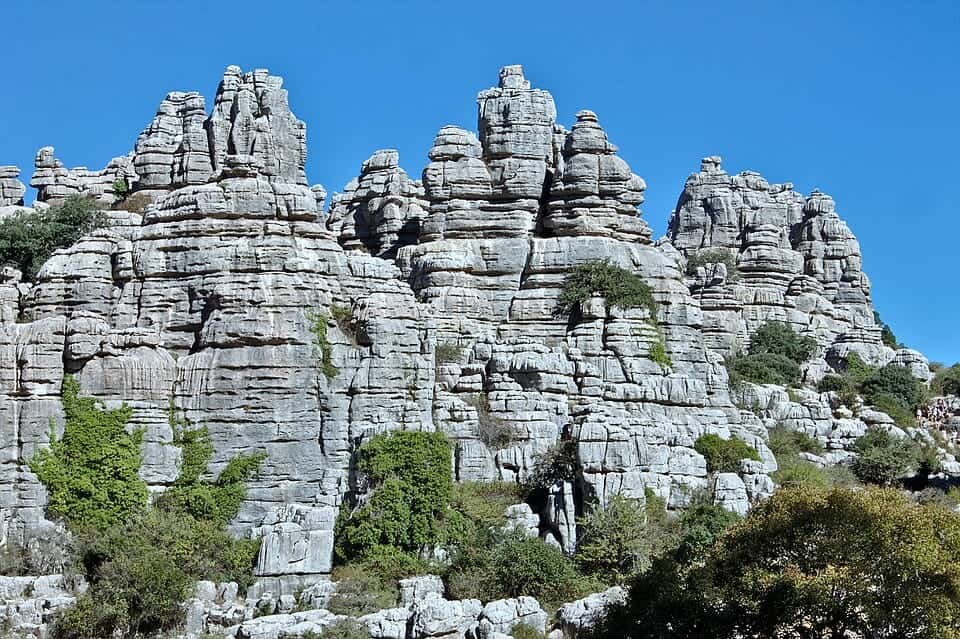
To identify limestone, look for a soft, light-colored sedimentary rock — usually white, cream, tan, or gray — that fizzes when you put a drop of vinegar on it and is soft enough to scratch with a steel knife or even a copper penny. That fizz is the giveaway: limestone is made mostly of calcium carbonate, so a weak acid makes it bubble and release carbon dioxide, a test almost no other common rock passes so dramatically. Many limestones are also packed with visible marine fossils — shells, coral, crinoid stems — because the rock formed on ancient sea floors. If your rock is dull, fairly soft, pale, and fizzes with vinegar, it is almost certainly limestone. Here is how to confirm it and tell it from the rocks it is most often confused with.
How to Identify Limestone
Limestone is one of the most common sedimentary rocks on Earth, and a few quick tests at the kitchen table settle the identification. Work through color and texture, then hardness, then the acid test, and finish by looking for fossils.
Color and texture
Limestone is usually pale — chalky white, cream, buff, light gray, or tan — though iron and organic matter can darken it to yellow, brown, blue-gray, or nearly black. The surface is typically dull to earthy rather than glassy or sparkling, and the grain ranges from so fine it looks smooth, like hardened mud, to visibly granular, almost sugary. Unlike granite, limestone shows no interlocking crystals of different minerals and no salt-and-pepper speckle; unlike sandstone, it does not feel gritty, like compressed sand.
The hardness test
Limestone is soft, a 3 on the Mohs hardness scale. A steel knife or nail scratches it easily, and even a copper penny will usually leave a mark. Crucially, limestone will not scratch glass — if your rock scratches a glass bottle, it is harder than limestone and probably quartz-rich, such as quartzite or chert. This softness, combined with the fizz test below, separates limestone from most of its pale lookalikes at once.
The acid (vinegar) test
This is the definitive test. Place a drop of white vinegar — or dilute hydrochloric acid if you have it — on a clean surface of the rock and watch closely. Limestone fizzes and bubbles visibly as the acid reacts with its calcium carbonate and releases carbon dioxide. The reaction can be vigorous on pure limestone and weaker on impure or dolomitic rock. If nothing happens on a dry surface, scratch a little powder from the rock first and drip the acid on the powder, which exposes more surface and coaxes a reaction out of stubborn samples.
Look for fossils
Because most limestone formed from the shells and skeletons of marine organisms settling on ancient sea beds, fossils are common and diagnostic. Look for the round buttons and stems of crinoids, the coiled shapes of ammonites and snails, clam and brachiopod shells, or the honeycomb and branching patterns of coral. A pale, soft rock studded with seashell-like fossils is almost certainly limestone. Some limestones are made almost entirely of visible fossil fragments (coquina) or tiny spherical grains (oolite).
A Quick Field Routine
When you are unsure, run the tests in this order — each one narrows the field:
- Check the color and feel: pale, dull, and either smooth or sugary — not glassy, not gritty.
- Scratch it: a knife or penny marks it, but it will not scratch glass.
- Drip vinegar on it: a clear fizz confirms calcium carbonate.
- Hunt for fossils: shells, coral, or crinoid stems seal the identification.
Limestone vs. Dolomite, Chalk, Marble, and Sandstone
Several pale rocks resemble limestone. These clues tell them apart:
- Dolomite (dolostone) — looks almost identical but fizzes only weakly, and usually only when powdered, because it is calcium-magnesium carbonate rather than pure calcium carbonate. A slow, faint reaction points to dolomite; a brisk fizz to limestone.
- Chalk — a soft, extremely fine, porous, bright-white form of limestone that rubs off on your fingers and crumbles easily. It fizzes like other limestone but is far softer and more friable.
- Marble — limestone recrystallized by heat and pressure into a harder rock with a sugary, interlocking crystal texture and often swirling color banding. Marble still fizzes with acid but is harder, takes a polish, and lacks fossils.
- Sandstone — made of cemented sand grains, so it feels gritty like sandpaper and the grains rub off; most sandstone does not fizz unless it has a carbonate cement.
- Quartzite and chert — hard, glassy, pale rocks that scratch glass and do not fizz at all; the failed acid and hardness tests rule out limestone immediately.
Why Identifying Limestone Matters
Limestone is more than a common rock to recognize on a hike. It is the parent material of caves, sinkholes, and the dramatic karst landscapes that form where mildly acidic water dissolves it over millennia, so knowing you are standing on limestone explains a great deal about the terrain and water around you. It is also one of the most-used rocks in human history — quarried for building stone, crushed for roads and concrete, burned to make lime and cement, and spread on fields and gardens to sweeten acidic soil. For fossil hunters, limestone is prime hunting ground, because its gentle marine origins preserve shells and skeletons beautifully.
Frequently Asked Questions
What is the easiest way to tell if a rock is limestone?
The vinegar test. A drop of white vinegar on limestone fizzes and bubbles as the acid reacts with calcium carbonate. Almost no other common pale rock reacts so clearly, especially when you combine the fizz with limestone’s softness.
Does limestone scratch glass?
No. Limestone is soft (Mohs 3) and cannot scratch glass; glass will scratch it instead. If your pale rock scratches glass, it is a harder, quartz-rich rock such as quartzite or chert, not limestone.
What is the difference between limestone and dolomite?
Both are carbonate rocks and look alike, but limestone (calcium carbonate) fizzes briskly with vinegar, while dolomite (calcium-magnesium carbonate) reacts only weakly, and often only when powdered. The strength of the fizz is the quickest tell.
Is limestone worth anything?
Limestone is abundant and not a gemstone, so individual pieces have little collector value, but it is enormously useful in bulk — for building stone, cement, road base, and agricultural lime — and fossil-rich limestone can be prized by collectors.
Found a pale, soft rock and not sure whether it is limestone, dolomite, or sandstone? Snap a photo and let Spotter help you identify it as a starting point, then confirm it at home with a scratch test and a drop of vinegar.
Try Spotter free on iPhone or Android
Plants, animals, fungi and rocks from one photo. 5 free identifications every day, no card required.