A juniper is an evergreen in the cypress family with two giveaway features: tight, scale-like foliage pressed against the twig, often mixed with sharp awl-shaped needles, and round, berry-like cones that ripen from green to a frosted blue. That combination separates a juniper from a true cedar, which carries flat needles and large woody cones, and from arborvitae, whose scale leaves grow in flat sprays and whose cones are small and woody. The name is where most of the confusion starts. The tree many people in the eastern United States call "cedar," the eastern red cedar, is not a cedar at all. It is a juniper, Juniperus virginiana. This guide covers how to identify a juniper with confidence and tell it from the look-alikes that share the "cedar" name.
How to Identify a Juniper
Junipers are a big group, from low creeping shrubs to 40-foot trees, but they share a consistent set of field marks. Work through the foliage, the cones, the bark and the overall form, and most junipers fall into place. This fall, Spotter users identified junipers across several species, including Utah juniper twice and Rocky Mountain juniper once, with the app averaging around 88 percent confidence. The features it reported each time match the list below: scale-like foliage, a shrubby to conical evergreen form, and fibrous grayish bark on a tree growing in open, rocky ground.
Scale leaves, often with prickly juvenile needles
Adult junipers wear tiny scale-like leaves, roughly a sixteenth of an inch long, that overlap in opposite pairs and press flat against the twig, so the branchlet feels ropey rather than needly. Younger plants, new shoots and some species also carry awl-shaped juvenile leaves that stand out from the twig and feel sharp to the touch. Many junipers show both leaf types on the same plant, which is a reliable clue in itself. Common juniper (Juniperus communis) is the exception that keeps its stiff, three-sided needles for life, held in whorls of three with a single white band on the upper side.
Berry-like cones, not woody cones
A juniper’s "berries" are actually fleshy seed cones. On female plants they start green and ripen to a frosted, waxy blue or blue-gray over one to two seasons, each holding one to several seeds. Most junipers are dioecious, meaning male and female cones grow on separate plants, so only some trees carry the blue fruit while others produce small pollen cones. The U.S. Forest Service describes eastern red cedar as dioecious, with berry-like cones that shift from green to whitish to bluish as the season goes on. True cedars and pines, by contrast, make dry, scaly, woody cones, so a soft blue berry-like cone is one of the quickest ways to land on juniper.
Fibrous, reddish bark and a strong aroma
Juniper bark is thin and fibrous and peels away in long, narrow vertical strips, usually reddish-brown to gray. The wood and crushed foliage give off the warm, pencil-shavings scent that got these trees called "cedar" by early colonists in the first place, even though they are not related to the true cedars of Europe and Asia. The aroma plus the shredding bark is a strong pair of clues when the foliage is out of reach overhead.
Form and habitat
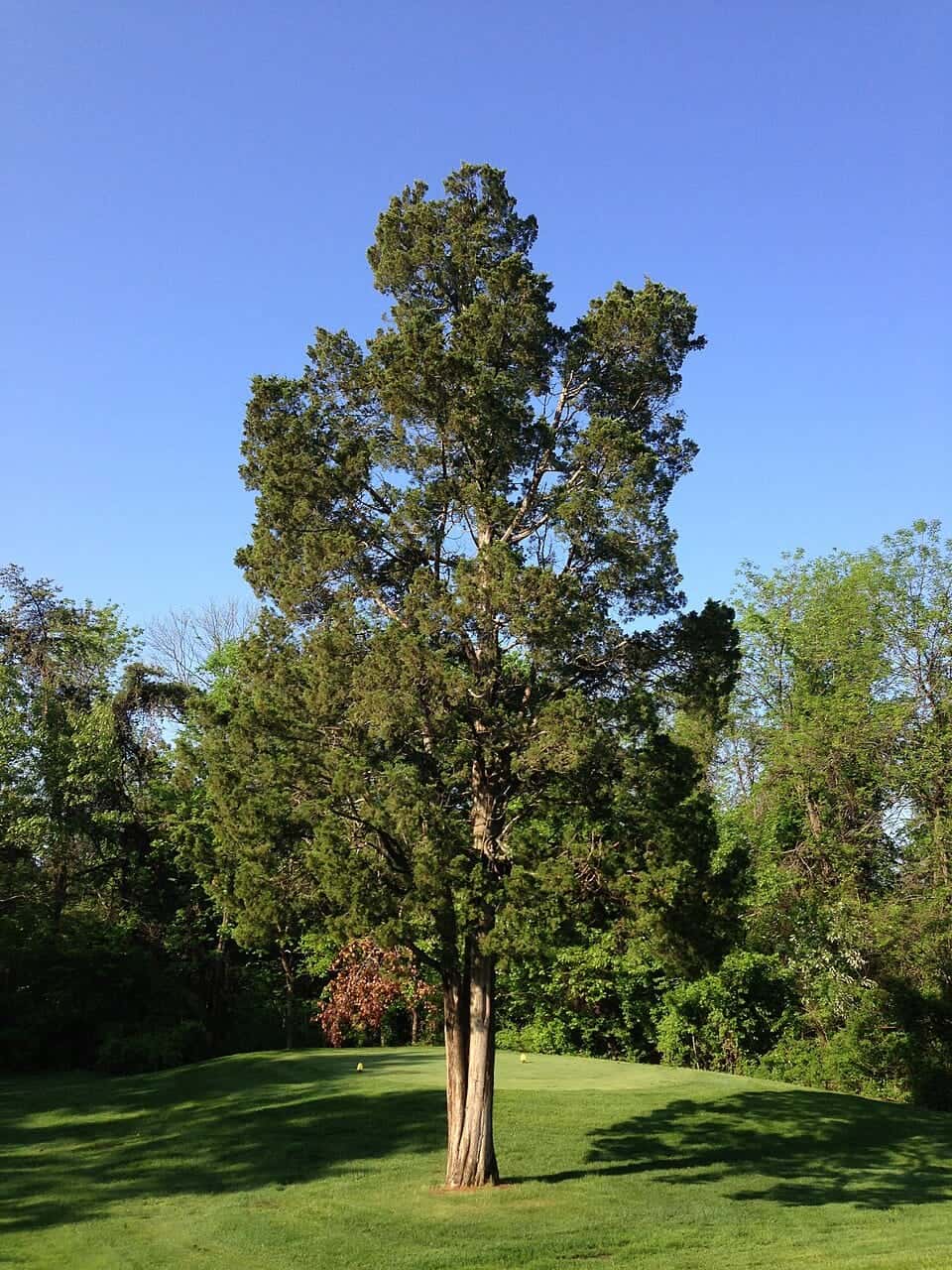
Junipers range widely in shape. Eastern red cedar is typically a dense, narrow, columnar to conical tree of old fields, fencerows and limestone bluffs. Western species such as Utah and Rocky Mountain juniper are often shrubby or multi-trunked and grow on dry, rocky slopes, exactly the habitat Spotter’s recent identifications came from. Creeping and shore junipers hug the ground as wide mats. Whatever the shape, junipers are tough, drought-hardy pioneers of poor, sunny, well-drained soil, which is why they colonize overgrazed pastures and road cuts so readily.
Juniper vs. cedar, arborvitae and other look-alikes
Several evergreens get called "cedar" or get mistaken for juniper. The table sorts the four most common sources of confusion by features you can check in the field. The northern white-cedar, or arborvitae, is the one people mix up with juniper most often in yards and hedges.
| Plant | Foliage | Cones or fruit | Bark and form | Quick tell |
|---|---|---|---|---|
| Juniper / eastern red cedar (Juniperus virginiana) | Scale-like adult leaves, often mixed with sharp awl-shaped needles | Soft blue, berry-like cones on female plants | Thin reddish-brown bark peeling in strips; narrow, dense crown | Blue berry-like cones plus a mix of scale and needle leaves |
| Arborvitae / northern white-cedar (Thuja occidentalis) | Scale-like leaves in flat, fern-like sprays | Small, dry, woody cones about a half inch long | Fibrous reddish-brown bark; conical, common in hedges | Flat sprays of foliage and tiny woody cones, no blue berries |
| True cedar (Cedrus, such as deodar or Atlas) | Stiff needles in dense clusters on short spur shoots | Large, upright, barrel-shaped woody cones that fall apart on the tree | Gray ridged bark; big spreading evergreen | Real needles and big upright cones; native to the Mediterranean and Himalayas |
| Western red cedar (Thuja plicata) | Glossy scale-like sprays with white marks beneath | Small woody cones that curve upward | Stringy reddish bark; very large Pacific Northwest tree | A western giant, not a juniper despite the name |
If you are sorting out needled evergreens rather than scale-leaved ones, our guide to pine vs. spruce vs. fir covers those three, and you can always identify a tree from a photo when the field marks are not adding up.
Frequently Asked Questions
Is eastern red cedar a juniper?
Yes. Eastern red cedar is Juniperus virginiana, a true juniper in the cypress family (Cupressaceae), not a member of the true cedar group (Cedrus). Early colonists named it "cedar" for its fragrant, reddish wood, and the name stuck even though the two are unrelated. If a fencerow "cedar" in the eastern United States carries blue berry-like cones, it is a juniper.
What is the difference between a juniper and a cedar?
Junipers carry scale-like or prickly needle foliage and soft, berry-like blue cones, and belong to the cypress family. True cedars (Cedrus) carry stiff needles in clusters and large, upright, woody cones, and come from the mountains of the Mediterranean and Asia. Most North American trees known as "cedar," including eastern red cedar, western red cedar and northern white-cedar, are not true cedars at all.
Why does my juniper have two different kinds of leaves?
That is normal. Junipers produce sharp, awl-shaped juvenile leaves on seedlings and vigorous new shoots, and tight, scale-like adult leaves on older growth. A single plant often shows both at once, and eastern red cedar is a classic example. The mix of leaf shapes is a helpful confirmation that you are looking at a juniper rather than an arborvitae, which sticks to flat scale sprays.
Why is my juniper or arborvitae turning brown in fall?
Evergreens shed their oldest inner foliage every autumn, so bronzing or browning on the inside of a juniper or arborvitae is usually normal seasonal needle drop rather than a dying plant. Our guide to seasonal needle drop walks through telling the normal version from a real problem.
Try Spotter free on iPhone or Android
Plants, animals, fungi and rocks from one photo. 5 free identifications every day, no card required.