The fastest way to tell pine, spruce, and fir apart is to look at how the needles attach to the twig. Pines carry their needles in small bundles of two, three, or five wrapped together in a papery sheath, while spruce and fir hold their needles singly, each one joined straight to the branch. To separate spruce from fir, roll a single needle between your finger and thumb: a spruce needle is stiff, sharp, and four-sided, so it rolls easily; a fir needle is flat, soft, and will not roll. Those two checks — bundled or single, then square or flat — sort the three great groups of evergreens almost every time. Here is how to work through it in the field, cone and bark clues included, and how to rule out the look-alikes people mix in.
How to Identify Pine, Spruce, and Fir
All three are needle-leaved conifers that stay green through winter, which is exactly why they get lumped together. But a handful of features — needle attachment, needle shape, the twig itself, and the cones — separate them reliably. Run through them in order and you can usually name the tree from a single branch tip.
Check how the needles attach
Start here, because it splits pines from the other two instantly. Pine needles grow in clusters, or fascicles, of two to five needles bound at the base by a thin papery wrapper — pull a cluster off and you will see the needles are held together at one end. Spruce and fir needles, by contrast, attach to the twig one at a time, spaced individually along the branch. If the needles come in little bundles, you are holding a pine; if each needle stands alone, move on to the roll test.
Roll a needle: square spruce vs. flat fir
Once you know the needles are single, pluck one and roll it between your fingers. A spruce needle is square or diamond-shaped in cross-section, so it spins easily and feels stiff, sharp, and prickly — grab a spruce branch and it can genuinely bite. A fir needle is flat and soft, often with a blunt or slightly notched tip, and because it is flat it refuses to roll and lies flat between your fingers. The old mnemonics help: "spruce is square and spiky, fir is flat and friendly."
Feel the twig
The branch itself is a great confirming clue. Spruce needles sit on tiny raised woody pegs, so once the needles drop the twig feels rough and bumpy, like coarse sandpaper. Fir needles attach with a flat, round base — like a tiny suction cup — and leave smooth, flat scars, so a bare fir twig feels clean and smooth. Running a thumb along a stripped twig is often enough to decide spruce versus fir on its own.
Look at the cones
If the tree has cones, they settle it. Fir cones stand upright on the branches like candles and fall apart on the tree, scattering their scales, so you almost never find a whole fir cone on the ground. Spruce cones hang down, are papery and flexible, and drop in one piece, littering the ground beneath the tree. Pine cones are the familiar woody, stiff, often large cones with thick scales, and they also fall whole. Upright cones that vanish point to fir; hanging papery cones on the ground point to spruce; hard woody cones point to pine.
Bark and overall shape
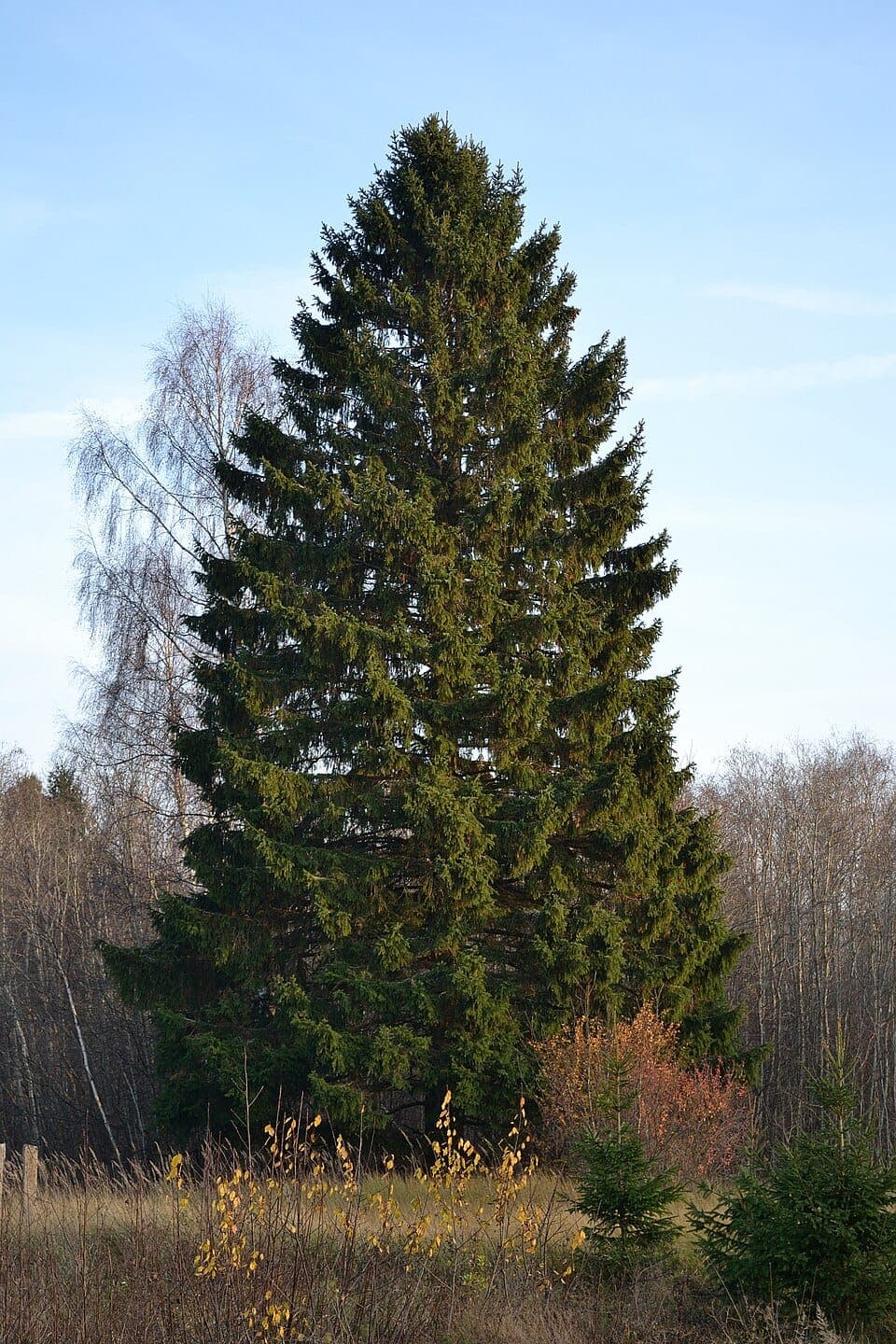
Shape and bark offer a last cross-check. Firs and spruces tend to grow in a narrow, symmetrical, steeple-like spire that tapers to a sharp point — the classic Christmas-tree silhouette. Pines usually look more open and irregular, with needles tufted toward the branch ends and gaps of bare branch between. Many mature pines have reddish, plated, or flaky bark; spruces often show scaly, grayish bark; and many firs have smooth gray bark dotted with resin blisters when young.
A Quick Step-by-Step
- 1Are the needles in bundles of 2 to 5 held by a papery sheath? If yes, it is a pine. Stop here.
- 2If the needles are single, roll one between your fingers. Does it spin easily and feel square, stiff, and sharp? That is a spruce.
- 3Does the needle stay flat, feel soft, and refuse to roll? That is a fir.
- 4Confirm with the twig: rough and pegged means spruce; smooth means fir.
- 5Confirm with cones if present: upright and crumbling means fir; hanging and papery on the ground means spruce; hard and woody means pine.
Try Spotter Free on iOS & Android
Plants, animals, fungi, and rocks — all from a photo. 5 free identifications every day, no credit card required.
Evergreen Look-Alikes to Rule Out
Several other evergreens get called "pine" or "fir" by habit but belong to different groups. A few features keep them straight:
- Hemlock — short, flat, soft needles of slightly uneven length on a smooth twig, with tiny cones and a graceful, drooping leader at the treetop. Often mistaken for fir, but the needles are smaller and the whole tree looks softer and more weeping.
- Douglas-fir — despite the name, not a true fir. Its soft, flat needles grow all around the twig and its hanging cones have a distinctive three-pronged bract sticking out of each scale, like the back half of a mouse. The hyphen in "Douglas-fir" signals it is its own thing.
- Arborvitae and true cedars — these have flat, scale-like or overlapping foliage sprayed out in fans, not individual needles, so they feel soft and ropey rather than needly.
- Juniper — scaly or short prickly foliage and round, berry-like blue cones rather than typical woody cones. The "berries" are a giveaway.
- Yew — flat, soft, dark-green needles like a fir, but with a single red, fleshy, cup-shaped seed instead of a dry cone. All parts of a yew are highly toxic, so it is worth recognizing.
Where You Will Find Each One
Habitat narrows things down too. Spruces and firs lean toward cold climates, high elevations, and northern forests, which is why they dominate the boreal woods and mountain slopes and why they are the backbone of the Christmas-tree trade. Pines are the most adaptable of the three and grow nearly everywhere — sandy coastal plains, dry ridgetops, old fields, and suburban yards across the country. If you are in a warm, dry, low spot, a random evergreen is far more likely to be a pine than a spruce or fir.
Frequently Asked Questions
What is the easiest way to tell spruce from fir?
Roll a needle between your fingers. A spruce needle is four-sided, stiff, and sharp, so it rolls easily and feels prickly; a fir needle is flat and soft and will not roll. Back it up by feeling the twig: rough and bumpy with little pegs means spruce, smooth means fir.
Do pine needles really grow in bundles?
Yes — this is the single best way to recognize a pine. Pine needles come in clusters of two, three, or five joined at the base by a papery sheath. Spruce and fir needles attach to the twig one at a time, never in bundles.
Is a Douglas-fir a true fir?
No. Despite the name, Douglas-fir is its own genus, which is why it is written with a hyphen. You can spot one by the three-pronged papery bract that pokes out from between the scales of its hanging cones — no true fir has that, and true fir cones stand upright and fall apart on the tree.
How can I identify an evergreen in winter?
The needle and cone clues work year-round, which makes conifers some of the easiest trees to identify in winter when broadleaf trees are bare. Grab a low branch tip, check whether the needles are bundled or single, roll one, and feel the twig — that is usually enough without a single leaf or flower.
Standing in front of an evergreen and still not sure whether it is a pine, spruce, or fir? Snap a photo of a branch tip and let Spotter help you identify it as a starting point, then confirm it yourself with the needle-and-cone checks above.
Try Spotter Free on iOS & Android
Plants, animals, fungi, and rocks — all from a photo. 5 free identifications every day, no credit card required.