
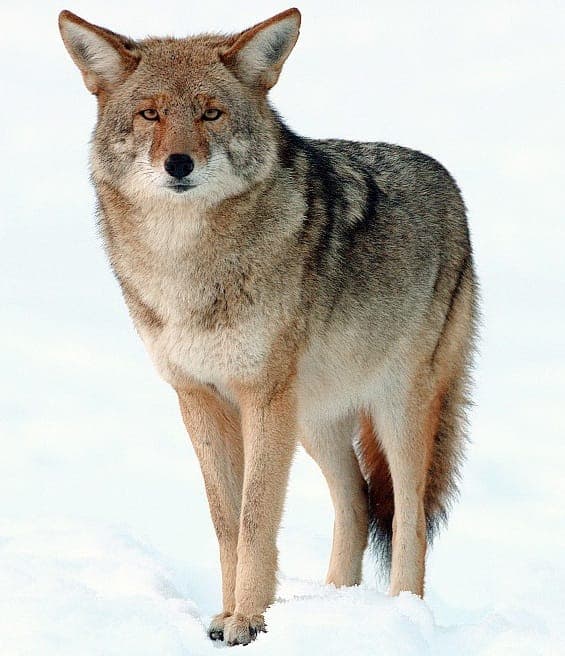
The quickest way to tell a coyote track from a dog track is the shape of the print and the trail it leaves. A coyote print is a tidy, compact oval, usually 2.5 inches long or a bit more, with the toes held close together, slim and sharp claw marks, and — most tellingly — a nearly dead-straight line of tracks that runs purposefully across the landscape. A dog track is rounder and more splayed, with blunt, heavy claw marks, toes that spread out, and a meandering trail that wanders from scent to scent. No single print is always conclusive, because a lean, well-behaved dog can leave a coyote-like track, but read the whole trail and the answer usually becomes clear. Here is how to tell them apart in mud, sand, or snow.
How to Tell a Coyote Track From a Dog Track
Both animals are canines, so they share the basic blueprint: four toes on each foot, a triangular heel pad, and claw marks that usually register in front of the toes. The differences are in the proportions and, above all, in how the animal moves. Work through the marks below in order.
Overall shape and size
A coyote’s front track is a compact oval, roughly 2.25 to 3 inches long and clearly longer than it is wide, with a neat, almost delicate look. Dog tracks come in every size, but most are rounder overall and often as wide as they are long, with a chunky, spread-out appearance. If the print is noticeably longer than wide and looks tight and oval, lean coyote; if it looks round and sprawling, lean dog. Coyote front feet also print larger than the hind feet, a detail that holds up in clear substrate.
Toe position and the “X”
In a coyote track the two middle toes sit forward and close together, roughly parallel, and the whole foot looks compact and controlled. You can usually draw an imaginary X through the negative space between the toe pads and the heel pad without crossing any pad — the toes point forward rather than splaying outward. A dog’s toes tend to spread and point outward, the print looks looser, and that clean X is broken by a toe or the heel pad. Tightly grouped, forward-pointing toes are one of the most reliable coyote signs.
Claw marks
Coyotes have thin, sharp claws, and often only the two center claws register as fine, close-set points ahead of the toes — the outer claws may not print at all. Dogs generally have thicker, blunter claws that leave heavier, more obvious marks, and all four front claws often show. If the claw marks are dainty, sharp, and mostly just the front two, that points to a coyote; broad, blunt, and all showing points to a dog.
The heel pad
Look at the rear pad (the metacarpal or “heel” pad). A coyote’s is relatively small and neatly triangular in proportion to the toes. A dog’s heel pad is usually larger and blockier relative to the foot. On its own this is a subtle clue, but combined with the oval outline and tight toes it helps confirm a coyote.
The trail: gait and stride
This is the single best tell, and it is why you should read the whole line of tracks rather than one print. A traveling coyote is a study in efficiency: it moves in a nearly straight line, and its hind foot often lands almost exactly where the front foot did (called direct registering), leaving a tidy, evenly spaced trail that heads somewhere with intent. At a trot the tracks are typically spaced about 15 to 22 inches apart in that straight line. A pet dog, by contrast, has nowhere it needs to be — it wanders, circles, backtracks, and criss-crosses its own path, and its trail sprawls to either side. A straight, purposeful, energy-saving trail says coyote; a loopy, distracted one says dog.
Try Spotter Free on iOS & Android
Plants, animals, fungi, and rocks — all from a photo. 5 free identifications every day, no credit card required.
Could It Be a Fox, Wolf, or Cat Instead?
Coyotes and dogs are not the only tracks you might be puzzling over. A few other animals leave similar prints:
- Red fox — smaller than a coyote (about 1.75 to 2.5 inches) and often oddly blurred or indistinct because the paws are so densely furred, sometimes showing a small bar or chevron across the heel pad.
- Gray wolf — much larger, commonly 4 to 5 inches long and broad; if you are in wolf country and the track dwarfs your palm, think wolf, not coyote.
- Domestic dog — the most common look-alike; look for round shape, splayed toes, blunt claws, a large heel pad, and above all a wandering trail (and often a nearby human footprint or a collar tag on the animal itself).
- Bobcat or cougar — cat tracks are rounder, usually show no claw marks (cats retract their claws), have an asymmetrical “lead toe,” and a large heel pad with two lobes on the front edge and three on the back.
Why Reading Coyote Tracks Matters
Coyotes now live in nearly every U.S. state, including cities and suburbs, so finding their tracks in a park, a greenway, or your own backyard is completely normal and not a cause for alarm. Reading the trail tells you who is sharing your neighborhood and where they travel, which is genuinely useful if you keep chickens, cats, or a small dog. Coyotes generally avoid people and are not a threat to adults, but it is smart to keep small pets leashed or supervised at dawn and dusk, secure trash and pet food, and never feed or approach a wild coyote — a coyote that loses its fear of people is the one that causes problems. If you see a coyote acting boldly, making yourself big and loud (“hazing”) usually sends it on its way.
Frequently Asked Questions
How big is a coyote track?
A coyote’s front track is usually about 2.25 to 3 inches long and clearly oval, longer than it is wide. The hind track is a little smaller. Anything much bigger and rounder is likely a dog or, in the right region, a wolf.
Do coyote tracks show claw marks?
Yes, usually. Coyotes typically leave thin, sharp claw marks from the two middle toes, sometimes just faint points. Dogs leave heavier, blunter claw marks and often show all four front claws. Cats, by contrast, usually leave no claw marks at all.
How can you tell a coyote trail from a dog’s?
Follow the line of tracks. A coyote travels in a straight, evenly spaced, purposeful line and often steps its hind foot into the front footprint. A pet dog wanders, circles, and criss-crosses its own path. The gait gives it away even when a single print is ambiguous.
Could a coyote track actually be a fox or a wolf?
Size sorts them out. A fox track is smaller and often looks fuzzy or blurred from furred paws; a wolf track is much larger, commonly 4 to 5 inches long. A crisp oval print around 2.5 to 3 inches, in a straight trail, is the classic coyote.
Found a clear print in the mud or snow and want to be sure who left it? Snap a photo and let Spotter help you identify the animal and its tracks — and get to know the wildlife moving through your neighborhood.
Try Spotter Free on iOS & Android
Plants, animals, fungi, and rocks — all from a photo. 5 free identifications every day, no credit card required.