
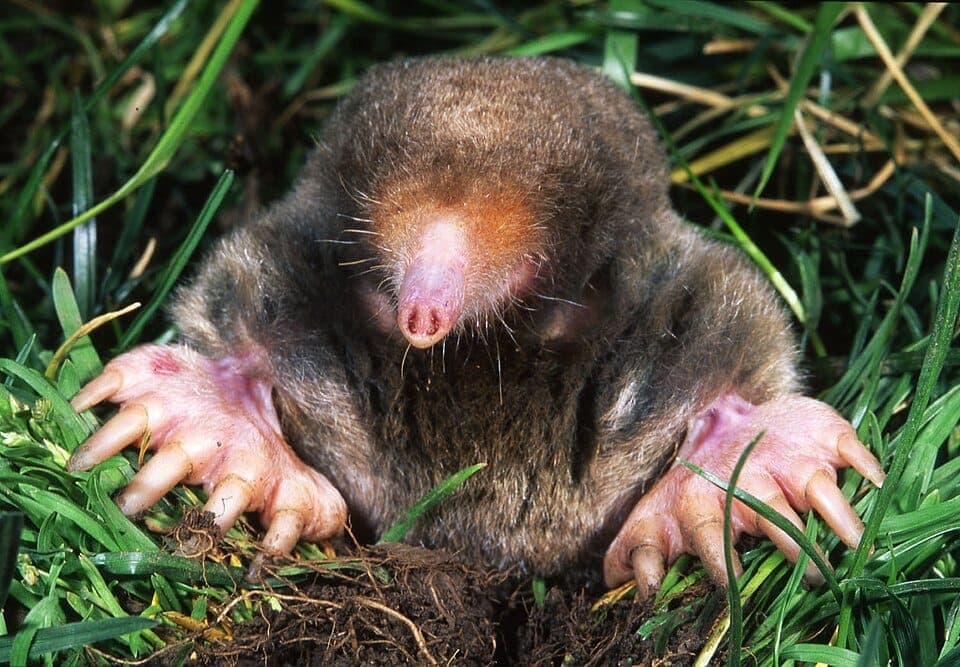
The quickest way to tell a mole from a vole is what they leave behind: moles push up cone-shaped mounds of soil and raised, spongy ridges as they tunnel for insects, while voles leave narrow, above-ground runways worn into the grass and gnaw on plant stems, bark, and roots. Both are small, brownish, tunneling animals blamed for wrecked lawns, so people use the two names interchangeably — but they are completely different creatures that do different damage, and the right fix depends on which one you have. Here is how to tell a mole from a vole by the animal itself and, more usefully, by the signs each one leaves in your yard.
How to Tell a Mole From a Vole
Moles and voles overlap in size and color and both dig, which is why a glance at a torn-up lawn rarely settles the question. Work through the animal’s body, the shape of its diggings, the paths it makes, and the plant damage it causes, and the two separate cleanly. In practice you will almost always identify them from the sign rather than the animal, because you rarely get a good look at either one.
The animals themselves
A mole is not a rodent at all — it is an insectivore, about 5 to 8 inches long, with velvety gray-brown fur, a pointed pink snout, no visible eyes or ears, and enormous, outward-facing front paws built like paddles for digging. A vole is a true rodent, a compact 4 to 7 inches long, with a stocky mouse-like body, small dark eyes, short rounded ears often buried in fur, a short tail, and chisel-like front teeth. If you do see the animal, the giveaway is the front feet and face: giant spade-shaped paws and a naked, tapering snout mean mole, while a blunt-faced little "meadow mouse" means vole.
Molehills and surface ridges — classic mole sign
Moles announce themselves two ways. First, molehills: round, volcano-shaped mounds of loose, crumbly soil pushed straight up from below, usually with no obvious hole in the middle because the tunnel entrance is plugged underneath. Second, surface ridges: raised, spongy lines of heaved-up turf that snake across the lawn and give way softly when you step on them — these are shallow feeding tunnels dug just under the surface. Neat cone-shaped mounds and squishy raised ridges point to a mole.
Runways and open holes — classic vole sign
Voles work at the surface instead of pushing up soil. Their signature is a network of runways: narrow, clean paths about 1 to 2 inches wide worn right into the grass, where voles have clipped the vegetation low and traveled the same routes over and over. At intervals these runways drop into small, open burrow holes roughly the size of a golf ball with no mound of dirt around them. Skinny worn trails and clean open holes with no volcano of soil point to voles. The runways become especially obvious in early spring, when melting snow suddenly reveals a whole maze of them across the lawn.
What each one eats — and the damage it does
This is the most important difference for a gardener. Moles are carnivores that eat earthworms, grubs, and other insects; they do not eat plants, so any plant damage over a mole tunnel is incidental — roots disturbed as the mole plows through, not chewed off. Voles are herbivores that gnaw stems, roots, and bulbs, and especially the bark at the base of young trees and shrubs, often girdling and killing them over the winter. If plants are actually being eaten — bark stripped in a ring near the ground, bulbs hollowed out, seedlings clipped off — that is a vole, not a mole.
Try Spotter Free on iOS & Android
Plants, animals, fungi, and rocks — all from a photo. 5 free identifications every day, no credit card required.
Mole, Vole, Gopher, or Mouse?
A few other small diggers get lumped in with moles and voles. Here is how to rule them out:
- Pocket gopher — pushes up much larger, fan- or crescent-shaped mounds of soil with a plugged hole off to one side, and its tunnels are deeper and wider than a mole’s; common mainly in the central and western states.
- Shrew — a tiny, mouse-sized insectivore with a long pointed snout like a mole’s but a slender body and normal-sized feet; it often travels in vole runways rather than making its own.
- Field mouse (deer mouse or house mouse) — big ears, large eyes, and a long tail, whereas a vole has small hidden ears and a short tail; mice climb and enter buildings far more readily than voles.
- Chipmunk — striped, active in daylight, and digs a clean, dirt-free burrow entrance about two inches across, usually tucked near cover rather than out in the open lawn.
Why It Matters: Protecting Your Lawn and Plants
Knowing which animal you have changes what you should do about it. Moles are largely a cosmetic problem — the tunnels and mounds are unsightly, but the animal is eating grubs and aerating the soil, and a single mole can range across a surprisingly large lawn, so the "infestation" is often just one or two animals. Voles are the bigger threat to plantings because they kill trees, shrubs, and perennials by gnawing roots and girdling bark, especially hidden under winter snow. For both, the least-toxic first steps are the same: reduce cover by keeping grass mowed and pulling mulch back a few inches from tree trunks, protect young trees with hardware-cloth guards, and tolerate the harmless ones where you can. If damage is severe or ongoing, a local extension office or licensed wildlife professional can recommend control that is legal in your area.
Frequently Asked Questions
How do I know if I have moles or voles?
Look at the sign, not the animal. Volcano-shaped soil mounds and raised, spongy ridges you can feel underfoot mean moles; narrow worn runways in the grass with open, mound-free holes and chewed plants mean voles. When both plant damage and surface runways are present, you are dealing with voles.
Are moles rodents?
No. Moles are insectivores, in the same broad group as shrews, and they do not gnaw or eat plants. Voles are true rodents closely related to mice, with ever-growing front teeth they use to chew through vegetation.
Do moles eat plant roots and bulbs?
Not usually — moles eat insects and earthworms, so a plant sitting over a mole tunnel is disturbed rather than eaten. Hollowed-out bulbs and gnawed roots are almost always voles or mice taking advantage of the loosened soil, sometimes traveling through old mole tunnels to reach them.
Do voles use mole tunnels?
Yes. Voles and shrews often move into a mole’s abandoned tunnels to travel and feed, which is a big reason the two animals get blamed for each other’s damage. Runways and open holes sitting on top of an old mole tunnel system usually mean you have both a mole and voles.
Not sure whether the animal — or the tunnels — in your yard belongs to a mole, a vole, or something else? Snap a photo of the animal, the mounds, or the runways and let Spotter help you figure out what you’re dealing with.
Try Spotter Free on iOS & Android
Plants, animals, fungi, and rocks — all from a photo. 5 free identifications every day, no credit card required.