
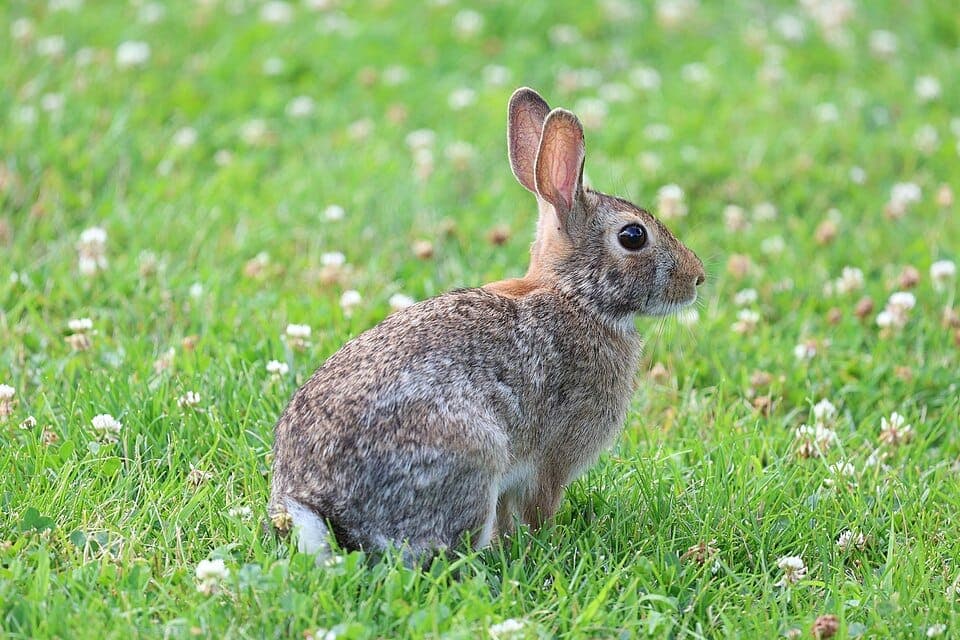
The quickest way to tell a rabbit from a hare is size and the newborns: hares are larger and leggier with much longer ears, and their babies are born furred, open-eyed, and ready to run, while rabbit kits are born blind, naked, and helpless in a nest. Confusingly, common names get this backward — a cottontail is a true rabbit, while a jackrabbit is actually a hare, and the domestic "Belgian hare" is really a rabbit. Rabbits and hares look alike at a glance and belong to the same family, but they are different animals with different bodies, habits, and even skeletons. Here is how to tell a rabbit from a hare in the field, and how the cottontails and jackrabbits you actually see fit in.
How to Tell a Rabbit From a Hare
Rabbits and hares share the long ears, big hind feet, twitching nose, and bounding hop that make them unmistakable as members of the family Leporidae. But put them side by side and the differences are clear in their size, their proportions, how their young are born, and where they live. You will usually identify the one in your yard by size and behavior, since you rarely get to inspect a newborn.
Size and build
Hares are bigger and rangier. A typical cottontail rabbit weighs just 1 to 3 pounds and has a compact, rounded body, while a jackrabbit (a hare) can reach 6 to 10 pounds and stands tall and lanky on long legs. Hares are built like sprinters — longer, leaner, and more angular — whereas rabbits look softer and more hunched. If the animal seems surprisingly large and leggy for a "bunny," you are probably looking at a hare.
Ears and legs
Hares take the family’s signature features to an extreme. Their ears are noticeably longer — a jackrabbit’s can be a third of its body length, often with black tips — and their hind legs are longer and more powerful, built for explosive, zigzagging speed across open ground. Rabbits have shorter ears and shorter legs suited to dashing a short distance to the nearest burrow or brush pile. Exceptionally long, black-tipped ears and long back legs point to a hare.
The babies are the biggest difference
This is the defining split between the two. Hares are born precocial — fully furred, with their eyes open, able to hop within hours of birth — because they are raised out in the open with no burrow to hide in. Rabbits are born altricial — hairless, blind, and utterly helpless — and depend on a sheltered nest for their first couple of weeks. A nest of naked, pink, closed-eyed young means rabbits; a single furred, bright-eyed youngster crouched alone in the grass is a baby hare (a leveret), not an orphan.
Nests, burrows, and behavior
Rabbits tend to be more social and often shelter in burrows or dense cover; the European rabbit famously digs extensive communal warrens, and cottontails use brush, thickets, and shallow nests called forms. Hares are generally solitary and do not dig burrows at all — they rest in a simple scrape in the grass and rely on speed and camouflage to survive. A hare’s escape strategy is to freeze, then explode into a fast, jinking run; a cottontail more often bolts a short distance to the nearest cover.
Color and coat
Both are usually brown or gray for camouflage, but some hares change with the seasons in a way rabbits do not. Northern hares like the snowshoe hare and several jackrabbit species molt to white in winter to blend with snow, then back to brown in summer. Cottontails stay brown year-round and flash the fluffy white underside of the tail — the "cotton ball" that gives them their name — as they bound away.
Try Spotter Free on iOS & Android
Plants, animals, fungi, and rocks — all from a photo. 5 free identifications every day, no credit card required.
Cottontail, Jackrabbit, or Something Else?
In North America, almost every wild "rabbit" you see is a cottontail, and almost every "jackrabbit" is really a hare. Here is how the common look-alikes sort out:
- Eastern cottontail — the classic backyard rabbit across much of the country: small, brown, short-eared, with the white powder-puff tail; a true rabbit.
- Jackrabbits (black-tailed, white-tailed, antelope) — large, long-eared hares of open country in the West and Great Plains, despite the "rabbit" in the name.
- Snowshoe hare — a forest hare of the north with huge hind feet that turns white in winter; a true hare.
- European rabbit — the ancestor of all domestic rabbits, a burrowing, warren-living true rabbit introduced in many places.
- Pika — a small, round, short-eared relative that lives in mountain rockslides; often mistaken for a tiny rabbit but in its own group within the same order.
The shortcut: small, short-eared, white-cotton-tail, babies born helpless and blind, sticks near cover — rabbit. Large, with very long ears and legs, babies born ready to run, rests in the open and sprints — hare, even if it is called a jackrabbit.
Why the Difference Matters
Beyond settling an argument, the distinction is genuinely useful. If you find a nest of blind, naked young in a shallow scrape in your lawn, those are cottontail kits — the mother visits only briefly at dawn and dusk, so the nest is almost never truly abandoned, and the best thing is to leave it alone and keep pets away. A lone furred, open-eyed youngster sitting still in the grass is a normal, healthy young hare or well-developed rabbit doing exactly what it should; it does not need rescuing. Knowing which animal you have also explains the behavior you see — why the big "rabbit" in the field won’t go to ground (it is a hare with no burrow), or why the cottontails vanish instantly into the brush pile.
Frequently Asked Questions
Is a jackrabbit a rabbit or a hare?
A jackrabbit is a hare, despite its name. It has the long ears, long legs, and open-ground lifestyle of a true hare, and its young are born furred and ready to move, unlike helpless newborn rabbits.
Can rabbits and hares breed together?
No. Despite being close relatives in the same family, rabbits and hares have different numbers of chromosomes and very different development, and they do not interbreed. The domestic "Belgian hare" is a rabbit breed bred to look hare-like, not an actual hare.
What is the easiest way to tell them apart in the field?
Size and ears. Hares are distinctly larger and leggier with very long ears, often black-tipped, while rabbits are smaller and shorter-eared. If it flashes a white cotton-ball tail as it hops to cover, it is a cottontail rabbit.
I found a baby rabbit alone — is it abandoned?
Almost certainly not. Mother rabbits leave their young alone in the nest all day and return only briefly to nurse at dawn and dusk, and young hares naturally sit motionless by themselves. Leave it where it is, keep pets and children away, and contact a licensed wildlife rehabilitator only if it is clearly injured.
Spotted a long-eared visitor and can’t decide if it’s a cottontail or a jackrabbit? Snap a photo and let Spotter help you put a name to it.
Try Spotter Free on iOS & Android
Plants, animals, fungi, and rocks — all from a photo. 5 free identifications every day, no credit card required.