
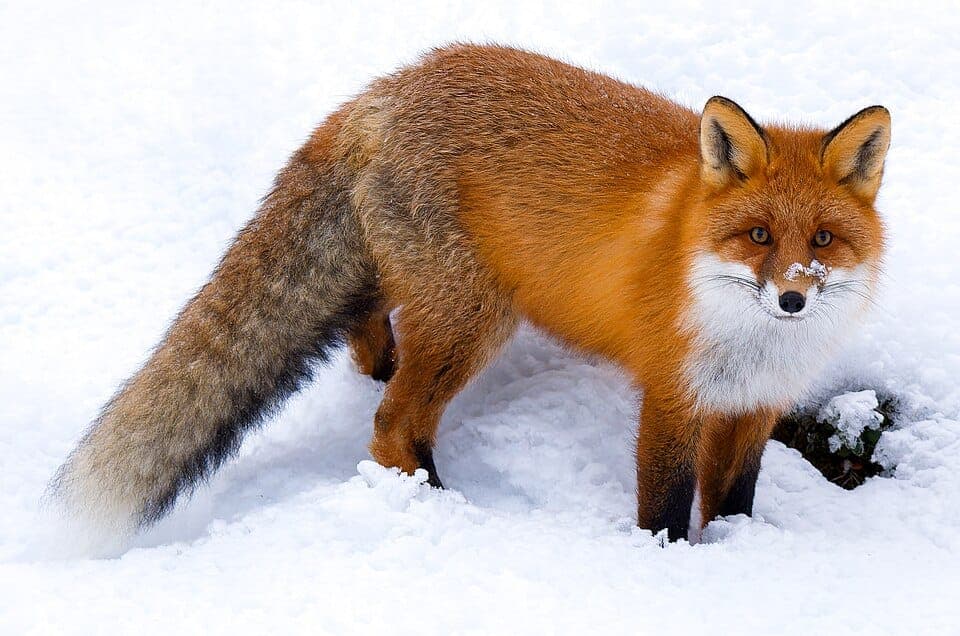
The surest way to tell a red fox from a gray fox is the tail tip and whether the animal can climb. A red fox has a white-tipped tail and blackish “stockings” on its lower legs; a gray fox has a black-tipped tail with a dark stripe running down it, a grizzled salt-and-pepper coat, and the remarkable ability to climb trees — the only wild dog in North America that regularly does. Coat color alone fools almost everyone, because red foxes are not always red and gray foxes wear plenty of rusty orange. Here is how to sort out which fox is trotting through your yard.
How to Identify a Red Fox vs. a Gray Fox
The tail tip — the one mark that always works
Look at the very end of the tail. A red fox always has a white tip; a gray fox never does — its tail ends in black, with a coarse black stripe or mane running along the top toward the body. This single feature holds up even in blurry trail-camera photos and at night, which is why wildlife biologists reach for it first. When every other clue is ambiguous, the tail tip settles it.
Coat color and pattern
A classic red fox is rusty orange over the back and sides with a white chest, throat, and belly and black lower legs, as if it stepped in ink. But color is unreliable: red foxes also come in silver, black, and “cross” forms blended from red and gray. A gray fox has a grizzled, salt-and-pepper gray back with that black stripe down the spine and tail, plus rusty-orange patches on the neck, ears, flanks, and legs and a white throat. Those rusty patches are what fool people into calling a gray fox a “red” one — so never judge by orange alone.
Body shape, face, and size
Red foxes look taller and more dog-like: long legs, a long pointed muzzle, tall pointed ears, and a lean frame of roughly 10 to 15 pounds that makes them seem bigger than they are. Gray foxes are stockier and lower to the ground, with shorter legs, a shorter muzzle, and a rounder, almost cat-like face; most weigh 7 to 13 pounds. If the animal looks leggy and elegant, lean red fox; if it looks compact and close to the ground, lean gray.
Behavior — does it climb?
Gray foxes have strong, hooked claws and genuinely climb trees — they will scramble up a trunk to rest on a branch, forage, or escape a coyote or dog, sometimes 30 feet or more off the ground. Red foxes cannot climb; they live their whole lives on the ground, hunting and denning in the open. If you ever see a fox up in a tree, you have identified a gray fox on the spot.
Habitat and where you’ll see each
Red foxes favor open country — fields, farmland, golf courses, and suburban edges — and are often bold enough to trot across a backyard in daylight. Gray foxes prefer dense woods, brushy cover, and rocky slopes, and they are more secretive and nocturnal, so they are seen far less often even where they are common. Where you are matters: a fox hunting a mowed field at dusk is more likely red; a fox slipping through thick brush or timber is more likely gray.
Sounds — the scream and the bark
You will often hear a fox before you see one, and the sound is startling. The classic “fox scream” — a hoarse, drawn-out shriek that carries through the dark and unsettles many people the first time — is made mostly by red foxes, especially during the winter breeding season, along with a sharp, dog-like “wow-wow-wow” bark used to keep contact and defend territory. Gray foxes are generally quieter and raspier and bark less often. So a bloodcurdling scream in the night is far more likely a red fox announcing itself than any animal in distress.
Tracks and other signs
Both leave small, neat, oval dog-like tracks a bit under two inches long, usually in a tidy straight line rather than the wandering trail a loose dog leaves. Red fox prints often look blurred in winter because their paws are so densely furred, and you may find their scat left pointedly on a rock, log, or trail junction as a scent marker. A den dug into a bank, hillside, or space under a shed — with a scatter of feathers, bones, and a musky smell — usually belongs to a red fox; gray foxes more often den in hollow logs, rock piles, and brush, matching their love of cover and their climbing habit.
Red Fox, Gray Fox, or a Coyote?
People also mix foxes up with coyotes and loose dogs. A few quick separations:
- Coyote — much larger (20 to 45 pounds), taller and longer-legged, grayish-tan, with a bushy tail carried low when it runs. Far bigger than any fox.
- Red fox — small and lean, rusty orange, black lower legs, and a white tail tip; runs with its tail held straight out.
- Gray fox — the smallest and stockiest, grizzled gray with a black-tipped tail, and the only one that climbs.
- Domestic dog — look for a collar, a blunter face, and a gait that lacks the low, gliding, purposeful trot of a wild fox.
Try Spotter Free on iOS & Android
Plants, animals, fungi, and rocks — all from a photo. 5 free identifications every day, no credit card required.
Are Foxes Dangerous?
Foxes are generally shy and pose very little threat to people. They rarely bother pets larger than a small cat, though they will take chickens and other poultry, so secure coops, trash, and pet food and never hand-feed a wild fox. A fox out in daylight is not automatically rabid — it is normal behavior, especially in spring and summer when parents are feeding pups. But a fox that is stumbling, circling, disoriented, unusually aggressive, or partly paralyzed could be sick; keep your distance, bring pets inside, and contact your local animal control or wildlife agency rather than approaching it.
Frequently Asked Questions
What is the easiest way to tell a red fox from a gray fox?
The tail tip. A white tip means red fox; a black tip means gray fox. It holds true no matter how much rusty or gray color is on the rest of the animal, which is why it is the go-to field mark.
Why is my “red” fox actually gray — or my gray fox reddish?
Coat color is genuinely unreliable. Red foxes occur in silver, black, and cross-color forms, and gray foxes wear rusty orange on the neck, ears, and legs. Judge by the tail tip, the leg color, and the overall build instead of the main coat color.
Can foxes really climb trees?
Gray foxes can — their curved claws let them climb to rest, forage, or escape danger, sometimes high into the canopy. Red foxes cannot climb, so any fox you spot up a tree is a gray fox.
Do foxes make good neighbors?
Mostly, yes. Foxes eat large numbers of rodents, rabbits, and insects and generally keep their distance from people. Just keep pets, poultry, and pet food secured, avoid feeding them, and enjoy watching them from afar.
Caught a fox on your trail camera or crossing the yard and not sure which one it is? Snap a photo and let Spotter help you identify the animal — and get to know one of the most adaptable predators in your neighborhood.
Try Spotter Free on iOS & Android
Plants, animals, fungi, and rocks — all from a photo. 5 free identifications every day, no credit card required.