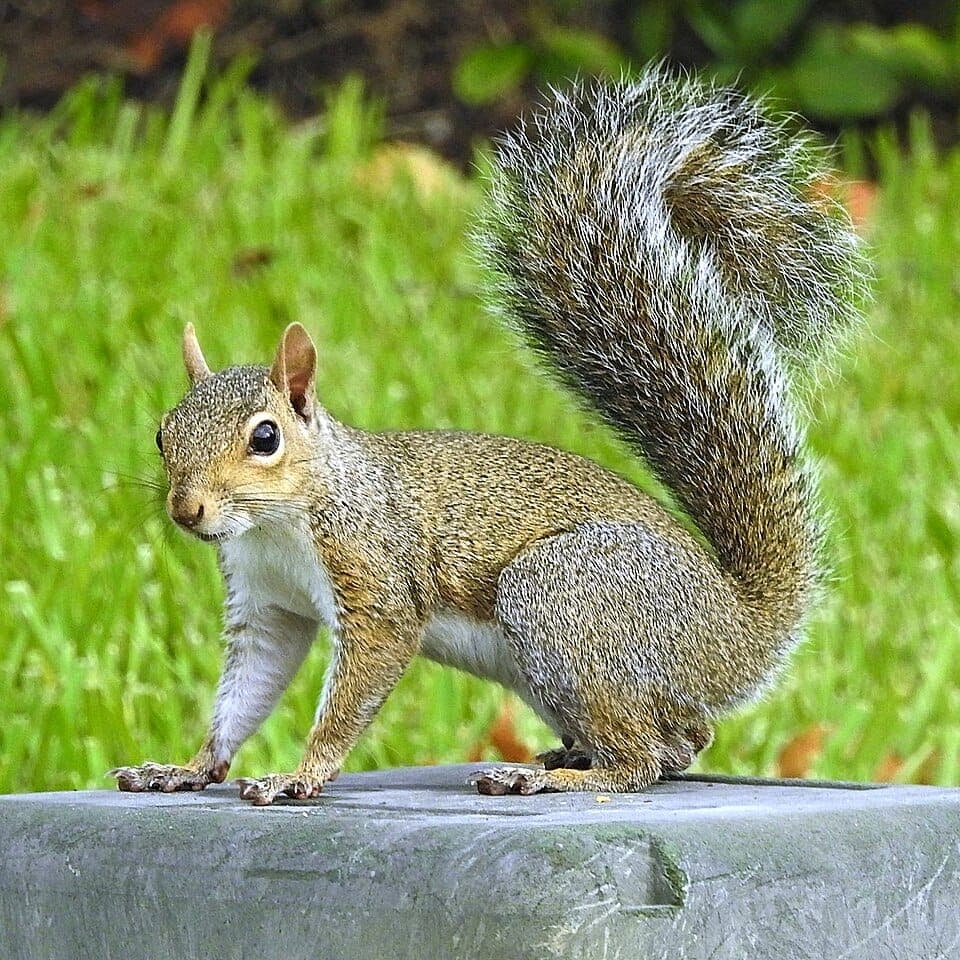
Three tree squirrels show up in most North American yards, and you can usually tell which is which by size, belly color, and the tail. The eastern gray squirrel is medium-sized, gray above with a clean white belly and a bushy tail frosted silvery-white at the edges. The fox squirrel is noticeably bigger and heavier, gray-brown above with a rusty-orange belly and an orange-tinged tail. The red squirrel is small, loud, and rusty-red above with a white belly, often with ear tufts in winter. Run through size, then belly color, then tail color, and the three sort out quickly. Here is how to identify each one and tell them apart for certain.
How to Identify Gray, Fox, and Red Squirrels
These are all tree squirrels — long-bodied, bushy-tailed, active by day, and at home in the branches — so they share a general shape. The differences are in scale, color, and attitude. Three quick checks do most of the work: how big it is, what color its belly is, and what color the tail is.
Eastern gray squirrel
The default squirrel across much of the East and Midwest, and widely introduced elsewhere. It runs about 9 to 12 inches in the body with a tail nearly as long again, and weighs roughly a pound to a pound and a half. The coat is gray — sometimes washed with brown — and the belly is clean white to pale gray. The tail is full and bushy with long hairs tipped in white or silver, giving it a frosted, halo-like outline when backlit. Many gray squirrels in some regions are solid black (a melanistic color form) or, rarely, white, but the size and shape stay the same.
Fox squirrel
The biggest tree squirrel in North America — up to roughly double the weight of a gray, sometimes reaching two and a half pounds and close to two feet long including the tail. Its back is grizzled gray-brown, but the giveaway is the warm color underneath: a rusty, orange, or buff-yellow belly, and a long bushy tail edged and tipped with orange or rust rather than white. Fox squirrels tend to spend more time on the ground and in open, parklike woods and suburbs than grays do.
Red squirrel
The smallest and feistiest of the three, barely half the size of a gray at about 7 to 8 inches in the body. It is rusty-red to reddish-brown above and whitish below, usually with a clear line separating the two, and in winter it grows prominent tufts of hair on its ears. Its tail is smaller and flatter than a gray’s, often rimmed with black-and-white. Red squirrels favor conifer and mixed forests, are intensely territorial, and are famous for the loud, scolding, chattering rattle they aim at intruders.
The three quick checks
- 1Size: tiny and reddish is a red squirrel; medium is a gray; clearly large and heavy is a fox squirrel.
- 2Belly color: white belly means gray squirrel; rusty-orange belly means fox squirrel; white belly with a bold red back means red squirrel.
- 3Tail color: white- or silver-frosted tail means gray; orange-edged tail means fox; small flat tail rimmed black-and-white means red.
Try Spotter Free on iOS & Android
Plants, animals, fungi, and rocks — all from a photo. 5 free identifications every day, no credit card required.
Quick Comparison
- Eastern gray — medium; gray coat, white belly, white-frosted bushy tail; towns, parks, and hardwood forests across the East and Midwest.
- Fox squirrel — large; grizzled gray-brown with a rusty-orange belly and orange-tinged tail; open woodlands, farmland edges, and suburbs.
- Red squirrel — small; rusty-red back, white belly, winter ear tufts, loud chatter; conifer and mixed northern forests.
- Overlap zones — grays and fox squirrels often share the same neighborhoods, so lean on size and belly color; reds usually stand out by being much smaller and noisier.
Other Squirrels You Might See
A few other animals get called "squirrels" or get mixed in with the three tree squirrels:
- Flying squirrels — small, soft, big-eyed, and nocturnal, with a loose fold of skin between the legs for gliding. If you only ever see it at night or at a feeder after dark, it may be a flying squirrel rather than a small red one.
- Chipmunks — ground squirrels with bold dark-and-light stripes running down the back and face, much smaller than a gray squirrel, and usually seen scurrying on the ground, not up in the canopy.
- Ground squirrels and prairie dogs — burrow-dwelling relatives of open country; they sit upright at burrow entrances and lack the big fluffy arboreal tail of a tree squirrel.
- Black and white squirrels — these are almost always color variants of the eastern gray squirrel, not separate species; the size, shape, and behavior match a gray exactly.
Telling Them Apart by Behavior
Habits help when a squirrel will not hold still for a good look. Gray squirrels are "scatter-hoarders" that bury thousands of individual nuts across their range each fall and relocate them later by smell and memory — the frantic autumn burying people notice is mostly grays and fox squirrels stocking up for winter. Fox squirrels do much the same but spend more of their time foraging out in the open and on the ground, often in parklike settings with scattered big trees. Red squirrels take a different approach: instead of scattering, they pile cones and food in a central cache called a midden — look for a mound of stripped cone scales at the base of a conifer — and they defend that larder loudly and aggressively all winter. None of the three truly hibernate; all stay active and visible through the cold months, which is part of why they are such familiar year-round yard animals.
Frequently Asked Questions
What is the difference between a gray and a fox squirrel?
Size and belly color. Fox squirrels are noticeably larger — up to about double the weight of a gray — with a rusty-orange belly and an orange-edged tail. Gray squirrels are medium-sized with a clean white belly and a white- or silver-frosted tail.
Are black squirrels a separate species?
No. Black squirrels are a melanistic (dark-pigmented) color form of the eastern gray squirrel, common in some cities and regions. Apart from color they are identical in size, shape, and behavior to ordinary gray squirrels.
Are red squirrels and chipmunks the same thing?
No. Red squirrels are tree squirrels — larger, reddish all over the back, and often up in conifers — while chipmunks are small ground squirrels with bold stripes down the back and face. If it has stripes and lives on the ground, it is a chipmunk.
Why is a squirrel chattering and scolding at me?
That loud, rattling scold is usually a red squirrel, which is fiercely territorial and announces any intruder — including you, a cat, or a hawk — with a burst of chatter and tail-flicking. Gray and fox squirrels are generally quieter and more tolerant of company.
Watching a squirrel raid the feeder and not sure whether it is a gray, a fox, or a red? Snap a photo and let Spotter help you identify it as a starting point, then confirm it with size, belly color, and the tail.
Try Spotter Free on iOS & Android
Plants, animals, fungi, and rocks — all from a photo. 5 free identifications every day, no credit card required.