Late summer into early fall is when climbing vines start to catch the eye, and every year the same anxious question comes up on the trail and in the backyard: is that poison ivy? A huge share of the time the answer is no — the plant scrambling up the tree trunk or fence, and turning a gorgeous early red, is Virginia creeper. It is a native, harmless vine that happens to grow in the same places as poison ivy and turns color at the same time. The trouble is that people react to the fear, not the plant, and end up avoiding a beautiful native while still not knowing what the real hazard looks like. One quick habit fixes that.
Count the Leaflets First
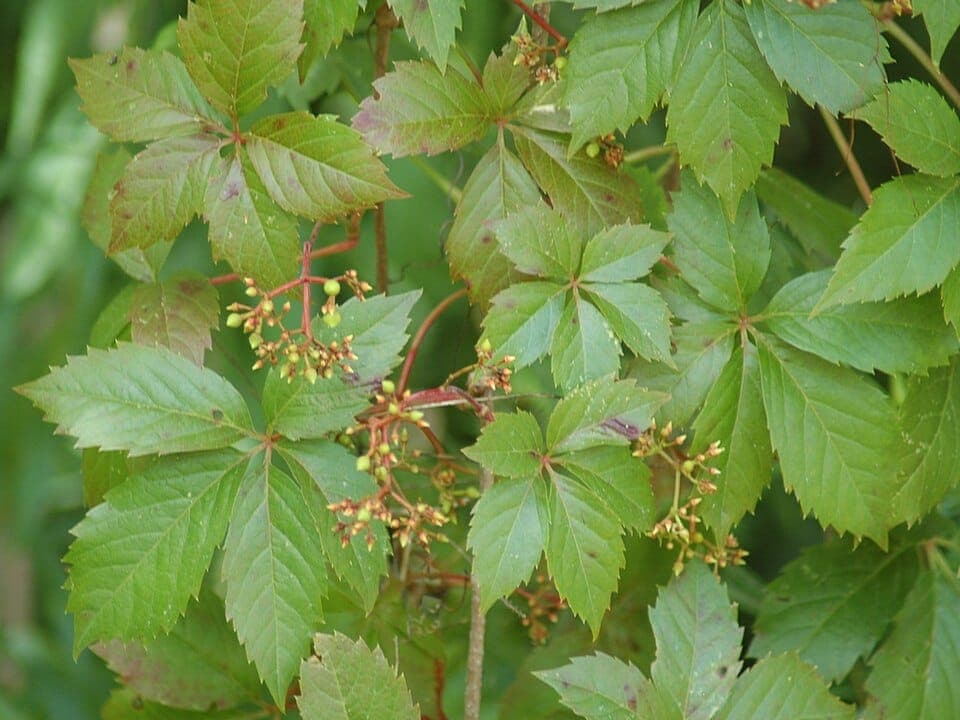
The fastest, most reliable check is to count the leaflets that make up each leaf. Virginia creeper almost always has five leaflets radiating from a single point, like the fingers of a hand. Poison ivy has three. The old rhyme still holds: "leaves of three, let it be." If you count a tidy set of five, you are looking at Virginia creeper, not poison ivy. Occasionally young Virginia creeper shows three leaflets, so use the rest of the clues below to confirm when you are unsure — but five leaflets is a strong all-clear.
- Leaflet count: Virginia creeper has five leaflets from one point; poison ivy has three.
- Leaf edges: Virginia creeper leaflets are evenly toothed all the way around; poison ivy leaflets have a few coarse notches or smooth edges and often a mitten-like lobe.
- Climbing method: Virginia creeper grips with branched tendrils tipped in tiny adhesive discs; poison ivy climbs with a fuzzy mat of reddish aerial rootlets, giving old vines a "hairy rope" look.
- Berries: Virginia creeper bears clusters of dark blue-black berries on bright pink-red stalks; poison ivy has clusters of dull, waxy white-to-cream berries.
- Fall color: both redden early, but Virginia creeper turns an especially vivid crimson that is one of the first big splashes of fall.
Try Spotter Free on iOS & Android
Plants, animals, fungi, and rocks — all from a photo. 5 free identifications every day, no credit card required.
A Safety Note on "Harmless"
Virginia creeper will not give you the itchy, blistering rash that poison ivy does, which is why it is such a relief to identify correctly. But "harmless" has limits worth stating plainly. The berries and foliage contain oxalate crystals and are toxic if eaten — never treat them as wild food, and keep children and pets from sampling them. Some people also get mild skin irritation from the sap when pruning it. And the key caution cuts the other way: if you cannot confidently rule out poison ivy, treat the plant as poison ivy until you can, because the cost of a wrong guess is a weeks-long rash.
Why It Is Worth Knowing
Virginia creeper is a valuable native plant — its berries feed songbirds through fall and winter, and its early scarlet color is one of the season’s best. Learning to separate it from poison ivy means you can leave the good vine in peace, remove the hazardous one with confidence, and stop treating every red-leaved climber as a threat. The five-versus-three leaflet check is the habit that makes all of that automatic.
Standing in front of a reddening vine and not sure which one it is? Snap a photo and let Spotter help you identify it — and when there is any doubt about poison ivy, keep your distance until you have a confident answer.
Try Spotter Free on iOS & Android
Plants, animals, fungi, and rocks — all from a photo. 5 free identifications every day, no credit card required.