It usually starts with the sound: a heavy thud on the roof, the deck, or the hood of the car, over and over, from mid-to-late summer into fall. Then you find them — round green balls about the size of a golf ball or small tennis ball, scattered across the lawn and driveway, some already softening and darkening into a black, gooey mess that stains the concrete. If a large shade tree is dropping firm green orbs on you right now, the overwhelmingly likely culprit is a black walnut. It is one of the most common "what is falling on my house?" questions of the season, and the tree is easy to recognize once you know what to look for.
How to Identify a Black Walnut Tree
Black walnut (Juglans nigra) is a large native hardwood of eastern and central North America, and several features line up to confirm it:
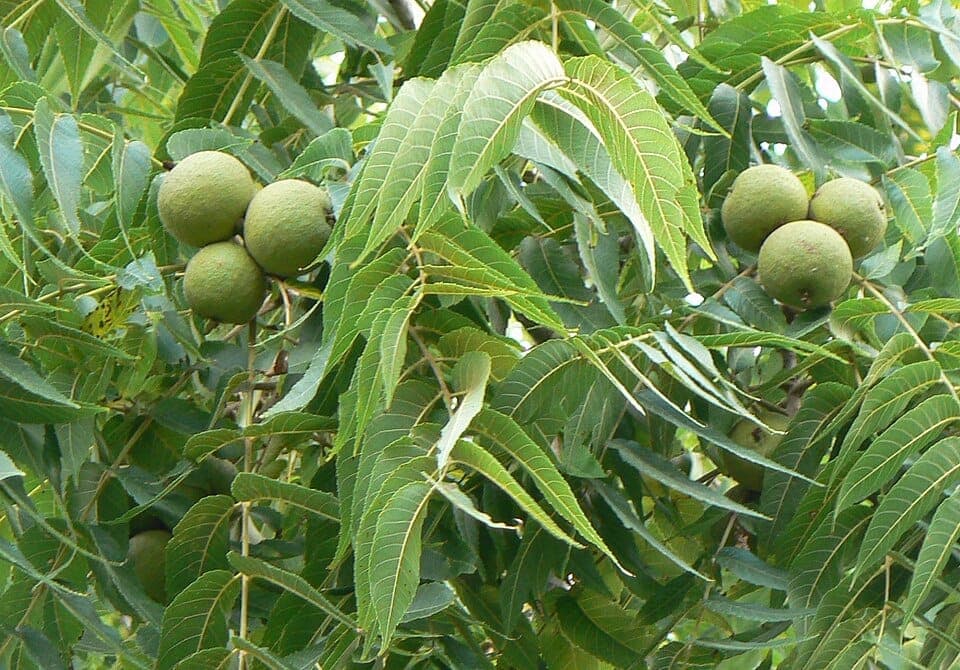
- The fruit: round, solid green balls roughly 1.5–2.5 inches across, with a thick, smooth-to-slightly-bumpy husk — not a spiky ball, not a dry cone, but a firm green sphere that browns and blackens as it rots
- The leaves: long and feather-like (pinnately compound), each with roughly 15–23 small pointed leaflets arranged along a central stalk, giving the foliage an airy, fern-like look
- A telltale smell: crush a leaf or scratch a green husk and you get a distinctive, sharp citrus-and-turpentine scent — one of the quickest confirmations
- The bark: dark gray-brown and deeply furrowed into a rough, diamond-shaped ridged pattern on mature trunks
- The habit: a tall, spreading tree often standing alone in yards, fence lines, and field edges, dropping its heavy fruit straight down beneath the canopy
If the falling balls are spiky rather than smooth, you are probably looking at something else — a sweetgum (spiky brown seed balls) or a horse chestnut or buckeye (spiny husk around a shiny nut). The smooth, heavy green sphere with that pungent citrus smell is the signature of black walnut.
Try Spotter Free on iOS & Android
Plants, animals, fungi, and rocks — all from a photo. 5 free identifications every day, no credit card required.
Why the Husks Stain Everything
The green husk is packed with a compound called juglone, along with tannins, and as the husks bruise and rot they release a dark brown-black juice that stains almost anything porous — concrete, asphalt, decking, and especially skin and clothing. Historically that same pigment was used as a natural dye and ink, which tells you how stubborn it is: once it soaks in, it does not wash out easily. The practical takeaway is to pick the fruit up while it is still firm and green rather than letting it soften and leak, and to wear gloves when you do, because bare hands can end up stained brown for a week or more.
Are Black Walnuts a Problem in the Yard?
Beyond the mess and the staining, black walnut is famous for juglone in another way: the tree releases it from roots, leaves, and husks into the surrounding soil, and a number of garden plants — tomatoes, peppers, and some ornamentals among them — are sensitive to it and may struggle when planted close to a mature walnut. This is a natural chemical competition called allelopathy, not a disease, and plenty of plants tolerate it fine, but it explains why a garden bed right under a walnut can underperform. The falling fruit is also a genuine slip-and-fall and lawn-mower hazard, so clearing it promptly is worth the effort.
A quick word on the nut inside and on pets: while the walnut kernel deep within the husk is the familiar edible nut, the moldy, rotting husks and hulls that sit on the ground can be genuinely risky for dogs — moldy walnut debris can harbor toxins that make pets sick — so it is wise to keep dogs from chewing on fallen husks and to check with a veterinarian if one does. As always, treat any wild-harvested food as a matter for in-person expertise, not a web article.
Black Walnut Look-Alikes
A few trees get confused with black walnut, and the details separate them:
- Butternut (white walnut): a close relative with similar compound leaves but egg-shaped, sticky, fuzzy husks rather than round smooth ones
- Hickories: also have compound leaves and drop nuts, but the husks split cleanly into segments and the nuts sit inside a harder, ribbed shell
- Tree-of-heaven and sumac: superficially similar feathery leaves, but no heavy round green fruit — sumac carries upright red seed clusters instead
Not sure whether the tree dropping green balls on your driveway is a black walnut, a hickory, or something else? Snap a photo of the leaves, bark, or fruit and let Spotter identify it as a starting point for getting to know the trees around your home.
Try Spotter Free on iOS & Android
Plants, animals, fungi, and rocks — all from a photo. 5 free identifications every day, no credit card required.