You find them everywhere: hard, round, spiky brown balls about the size of a golf ball, scattered across the lawn, collecting in the gutters and driveway, and downright painful to step on with bare feet. They roll under the mower, turn ankles, and seem to keep dropping for months. Rake them up and more appear. Those woody spiked balls — most people call them gumballs, gum balls, or "space bugs" — come from the American sweetgum tree, and once you learn to recognize the tree, the mystery is solved. Here is how to identify a sweetgum and understand its notorious fruit.
How to Identify a Sweetgum Tree
The American sweetgum (Liquidambar styraciflua) is a large, common shade and street tree across much of the eastern and southern United States. A few features together make it easy to confirm:
- The spiky balls: hard, woody, round seed capsules about 1 to 1.5 inches across, covered in stiff spikes or points, green while developing and ripening to brown; each ball is a cluster of fused capsules that open to release small seeds
- Leaves: glossy, star-shaped leaves with 5 (sometimes 7) pointed lobes, resembling a maple leaf but arranged singly (alternate) along the twig rather than in pairs, and giving off a sweet, resinous smell when crushed
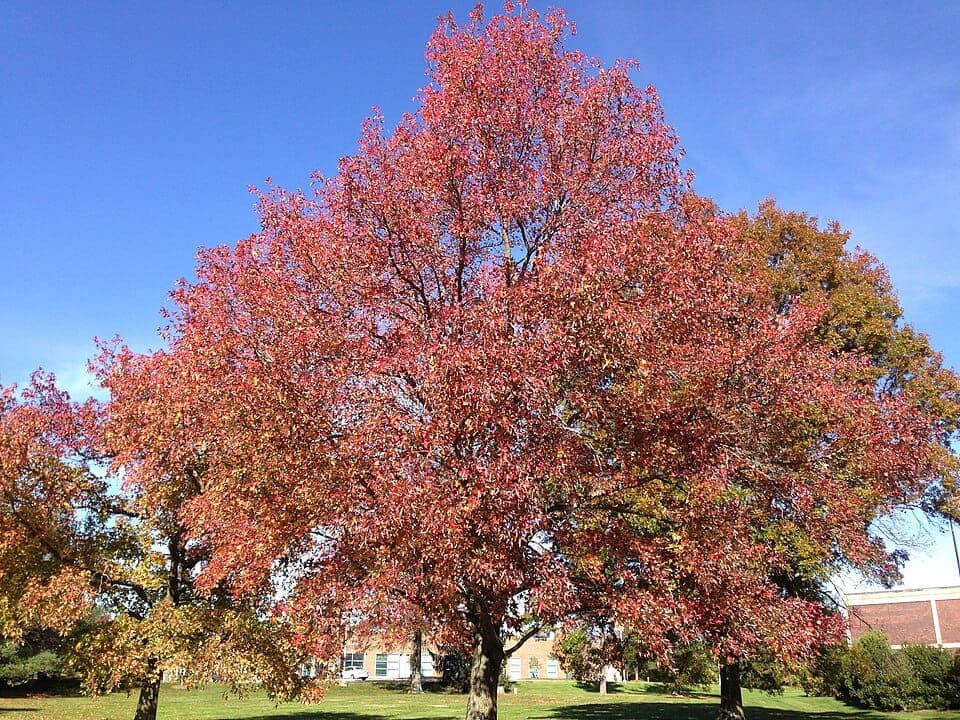
- Fall color: some of the most spectacular autumn color of any tree — the same tree can show yellow, orange, red, and deep purple leaves at once
- Bark: gray-brown and deeply furrowed into rough ridges on older trees
- Twigs: often develop distinctive corky "wings" or ridges along the branches
- Shape: typically a tall tree with a straight trunk and a neat, pyramid-to-oval crown
The single most reliable clue is the spiky ball itself: no other common North American tree drops a round, woody, spine-covered fruit like this. Pair that with the star-shaped, maple-like leaves arranged alternately along the twig, and you have a sweetgum. (Note that the leaf resemblance to maple is only skin-deep — maple leaves grow in opposite pairs and maples never produce spiky balls.)
Try Spotter Free on iOS & Android
Plants, animals, fungi, and rocks — all from a photo. 5 free identifications every day, no credit card required.
What Are the Spiky Balls, and When Do They Fall?
Each spiky ball is the tree’s fruit — a cluster of many small seed capsules fused into one hard, round head. Inside, the capsules hold the seeds; the numerous points and open "beaks" are the tips of those capsules. After the seeds are shed, the empty woody balls remain hard and durable, which is exactly why they persist so long. They begin forming in summer, ripen and brown in early fall, and then drop over an extended period from fall through winter and even into spring, so a single tree can litter the ground for months rather than all at once. The balls are tough enough to sit on the lawn for a year or more if you do not clear them.
This long, heavy drop is the main complaint about an otherwise handsome tree. The balls are a genuine tripping and slipping hazard on walks and driveways, uncomfortable underfoot, and a hassle to rake because they are so hard. Some people actually collect and use the dried balls in crafts, as mulch, or as prickly barriers in garden beds to deter animals.
Can You Stop a Sweetgum From Making Balls?
This is the question most homeowners ask, and the honest answer is that there is no easy switch. Established trees will keep fruiting; the practical options are limited and imperfect. There are growth-regulator products a professional arborist can apply that are timed to the spring bloom to reduce fruit set, but timing is tricky and results vary year to year. If you are choosing a new tree and dread the cleanup, seedless or "fruitless" sweetgum cultivars exist that produce few or no balls while keeping the great fall color. For an existing tree, most people simply live with it — raking or using a lawn sweeper or rolling "nut picker" — or, if the litter is truly unmanageable, consult an arborist about the tree’s options. Removing a large, healthy shade tree just for its fruit is a big step worth weighing carefully.
Sweetgum Look-Alikes
A few other trees drop spiky or spiny things and get confused with sweetgum, but the details separate them:
- Sycamore: also drops round brown seed balls, but they are soft and fuzzy (breaking apart into fluff), not hard and spiky, and sycamore has distinctive mottled, peeling white-and-tan bark
- Horse chestnut and buckeye: produce a spiny or bumpy green husk, but it splits to reveal a large, smooth, shiny brown nut inside — nothing like the hollow, seed-shedding woody ball of a sweetgum
- Chestnut (American or Chinese): drops a very spiny burr, but it is a soft-spined green husk enclosing edible nuts, not a hard woody sphere
- Sweet gum vs maple leaves: the star-shaped leaves look maple-like, but maples have paired (opposite) leaves and winged "helicopter" seeds, never spiky balls
Not sure whether the tree carpeting your yard with spiky balls is a sweetgum, a sycamore, or something else? Snap a photo of the leaves, bark, or one of the balls and let Spotter identify it as a starting point for getting to know the trees on your property.
Try Spotter Free on iOS & Android
Plants, animals, fungi, and rocks — all from a photo. 5 free identifications every day, no credit card required.