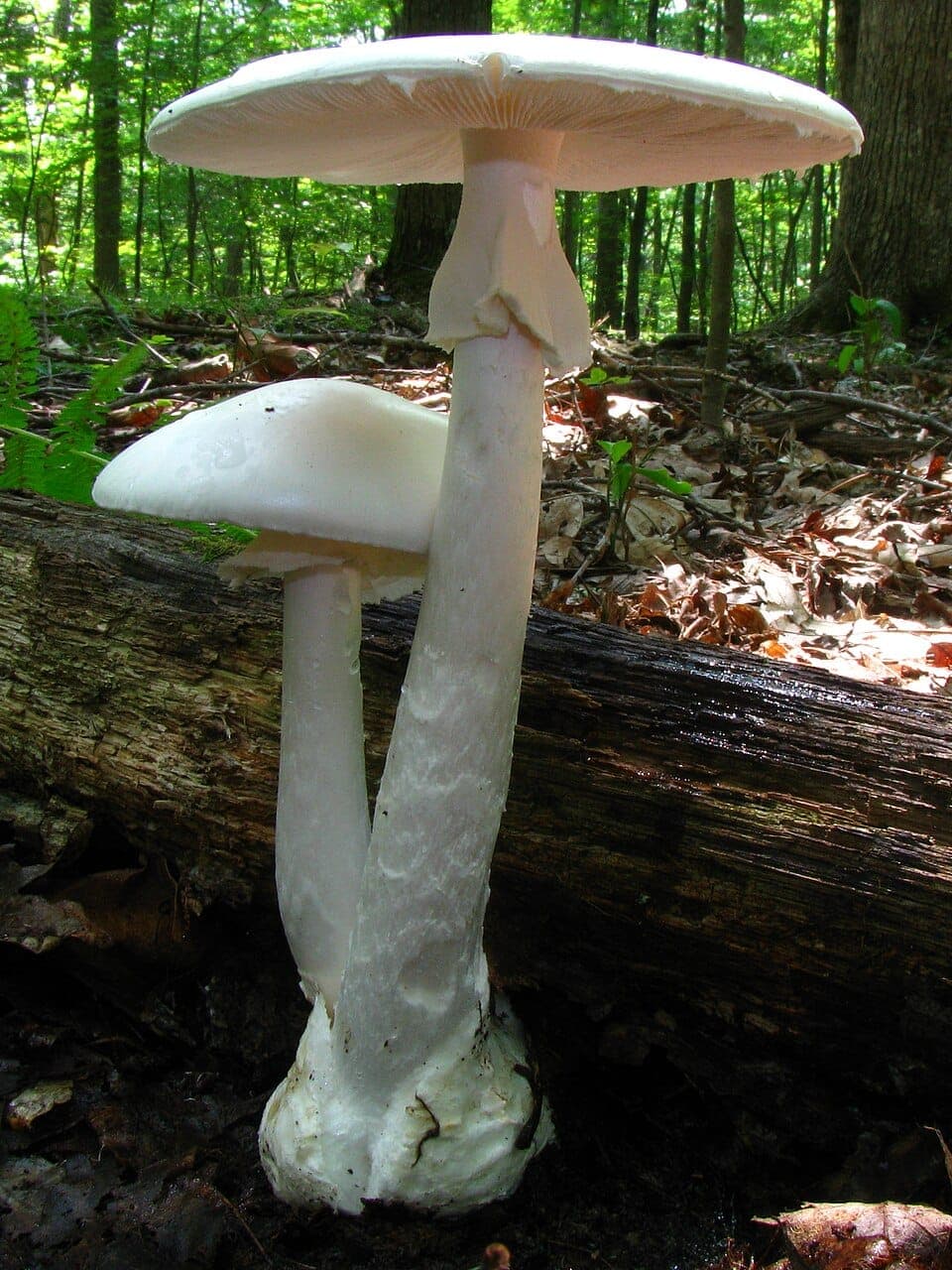
From July through October, after warm rains soak the ground, a striking pure-white mushroom appears in lawns, gardens, and the grassy edges of woods across much of North America. It stands tall and clean on a slender white stalk, with a smooth white cap and a delicate skirt-like ring — genuinely beautiful, and that beauty is the danger. This is very likely a destroying angel, a group of deadly Amanita species (such as Amanita bisporigera in eastern North America) that together cause a large share of the world’s fatal mushroom poisonings. There is no folk trick, no cooking method, and no "just a small taste" that makes it safe. The single most useful thing to know about it is how to recognize it and leave it completely alone.
How to Identify a Destroying Angel
Destroying angels are almost entirely white, top to bottom, and share a set of features that Amanita mushrooms are known for. Look for this combination:
- A smooth, dry cap that is pure white (occasionally with a faint cream or tan center), usually 2 to 5 inches across, starting egg-shaped and opening to convex or flat
- White gills underneath that are crowded together and typically do not attach to the stem
- A tall, white stem, often slightly fuzzy or shaggy, with a thin, skirt-like ring (annulus) hanging near the top
- A swollen, bulb-like base wrapped in a fragile, sac-like cup called a volva — the single most important field mark, often hidden just below the soil surface
- A white spore print, matching the white gills
That cup-like volva at the base is the classic Amanita signature, and it is why experienced foragers dig up the entire base of a white mushroom rather than snapping it off — cut it off and you may destroy the very feature that identifies a killer. The overall picture of an all-white mushroom with a ring on the stem and a sac at the swollen base should be treated as a serious red flag.
Try Spotter Free on iOS & Android
Plants, animals, fungi, and rocks — all from a photo. 5 free identifications every day, no credit card required.
Why It Is So Dangerous
Destroying angels contain amatoxins, compounds that attack the liver and kidneys. According to poison-control and mycology sources, a single cap can contain enough toxin to kill an adult, and the amatoxins are not destroyed by cooking, boiling, freezing, or drying — there is no preparation that renders the mushroom safe. Making it worse, the poisoning is deceptive: symptoms often do not begin for 6 to 24 hours after eating, and there is frequently a false "recovery" period where the person feels better even as the toxin is silently damaging the liver. By the time serious symptoms return, major organ damage may already be underway. This is why any suspected Amanita ingestion is a medical emergency, not a wait-and-see situation.
This article is for identification and safety only — it is not foraging guidance. Because deadly white Amanitas can resemble a few edible white mushrooms to an untrained eye, no beginner should ever eat a wild white mushroom based on an app, an article, or a photo. If you think anyone — a child, an adult, or a pet — may have eaten a wild mushroom, contact Poison Control or emergency services immediately and, if you safely can, keep a sample of the mushroom to help identification.
What to Do If It Is Growing in Your Yard
If destroying angels are coming up in a lawn where children or pets play, the safest response is simply to remove and bag them so no one is tempted to touch or taste them. Wear gloves as a matter of good habit (the toxin is a danger from eating, not from a quick touch, but there is no reason to handle them casually), and do not add them to compost that curious hands or animals could reach. Removing the visible mushrooms will not harm the tree or soil — the fungus lives largely underground in partnership with tree roots — but it does keep the poisonous fruit out of reach. New ones may appear after the next rain, so it is worth a quick check during the summer and fall flush.
Not sure whether that clean white mushroom in the yard is something harmless or a destroying angel you want gone before the kids find it? Snap a photo and let Spotter help you get a first read on what it is — then, when it comes to anything you might eat, always confirm with a local expert, because with wild mushrooms the cost of being wrong is simply too high.
Try Spotter Free on iOS & Android
Plants, animals, fungi, and rocks — all from a photo. 5 free identifications every day, no credit card required.