
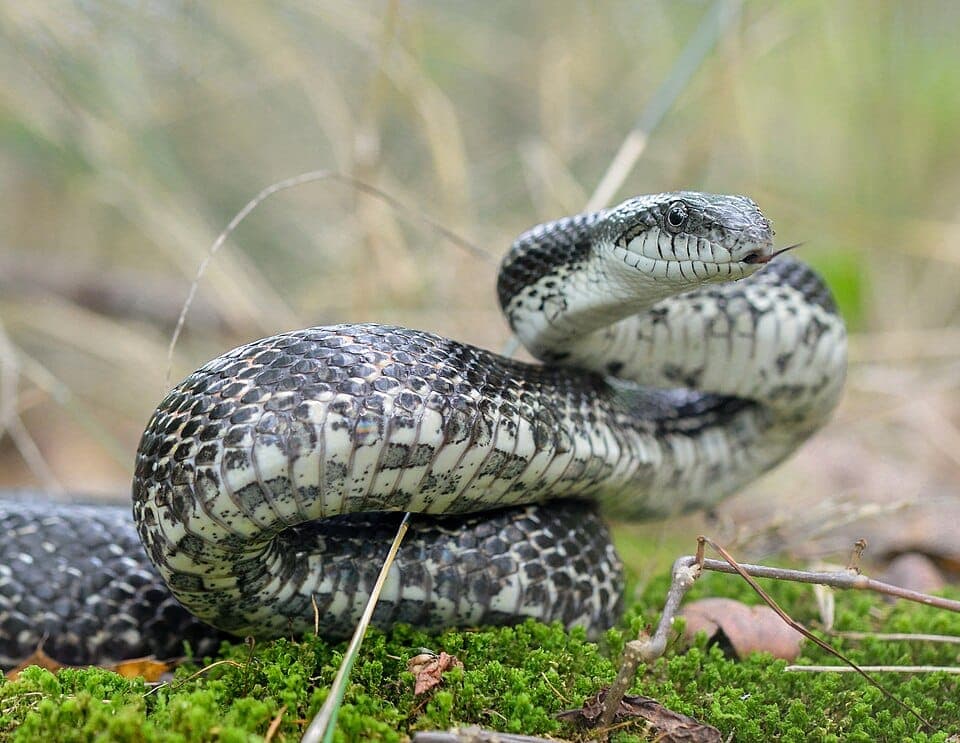
You come around the corner of the garage and there it is: a long, glossy black snake draped across the walk, climbing a shed wall, or pouring itself into a gap in the woodpile. For a lot of people that is a heart-in-the-throat moment, and late summer is exactly when it happens most — the weather is warm, snakes are active, and this year’s eggs are hatching, so both big adults and slim young snakes are on the move. The reassuring news is that across most of the eastern and central U.S., the big black snake in a yard is almost always a harmless rat snake or black racer. Here is how to identify one and tell it from the snakes that actually warrant caution.
How to Identify a Black Rat Snake or Racer
The two most common large black snakes in yards are the eastern rat snake and the black racer. They overlap in range and both read as simply "big and black" from a distance, but they share a set of traits that separate them from venomous species:
- Large size: both are long, slender-to-moderately-built snakes, commonly 3 to 6 feet and occasionally longer — often the biggest snakes people see in a yard
- Overall black or very dark body: adults are mostly black above, sometimes with faint remnants of a pattern, and a pale chin and throat
- A narrow head only a little wider than the neck, and round pupils — not the broad, triangular, distinctly wider head of a pit viper
- A long, tapering tail rather than a short, blunt one, and no rattle
- Active by day and often seen near buildings, sheds, fences, gardens, and woodpiles where rodents and birds are around
To tell the two apart, look at the surface and the attitude. A rat snake tends to look heavier-bodied and slightly rough or matte, because its back scales are keeled (each with a tiny ridge), and it is a famous climber — turning up on shed walls, around bird feeders, and even in rafters as it hunts. A black racer usually looks sleeker, glossier, and more athletic, with smooth scales and large eyes, and it lives up to its name by racing away fast when disturbed. A young rat snake looks nothing like the black adult: hatchlings are boldly blotched gray and brown, which sometimes gets them mistaken for a venomous snake before they darken with age.
Try Spotter Free on iOS & Android
Plants, animals, fungi, and rocks — all from a photo. 5 free identifications every day, no credit card required.
Are Black Snakes Dangerous?
Rat snakes and racers are non-venomous and pose no serious threat to people or pets. Neither wants anything to do with you; their goal is to get away. If cornered or grabbed, a rat snake may rear up, vibrate its tail against dry leaves (a bluff that can sound alarmingly like a rattlesnake), release a musky smell, or deliver a harmless bite that amounts to little more than a scratch. Racers are nervous and quick to flee, and can also bite defensively if pinned. In both cases the sensible response is the same: give the snake room and let it move on. Do not try to catch, kill, or handle it — most snakebites happen precisely when someone corners a snake they could have simply walked away from.
A black snake around the property is genuinely good news for pest control. Rat snakes are among the most effective natural predators of mice and rats, and they also eat other rodents, and racers add insects, frogs, and other small prey to the menu. A resident black snake usually means the yard has a food supply worth patrolling, and it is quietly keeping rodent numbers down for free.
Telling a Harmless Black Snake From a Venomous One
The whole reason to identify a black snake correctly is to rule out the small number of venomous species people worry about. In most of the U.S. that means pit vipers — copperheads, cottonmouths, and rattlesnakes — and they look and behave differently from a rat snake or racer:
- Body shape: venomous pit vipers tend to be thick and heavy-bodied for their length, with a broad, distinctly triangular head much wider than the neck; rat snakes and racers are comparatively slender with a narrow head
- Pattern: adult rat snakes and racers are essentially plain black, while copperheads wear hourglass crossbands and rattlesnakes wear blotches or bands — a uniformly black snake is not one of these
- Tail: rattlesnakes carry a rattle; a smooth, tapering tail with no rattle points away from that group (though a nervous rat snake may still buzz its tail against leaves as a bluff)
- Cottonmouth confusion: near water in the Southeast, a dark cottonmouth can be mistaken for a black snake, but it is thick-bodied, holds its ground with a gaping white mouth, and swims with its body riding high on the surface — very different from a fleeing racer
No identification should ever involve getting close. Color and pattern can be confusing, young snakes look different from adults, and regional look-alikes exist, so the rule is to observe from a safe distance and never handle a snake you cannot confidently name. If a snake is somewhere it truly should not be — inside a home, for instance — call a local wildlife professional rather than dealing with it yourself.
Not sure whether the big black snake sunning on your patio is a harmless rat snake or something you would rather keep well clear of? Photograph it from a safe distance and let Spotter identify the snake, so you can settle the question without stepping any closer.
Try Spotter Free on iOS & Android
Plants, animals, fungi, and rocks — all from a photo. 5 free identifications every day, no credit card required.