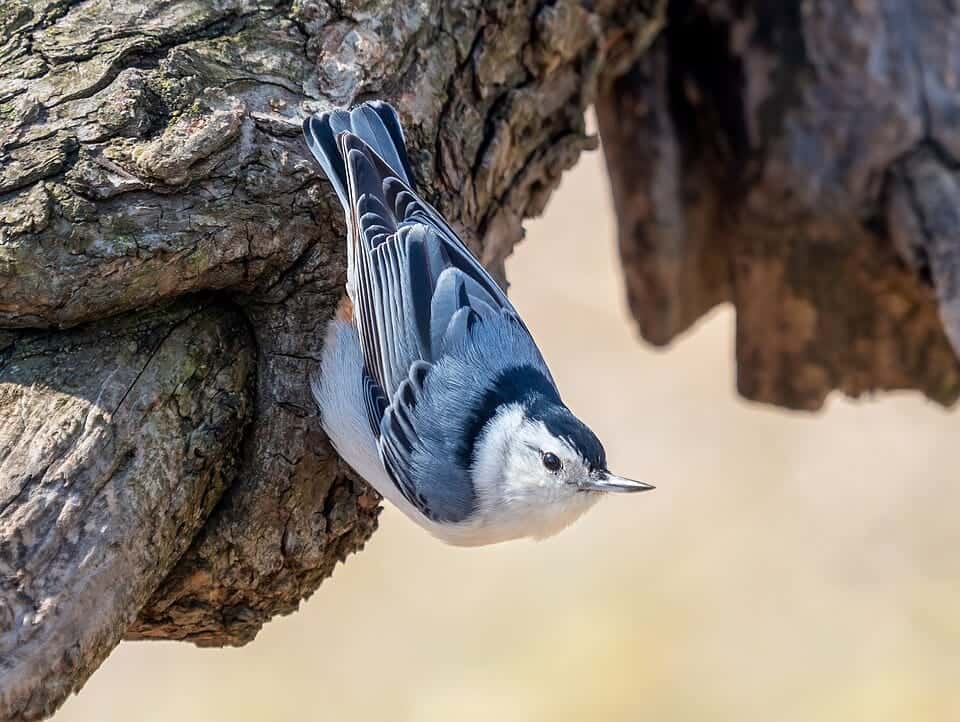
There is one backyard bird that gives itself away by breaking the rules of gravity. While woodpeckers and creepers hitch their way up a tree trunk, a nuthatch does the opposite: it walks head-first straight down the bark, stopping to jab into crevices along the way, as comfortable upside down as right-side up. At the feeder it is just as distinctive — a compact, big-headed, almost neckless little bird that zips in, grabs a single seed, and rockets back to a tree to wedge and hammer it open. If you have watched a small gray-and-white bird going the wrong way down your maple or oak, you have met a nuthatch. Here is how to identify the two you are most likely to see and understand their odd, upside-down way of life.
How to Identify a Nuthatch
Nuthatches share a compact, front-heavy shape and a set of habits that set them apart from every other feeder bird:
- The head-first descent: the giveaway — a nuthatch climbs down trunks and along the undersides of branches head-down, something woodpeckers and creepers do not do
- The shape: small and chunky with a large head, a sturdy pointed bill, and such a short tail and neck that it looks like it was pinched at both ends
- The color: blue-gray back and wings with clean, pale underparts and a dark cap running back from the bill
- The behavior: quick and restless, usually taking one seed at a time and flying off to jam it into bark before hammering ("hatching") it open
- The voice: nasal, tin-horn calls — a low, repeated "yank-yank" from the white-breasted and a higher, toy-trumpet "ank-ank" from the red-breasted
White-Breasted vs. Red-Breasted Nuthatch
Two nuthatches turn up at feeders across much of the country, and they are easy to separate once you know the face:
- White-breasted nuthatch: the larger and more widespread of the two — clean white face and breast, blue-gray back, and a black (male) or gray (female) cap, with no line through the eye; the classic year-round trunk-walker of yards and woods
- Red-breasted nuthatch: smaller and more compact, with a rusty-orange wash across the underparts and, most tellingly, a bold black stripe through the eye under a white eyebrow — like a little bandit mask; more tied to conifers and often the one that appears in new places in fall
A small, big-headed, short-tailed gray-and-white bird creeping head-first down a trunk is a nuthatch. Clean white face, no eye line: white-breasted. Rusty belly and a black eye-stripe: red-breasted.
Try Spotter free on iPhone or Android
Plants, animals, fungi and rocks from one photo. 5 free identifications every day, no card required.


Why They Climb Upside Down — and Cache Seeds
The head-first descent is not a stunt; it is a feeding strategy. By working down a trunk facing the ground, a nuthatch sees into bark crevices from an angle that a woodpecker climbing upward misses — catching spiders, insects, and eggs tucked into cracks that upward-facing birds pass over. The name "nuthatch" comes from the second half of their routine: they take a seed or nut, wedge it into a bark crevice, and hack it open with that chisel-like bill — an old sense of "hatch" meaning to hack. In fall they do this constantly, and they also cache food, jamming seeds into bark and under lichen to retrieve during winter. It is why a nuthatch grabs one seed and leaves: it is stockpiling, not just snacking.
Why You May See More Red-Breasted Nuthatches This Fall
The white-breasted nuthatch is a reliable year-round resident, but the red-breasted is famous for "irruptions" — fall and winter years when unusually large numbers push far south of their normal range. These movements are driven mainly by the cone crop up north: when spruce, fir, and pine seeds fail across the boreal forest, red-breasted nuthatches wander south in search of food, turning up at feeders in places that may go years between sightings. So if a little bandit-masked, rusty-bellied nuthatch shows up at your feeder this autumn where you have never seen one, you may be watching an irruption year unfold. Offer sunflower seeds, peanuts, and suet near some trees, and you give both nuthatches a reason to stay. Not sure whether that upside-down acrobat is a white-breasted or red-breasted nuthatch? Snap a photo and let Spotter help you tell them apart.
Try Spotter free on iPhone or Android
Plants, animals, fungi and rocks from one photo. 5 free identifications every day, no card required.