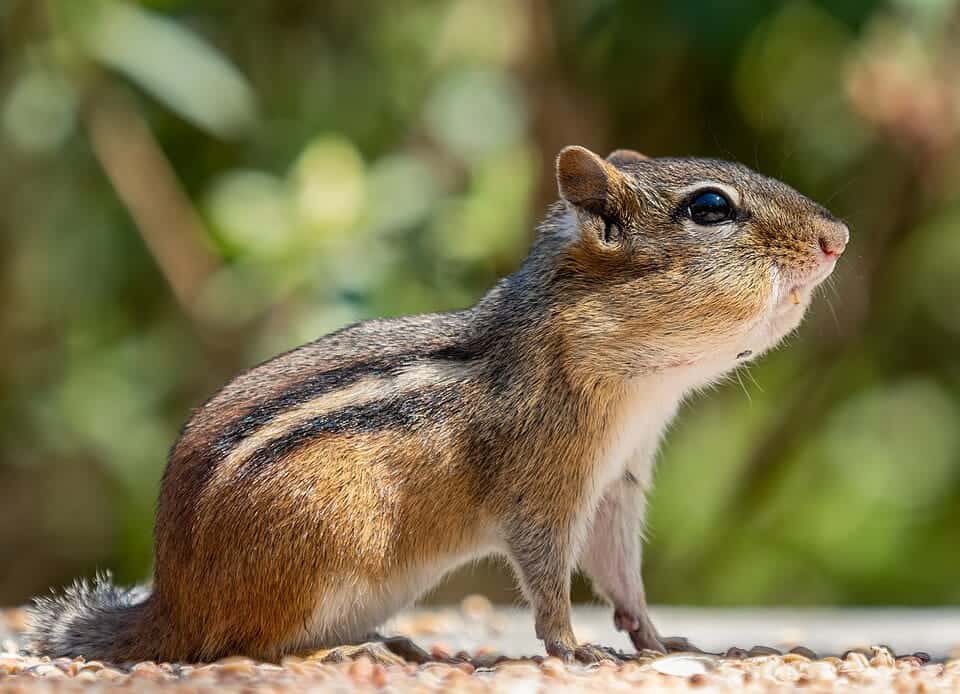
It streaks low across the patio or along a stone wall, stops dead with its tail straight up, and stares at you for a heartbeat before vanishing into a hole — a small, fast, chunky little animal with bold stripes and a face so stuffed with seeds its cheeks look ready to burst. That is a chipmunk, and in autumn it becomes one of the busiest animals in the yard, making trip after trip to jam nuts, seeds, and berries into cheek pouches that can stretch to three times the size of its head. If you have been wondering what the little striped ground-dweller is, and how it differs from the squirrels running the trees above it, here is how to know a chipmunk.
How to Identify a Chipmunk
Chipmunks are small and low to the ground, and a few marks make them unmistakable once you know what to look for:
- The stripes: bold dark stripes alternating with pale ones running down the back — and, crucially, stripes across the face through the eye, which no squirrel has
- The size: small and compact, roughly the length of your hand plus a modest tail — far smaller than a gray or fox squirrel
- The cheeks: prominent internal cheek pouches that visibly bulge when full, the single most telltale chipmunk behavior
- The tail: shorter and less fluffy than a tree squirrel’s, often held straight up as it runs
- The habits: ground-based — scurrying along walls, logs, and rock piles, and diving into burrow entrances in the ground rather than nesting up in trees
- The voice: a sharp, repetitive "chip" or "chuck" and a high trill, often given from a hidden perch
A small, stripe-faced animal running along the ground with its cheeks packed full of seeds is a chipmunk — in most of the eastern U.S. and Canada, the eastern chipmunk.
Try Spotter free on iPhone or Android
Plants, animals, fungi and rocks from one photo. 5 free identifications every day, no card required.


Chipmunk vs. Ground Squirrel vs. Tree Squirrel
Three look-alikes get confused, but each has a giveaway:
- Chipmunk: has stripes on both the body and the face, running through the eye — face stripes are the clincher
- Ground squirrel: some (like the golden-mantled ground squirrel of the West) have body stripes that look chipmunk-like, but their faces are plain with no stripes; they are also stockier and lack the dramatic cheek-pouch look
- Tree squirrel (gray, fox, red): much larger, with a big bushy tail and no stripes at all on the face or back, and they spend most of their time up in the trees rather than on the ground
Quick rule: face stripes plus stuffed cheeks close to the ground means chipmunk. Body stripes but a plain face means a ground squirrel. No stripes and a big fluffy tail means a tree squirrel.
Why Chipmunks Hoard So Hard in Fall
Unlike tree squirrels, which scatter thousands of nuts across the landscape, a chipmunk is a larder-hoarder: it hauls food back to a single well-stocked underground pantry in its burrow. In autumn this drive goes into overdrive. A chipmunk can gather well over a hundred acorns or seeds in a single day, using those stretchy cheek pouches as shopping bags to carry many at once. Rather than fattening up like a true hibernator, the chipmunk stockpiles food it will wake and eat through the cold months — it spends winter in a series of long naps deep in the burrow, rousing periodically to snack from the hoard. That is why the fall trips are so relentless: it is not eating everything now, it is provisioning the room it will sleep beside all winter. In much of the North, chipmunks disappear underground by late fall, so the busy autumn hauling is your best window to watch them.
Not sure whether the little striped animal by your steps is a chipmunk, a ground squirrel, or a young tree squirrel? Snap a photo and let Spotter help you tell them apart — chipmunks are one of the most charming yard animals to get to know before they vanish underground for winter.
Try Spotter free on iPhone or Android
Plants, animals, fungi and rocks from one photo. 5 free identifications every day, no card required.