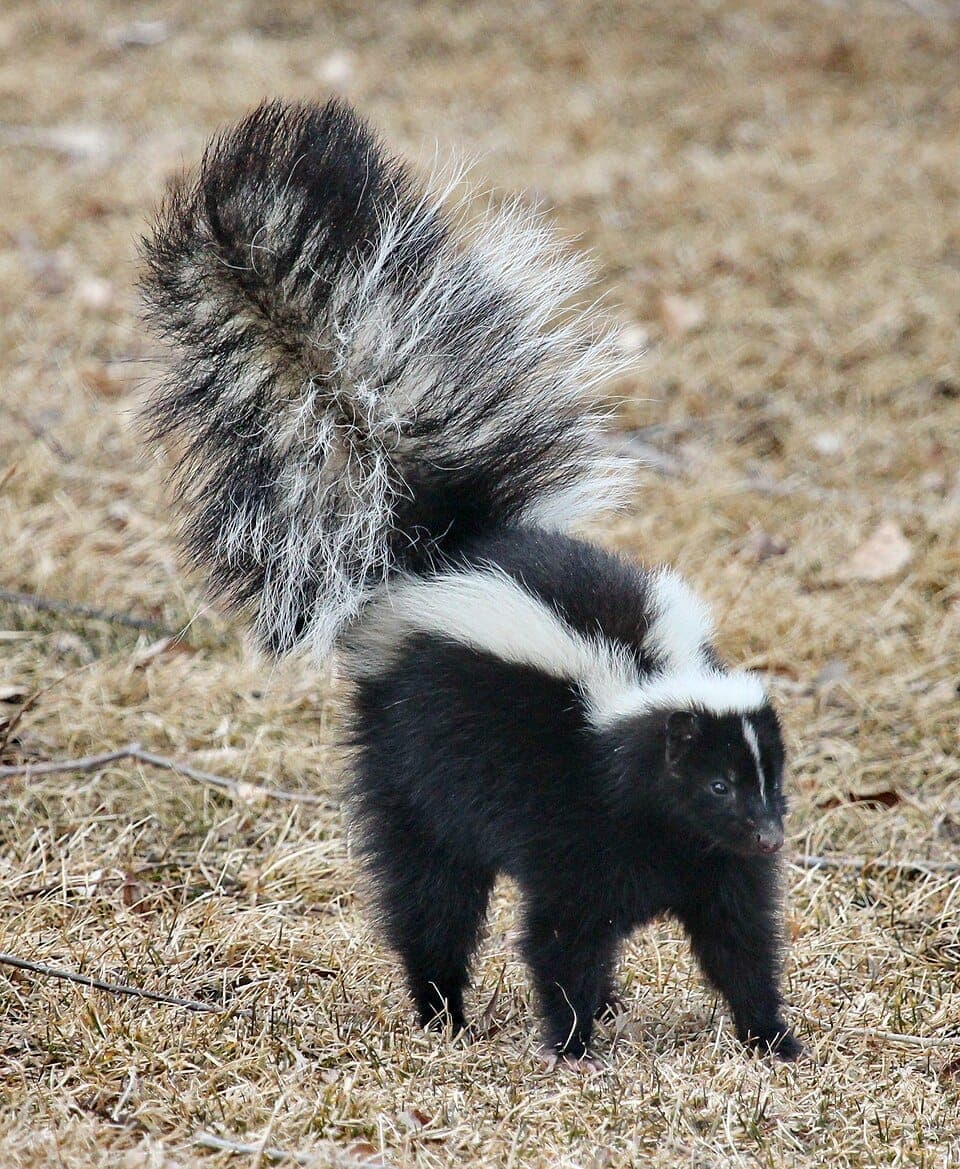
A skunk is the stout, short-legged, bushy-tailed mammal with bold black-and-white fur and a defensive spray you can often smell long before you see the animal. North America has two kinds most people meet: the common striped skunk, roughly the size of a house cat, with a white stripe or V running down a glossy black back, and the smaller spotted skunk, covered in a broken scramble of white stripes and spots and sometimes no bigger than a tree squirrel. Both carry the famous musk, both are active mostly at night, and both are far more interested in grubs, insects, and garbage than in you. Here is how to identify a skunk for certain, tell the striped kind from the spotted kind, separate skunks from the animals they are confused with, and keep yourself and your pets out of spray range.
How to Identify a Skunk
Almost nothing else in the yard looks like a skunk. Start with the overall impression: a low, heavy-bodied animal in black and white, with a small triangular head, short legs, and a large plume of a tail held up as it waddles along. That high-contrast coat is a warning to predators, not camouflage, so skunks move slowly and confidently and rarely bother to hide. The two North American species share that template; the white pattern and the size tell them apart.
Size and shape
A striped skunk is about the size of a domestic cat — roughly 13 to 18 inches in the body with a bushy tail nearly as long again, and a weight of about 6 to 10 pounds. A spotted skunk is far smaller and more weasel-like, often only a pound or two and no longer than a squirrel. Both have a pointed snout, a rounded body, short sturdy legs, and long front claws built for digging grubs out of the soil. The tail is full and feathery on both, and it is the first thing that goes up when a skunk feels threatened.
Color and pattern: the species tell
Every skunk is basically black with white markings, but the arrangement of the white is what names the species. The amount of white varies a lot between individuals — some striped skunks are almost all black, others carry broad white saddles — so look at the shape and layout of the markings rather than how much white there is.
The striped skunk
The striped skunk is the widespread, cat-sized one found across nearly all of the lower 48 and much of Canada. Look for a single white patch on the head that splits into two broad white stripes running down the back toward a white-plumed tail, and a thin white line down the center of the snout between the eyes. The classic image — a solid black animal with a bold white back stripe and a raised fluffy tail — is almost always this species. If you see a skunk the size of a cat in a suburb, a farm, or along a roadside, it is a striped skunk.
The spotted skunk
The spotted skunk is smaller, quicker, and much more weasel-like in build, with an intricate pattern of broken white stripes and spots rather than two clean lines — a white spot on the forehead, a spot in front of each ear, and swirling broken stripes along the body ending in a white-tipped tail. Spotted skunks are agile climbers that favor brushy, wooded, and rocky country and are far less tolerant of people than striped skunks. They are also famous for a dramatic warning display: before spraying, a spotted skunk may rear up into a full handstand on its front legs, tail aimed at the threat.
Signs, smell, and when you will see one
Skunks are mostly nocturnal, so you will often detect the signs before the animal. The lingering musky odor on a still night is the obvious one, but skunks also leave small, shallow, cone-shaped holes dug in lawns and mulch where they have rooted out beetle grubs and earthworms — a very common autumn and spring complaint. Their five-toed tracks show long claw marks ahead of the toes, and they frequently den under decks, sheds, porches, and woodpiles. If something is turning over patches of your lawn overnight, a striped skunk is a leading suspect.
Striped vs. Spotted Skunk at a Glance
- Striped skunk — cat-sized (6 to 10 pounds); a head patch splitting into two broad white back stripes and a thin white nose line; widespread in yards, farms, and roadsides across North America.
- Spotted skunk — much smaller (often 1 to 2 pounds) and weasel-like; a broken scramble of white spots and stripes with a forehead spot; prefers brushy, wooded, and rocky areas and is a capable climber.
- Behavior tell — a spotted skunk may do a front-leg handstand before spraying, while a striped skunk stamps its front feet, raises its tail, and arches its back as its warning.
- Amount of white — not reliable on its own; both species range from mostly black to heavily white, so read the pattern and the size instead.
Animals Mistaken for Skunks
A handful of other animals get called skunks in low light, and a few genuinely share the black-and-white theme:
- American badger — low, wide, and grizzled gray with a single white stripe running from the nose over the top of the head, but far broader and flatter than a skunk, with a short tail and huge digging claws.
- Black-and-white domestic cats — at night a tuxedo or bicolor cat is a common false alarm, but a cat has upright triangular ears, a long thin tail, and a lean build, and moves nothing like a waddling skunk.
- Virginia opossum — similar in size to a striped skunk but pale gray with a naked pink tail, a white face, and a hunched shuffle; no bold black body or white back stripes.
- Mink and weasels — long, low, and dark like a spotted skunk, but these are solid brown to near-black without the broken white spotting, and they live close to water.
Skunks and Safety
Skunks are not aggressive and would much rather walk away than fight, but their spray can reach several feet and causes intense stinging and watering if it hits the eyes. Give any skunk a wide berth and read its body language: a striped skunk that stamps its front feet, hisses, raises its tail, and arches its back is seconds from spraying, and a spotted skunk doing a handstand is giving the same warning. Back away slowly and quietly rather than running or making sudden moves. Keep dogs leashed at dusk and after dark, when most skunk encounters and most sprayed pets happen, and never corner a skunk or block its escape route.
Skunks are also one of the primary wildlife carriers of rabies in North America, so a skunk that is active and disoriented in broad daylight, stumbling, or unusually unafraid and approaching people should be treated as a potential rabies case: keep people and pets well away and contact your local animal control or wildlife agency rather than handling it yourself. Do not attempt to trap, touch, or relocate a skunk on your own.
Frequently Asked Questions
What is the difference between a striped and a spotted skunk?
Size and pattern. A striped skunk is cat-sized with a white head patch that splits into two broad stripes down the back. A spotted skunk is much smaller and weasel-like, with a broken scramble of white spots and stripes, and it may do a handstand before spraying.
Are skunks dangerous?
Skunks are not aggressive and avoid confrontation, but their spray stings badly and lingers, and skunks are a significant carrier of rabies. The sensible approach is simple: keep your distance, keep pets leashed after dark, and never corner, trap, or handle one. A skunk acting strangely in daylight should be reported to animal control.
What is digging small holes in my lawn at night?
Shallow, cone-shaped holes scattered across a lawn overnight are often a skunk rooting for beetle grubs and earthworms, though raccoons and others do it too. Skunks dig neat little conical plugs rather than tearing up large sheets of sod, and the digging usually peaks in fall and spring when grubs are near the surface.
How do I know a skunk is about to spray?
Watch for the warning display. A striped skunk stamps its front feet, hisses or growls, raises and fluffs its tail, and arches its back toward you. A spotted skunk may rear up into a handstand on its front legs. Any of these means stop, stay quiet, and back away slowly the way you came.
Caught a black-and-white animal on a trail camera or crossing the yard and not sure whether it is a striped skunk, a spotted skunk, an opossum, or a badger? Snap a photo and let Spotter help you identify it as a starting point, then confirm it with the size and the shape of the white pattern.
Try Spotter Free on iOS & Android
Plants, animals, fungi, and rocks — all from a photo. 5 free identifications every day, no credit card required.