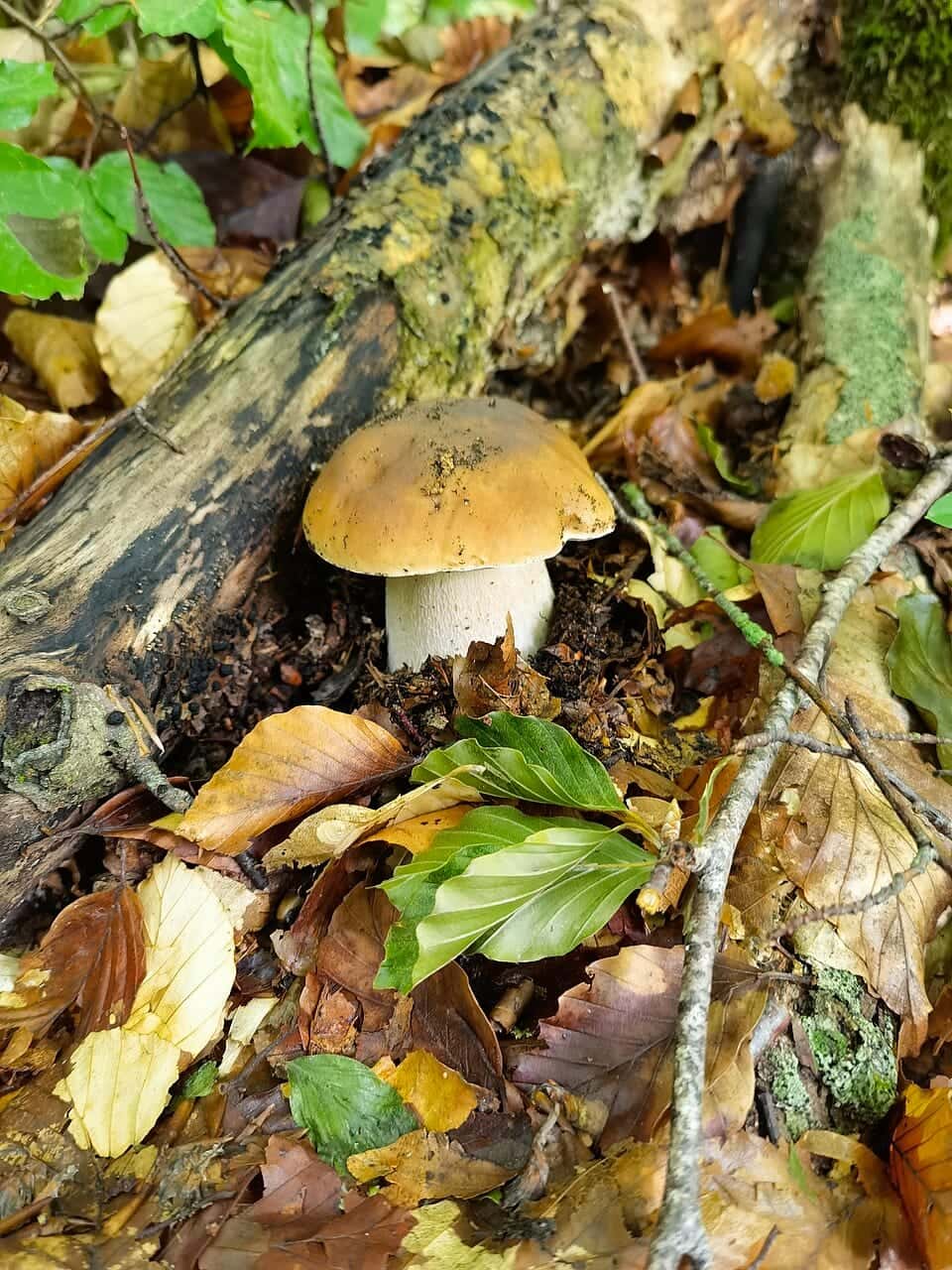
It is a damp fall morning and you find a fat, solid mushroom pushing up under the oaks or pines — a thick stalk and a rounded, bun-like cap, heavier and meatier than the flimsy toadstools in the lawn. You tip it over expecting the usual thin, bladed gills, and instead the underside is a soft, spongy layer riddled with hundreds of tiny holes, like a pale kitchen sponge. That spongy, pored underside is the calling card of the boletes, one of the most recognizable and beloved groups of mushrooms in the woods — a family that includes the famous porcini as well as a crowd of lookalike cousins ranging from harmless to bitter to genuinely poisonous. Here is how to recognize a bolete, why the group is so distinctive, and the safety facts to understand before this ever becomes a question of the dinner table.
How to Recognize a Bolete
Boletes are a whole group rather than a single species, but they share a set of features that make the group as a whole easy to spot:
- The spongy underside: instead of gills, the cap’s underside is a layer of tiny tubes ending in pores, giving it a sponge-like surface — the single defining trait of a bolete
- The build: typically stout and fleshy, with a thick, often bulbous stalk and a rounded to cushion-shaped cap, frequently in shades of brown, tan, red, or yellow
- The peelable sponge: in many boletes the spongy pore layer can be peeled cleanly away from the cap flesh, unlike gills, which are attached blades
- The habitat: growing from the ground (not on wood) in woods and at woodland edges, usually near trees, since most boletes partner with tree roots — often appearing after warm-season rains from summer into fall
- The reactions: many boletes bruise or change color when cut or handled — some stain blue almost instantly — and cap surfaces range from dry and velvety to sticky when wet
A stout, ground-growing mushroom with a spongy, pored underside instead of gills is a bolete. The most celebrated member is the king bolete or porcini (Boletus edulis), a large brown-capped bolete with a thick pale stalk marked by a fine raised net pattern near the top, whose pores are white when young and yellow to olive with age. But "bolete" covers hundreds of species, and telling one apart from another takes attention to color, staining, netting, and which trees it grows with — which is exactly why the safety rules below matter.
Try Spotter free on iPhone or Android
Plants, animals, fungi and rocks from one photo. 5 free identifications every day, no card required.


Why the Pores? A Different Way to Spread Spores
That spongy layer is not random — it is the bolete’s spore factory, and it does the same job that gills do for other mushrooms, just with a different design. The underside of any mushroom cap is where spores are made and released, and the goal is to pack as much spore-producing surface as possible into a small space and then drop the spores into the air below. Gilled mushrooms solve this with thin radiating blades; boletes solve it with a dense honeycomb of tiny vertical tubes, each lined on the inside with spore-bearing tissue and opening at the bottom as one of those little pores. When the spores are ripe, they fall down through the tubes and out the pores into the breeze. It is one of several designs mushrooms use — others include the ridges of chanterelles, the teeth of hedgehog mushrooms, and the pored brackets of shelf fungi — and recognizing which one you are looking at is one of the first and most useful steps in narrowing down any wild mushroom.
A Serious Word on Safety
Boletes have a friendly reputation because the group contains no counterpart to the deadly gilled Amanitas — there is no bolete that will kill you the way a destroying angel can. But that reputation gets people into trouble, because "no deadly boletes" is not the same as "all boletes are safe." Several boletes are genuinely poisonous and will make you seriously ill, causing violent stomach and digestive distress, and many more are simply so bitter they ruin anything they touch. Beyond that, individual species can vary in how people react to them, and any wild mushroom in poor condition or misidentified is a gamble. The honest bottom line is the same one that applies to every wild mushroom: never eat a wild mushroom based on a photo, an app, a web article, or a rule of thumb. A phone can help you notice that you are holding a bolete and get you a possible name, but confirming a wild mushroom as safe to eat requires hands-on identification by a knowledgeable expert or local mycological society, using spore prints, staining reactions, habitat, and traits a photo cannot capture. Treat any old, mushy, buggy, or uncertain mushroom as off-limits, and keep them away from curious children and pets.
Found a fat, spongy-bottomed mushroom under the trees this fall and want to start figuring out what it is? Snap a clear photo of the cap, the pored underside, and the whole stalk, and let Spotter help you identify it as a starting point for your own research — never as the final word on whether anything wild is safe to eat.
Try Spotter free on iPhone or Android
Plants, animals, fungi and rocks from one photo. 5 free identifications every day, no card required.