There is a particular kind of late-summer nuisance that everyone who spends time outdoors knows: you walk through a weedy field or trail edge and come back studded with prickly burs that grip your socks, your sleeves, and your dog’s fur so hard you have to pick them off one at a time. The two plants most often responsible are cocklebur and common burdock. Both are hitchhikers by design — the whole point of that clinging bur is to catch a ride to somewhere new.
How the Burs Catch You
Each bur is covered in dozens of tiny hooked spines, and it is those microscopic hooks — not glue or barbs — that snag the loops in fabric and the strands of animal hair. The plant produces them so that passing animals will carry its seeds far from the parent plant. It works so well that in the 1940s a Swiss engineer, after picking burs off his dog and studying the hooks under a microscope, used the same principle to invent hook-and-loop fastener — the product we now know as Velcro.
Telling Cocklebur and Burdock Apart
The two are easy to confuse when all you notice are the burs, but the plants look quite different up close:
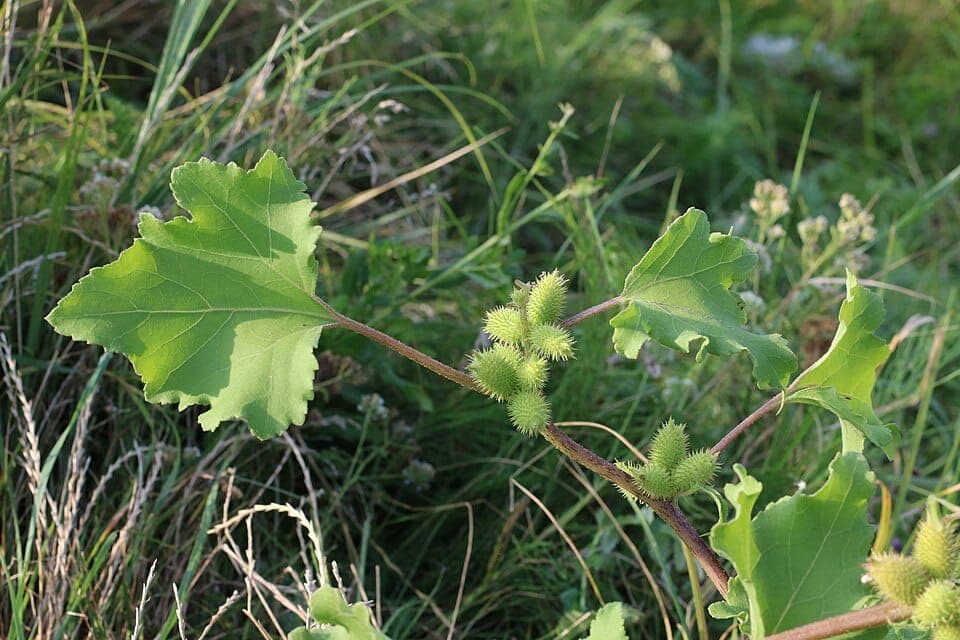
- Cocklebur — oval, football-shaped burs about an inch long, covered in stiff hooked prickles and often ending in two curved beaks; triangular, rough leaves; an annual weed of fields, shorelines, and disturbed ground
- Common burdock — round, ball-shaped burs that break apart into individual hooked segments; very large, rhubarb-like lower leaves; a biennial that sends up a tall, branching flower stalk in its second year, with purple thistle-like flowers before the burs form
Try Spotter Free on iOS & Android
Plants, animals, fungi, and rocks — all from a photo. 5 free identifications every day, no credit card required.
A Word of Caution
Cocklebur deserves respect for more than its burs: its seedlings and seeds are toxic to livestock and pets if eaten in quantity, so it is worth recognizing if you keep animals. The burs themselves can also become painfully matted in a dog’s coat or lodged around the eyes and mouth, so it is best to brush a pet down after a walk through weedy ground. Burdock is not considered poisonous — its root is a cultivated vegetable in some cuisines — but wild plants are easy to misidentify, and this article is for identification only, not foraging or consumption advice.
Keeping Them Out of the Yard
Both plants spread entirely by seed, and a single burdock can produce thousands of them, so the most effective control is to cut or pull the plants before the burs mature and dry. Getting them early — while they are still leafy and flowering, before that first crop of burs hardens — keeps this year’s hitchhikers from becoming next year’s patch.
Not sure whether the bur-covered weed at the trail edge is cocklebur, burdock, or something else entirely? Snap a photo and let Spotter help you identify it, so you know what you are dealing with before it ends up all over your clothes and your dog.
Try Spotter Free on iOS & Android
Plants, animals, fungi, and rocks — all from a photo. 5 free identifications every day, no credit card required.