
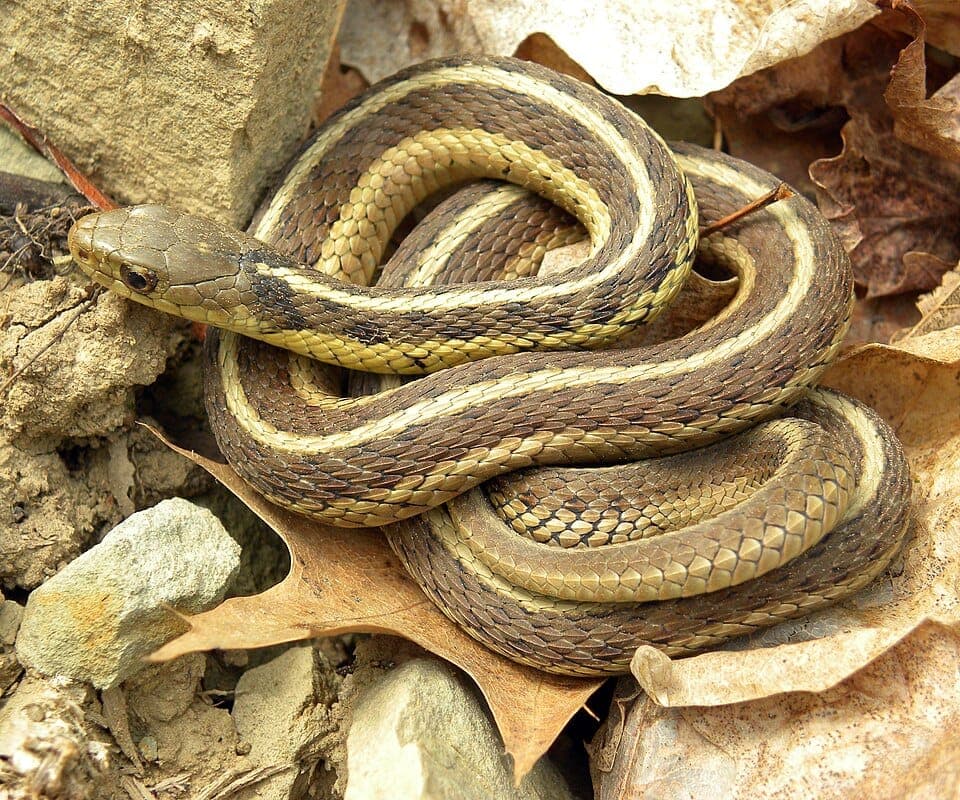
You are weeding a border or watering the tomatoes when a slender snake with pale stripes running down its length glides across the mulch and vanishes under the deck. For a lot of people that is a jolt — but of all the snakes you might meet in a backyard across most of the U.S. and Canada, the striped one is usually the most reassuring find. The "garden snake" that turns up in flower beds, compost piles, and rock walls is almost always a garter snake: common, non-venomous, and genuinely good to have around. In fact "garden snake" and "garter snake" are the same animal — the garden name simply stuck because that is where people keep running into them.
How to Identify a Garter Snake
Garter snakes are a widespread group with a lot of regional color variation, but they share a recognizable build and pattern:
- A slim, fairly small snake, typically about 1.5 to 3 feet long, with a body that stays thin rather than thick and heavy
- Long lengthwise stripes running head to tail — usually three, one down the spine and one along each side — in yellow, cream, greenish, or occasionally reddish tones
- A background color that varies widely: brown, olive, gray, or black, often with a checkerboard of darker spots between or alongside the stripes
- A relatively narrow head only a little wider than the neck, and round pupils
- A pale, plain belly and a tendency to be out and about by day, especially in sunny, moist spots near cover
The lengthwise stripes are the key trait. Most of the harmless "garden" snakes people report are garter snakes, and the combination of a thin body with long stripes running the length of the snake — rather than crossbands or blotches going around it — is the pattern to look for.
Try Spotter Free on iOS & Android
Plants, animals, fungi, and rocks — all from a photo. 5 free identifications every day, no credit card required.
Harmless, and Good for the Garden
Garter snakes are effectively non-venomous and no real threat to people or pets. Handled roughly they may musk, flatten, or give a small bite, but even a bite from a large one is no worse than a scratch. Left alone, they simply want to slip away. And they earn their keep: a garter snake in the yard is a natural pest-control service, eating slugs, worms, grubs, insects, and other small prey that trouble gardeners. Seeing one is generally a sign of a healthy, food-rich yard, not a problem to solve. The best response is to give it room and let it go on its way.
Telling It From Snakes That Matter More
The main reason to identify a striped snake correctly is to separate a harmless garter from the far smaller number of snakes worth real caution. Venomous North American snakes like copperheads and rattlesnakes are typically thicker-bodied and marked with crossbands or blotches around the body rather than clean lengthwise stripes, and rattlesnakes carry a rattle at the tail. A thin snake with long racing stripes is not one of them. That said, color and pattern can be confusing, look-alikes exist, and no one should get close to a snake to check — identify from a safe distance and never handle a snake you cannot confidently name. If a snake is somewhere it truly should not be, such as inside a home, call a local wildlife professional rather than dealing with it yourself.
Want to be certain the striped visitor in your flower bed is a friendly garter snake and not something you would rather keep your distance from? Photograph it from a safe distance and let Spotter identify the snake, so you can settle the question without getting close.
Try Spotter Free on iOS & Android
Plants, animals, fungi, and rocks — all from a photo. 5 free identifications every day, no credit card required.