
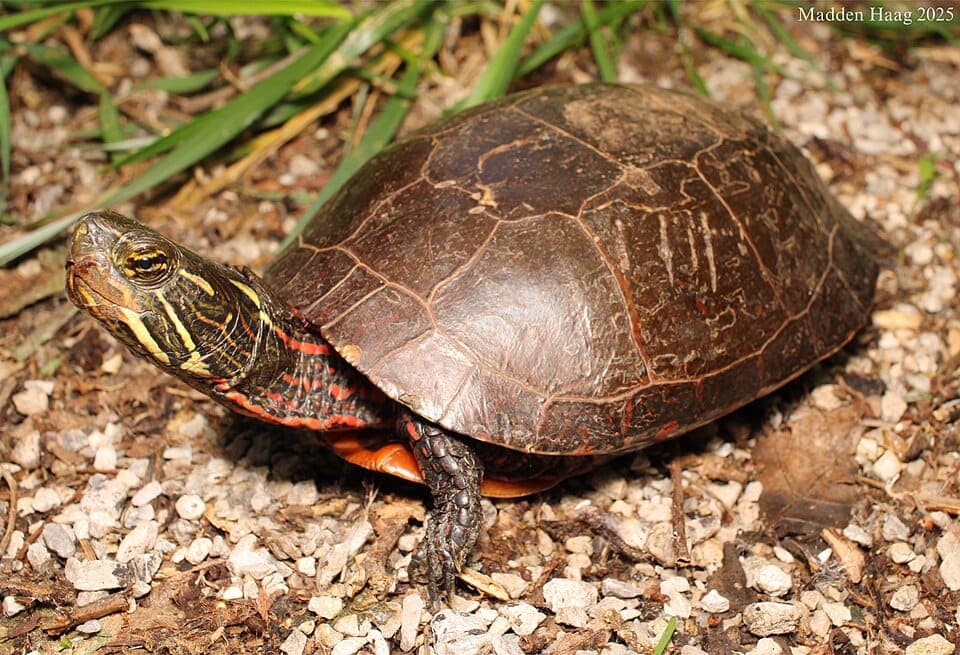
If a pond turtle has a bright red or orange patch just behind each eye, it is almost certainly a red-eared slider; if the stripes and spots on its head are yellow and the underside of its shell is a rich red-orange, it is a painted turtle. These are the two turtles most people find basking on logs, kept as pets, or wandering across a road, and they are mixed up constantly. Here is how to tell a painted turtle from a red-eared slider at a glance and up close.
How to Tell a Painted Turtle From a Red-Eared Slider
Head markings — the fastest tell
Look right behind the eye. A red-eared slider has a bold red, orange, or occasionally maroon patch there — the “red ear” that gives the species its name — set against a green head streaked with thin yellow lines. A painted turtle has no red ear patch at all; its head and neck are marked with clean yellow stripes and spots, including a yellow line behind the eye. Red behind the eye means slider; yellow means painted turtle. On rare old or very dark (melanistic) sliders the patch can fade, so if it is unclear, move to the shell.
The top of the shell (carapace)
A painted turtle’s upper shell is smooth, flat, and low, oval and olive to nearly black, usually with red or orange markings along the outer rim and pale, well-defined seams between the plates. A red-eared slider’s shell is a touch more domed and rougher-textured, olive-green with yellow streaks and bars that darken with age; older sliders can look almost uniformly dark and worn. Smooth, flat, and neatly edged points to painted; taller and rougher points to slider.
The bottom of the shell (plastron)
Flip your view to the belly and the underside of the rim. A red-eared slider’s plastron is yellow with a dark blotch or eyespot in each plate. A painted turtle’s belly is often plainer yellow, but the giveaway is the underside of the shell’s outer edge, which is washed in bright red-orange — a slider never has that red rim. (Some painted turtle subspecies also show a bold dark inkblot pattern down the center of the belly.)
Size and shape
Red-eared sliders are the bigger, bulkier turtle, commonly 5 to 8 inches long with females reaching about 11 to 12 inches. Painted turtles are smaller and flatter, usually around 4 to 6 inches. A large, notably high-domed pond turtle basking on a log is more likely a slider; a small, flat one is more likely a painted turtle. In both species the females grow noticeably larger than the males, and males have longer front claws and a longer tail, so a very big individual is usually a female of whichever species you are looking at.
Where you find them
Both love slow, weedy ponds, lakes, and marshes, and both pile onto the same basking logs in the sun, which is part of why they are confused. Painted turtles are native across much of North America; red-eared sliders are native to the south-central U.S. but, thanks to the pet trade, released sliders now turn up in ponds far outside that range — often right alongside the painted turtles they can crowd out.
Behavior and when you’ll see them
Both are “basking” turtles that haul out on logs, rocks, and banks to soak up the sun, sometimes stacked several deep, and both slide into the water at the first hint of danger — which is where the slider gets its name. You will see them most on warm, sunny days from spring through early fall; on a cool morning they stay tucked in the mud. Painted turtles are famously cold-tolerant and are among the first turtles out basking on a mild late-winter day, while sliders tend to wait for steadier warmth. In the north, both spend the coldest months dormant at the bottom of a pond, so a turtle you puzzle over in July may be nowhere to be found in January.
Turtles They Are Also Confused With
A few other basking turtles get mistaken for these two:
- Yellow-bellied slider — a close cousin of the red-eared with a yellow blotch behind the eye instead of red, and a bright yellow belly.
- Common map turtle — has a low sawtooth ridge down the middle of the shell and a small yellow spot behind the eye.
- River cooter — larger and boldly patterned; check the head stripes and the flatter, wider shell.
- Snapping turtle — a huge head, long saw-toothed tail, and small cross-shaped belly plate; never confuse a smooth-shelled basking slider with a snapper.
A Note on Pet Turtles and the Wild
Many red-eared sliders in northern ponds are former pets that were let go — a practice that is illegal in many places and genuinely harmful, because released sliders outcompete native painted turtles for food and basking sites and can spread disease. Never release a pet turtle into the wild, and never take a wild turtle home. If you do handle a wild turtle briefly, keep it low to the ground, return it exactly where you found it, and wash your hands afterward, since turtles can carry Salmonella.
Frequently Asked Questions
What is the red mark behind a turtle’s eye?
That red or orange patch just behind the eye is the signature of a red-eared slider — it is how the species got its name. Painted turtles have yellow stripes and spots there instead, never a red ear patch.
Is my turtle a painted turtle or a slider?
Check the head first: a red ear patch means slider, yellow stripes mean painted turtle. If the head marks are faded, look at the shell edge — bright red-orange along the underside of the rim points to a painted turtle.
Do painted turtles and red-eared sliders get along?
They frequently bask on the same logs, but introduced sliders can outcompete native painted turtles for food and prime basking spots. That competition is one of the main reasons releasing pet sliders into the wild is discouraged.
How big do they get?
Red-eared sliders commonly reach 5 to 8 inches, with large females up to about a foot. Painted turtles usually top out around 4 to 6 inches, though big females can be somewhat larger. Both are long-lived, routinely reaching 20 to 40 years in a healthy pond, so the turtle basking on your log may be older than you would guess.
Should I move a turtle crossing the road?
If it is safe for you, you can help a turtle finish crossing in the direction it was already headed, then let it go on its way — never turn it around or carry it off to a “better” pond, which just disorients it and can spread disease. Keep it low to the ground in case it slips, and wash your hands afterward.
Spotted a turtle basking on a log and not sure which one it is? Snap a photo and let Spotter help you identify it — and tell the native painted turtle from the wandering red-eared slider.
Try Spotter Free on iOS & Android
Plants, animals, fungi, and rocks — all from a photo. 5 free identifications every day, no credit card required.