
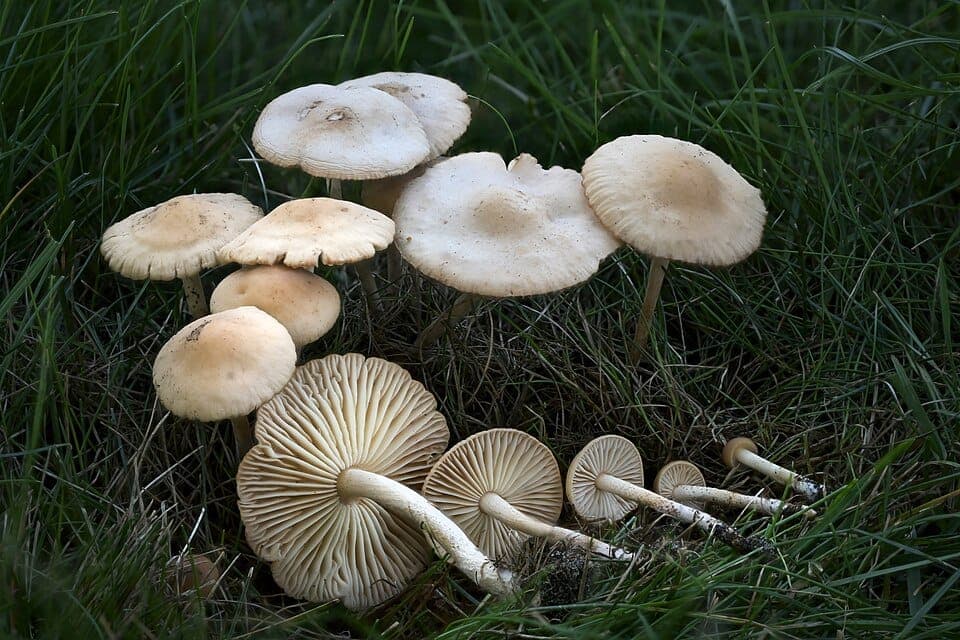
One of the more startling things a lawn can do is sprout a ring of mushrooms overnight — a circle or arc so tidy it looks deliberate. Sometimes there are no mushrooms at all, just a band of grass that is greener, or browner, than everything around it. For centuries these circles were blamed on fairies dancing in the night, which is where the name fairy ring comes from. The truth is stranger in its own way: the whole ring is the visible edge of one fungus growing outward through the soil.
Why It Grows in a Circle
A fairy ring begins from a single point — often a buried scrap of wood, an old root, or a clump of organic matter where a fungus takes hold. From that center, the underground network of fungal threads (the mycelium) grows outward in every direction at a fairly even rate, like ripples spreading from a dropped stone. The oldest threads at the center die off, while the living, actively feeding edge keeps pushing outward. Because that edge is a ring, the mushrooms and the grass effects it produces all appear along a circle — one that widens a little more each year, sometimes for decades.
The Three Things You Might See
Fairy rings show up in a few different ways depending on the fungus and the conditions:
- A ring of mushrooms or small puffballs, usually appearing after rain in late summer and fall
- A ring of dark green, fast-growing grass, where the fungus releases nitrogen as it breaks down organic matter
- A ring of thin, brown, or dead grass, where a dense mat of fungal threads keeps water from soaking in to the roots
Try Spotter Free on iOS & Android
Plants, animals, fungi, and rocks — all from a photo. 5 free identifications every day, no credit card required.
Why Now — and Why After Rain
The fungus is present in the soil year-round, but it only pushes up mushrooms — its fruiting bodies — when conditions are right, and that usually means a stretch of warm weather followed by rain. That is why fairy rings are most conspicuous from late summer into fall. The mushrooms are simply the reproductive part of a fungus that has been living quietly underground the whole time, doing the useful work of decomposing dead roots and thatch.
Should You Do Anything About It?
Most fairy rings are harmless to a lawn and need no treatment. If mushrooms are the only concern, they can be raked or mowed off — though new ones may appear after the next rain. A dead-grass ring is the most stubborn type, because the underground mat repels water; deep, thorough watering and core aeration over the affected band can help the grass recover. One caution worth stating plainly: lawn mushrooms include species that are toxic if eaten, and identifying them precisely is difficult, so keep curious children and pets away and never treat a lawn mushroom as food.
Curious what species is fruiting in the ring on your lawn? Snap a photo and let Spotter help you identify it — a satisfying way to put a name to the fungus behind the folklore, while remembering that no ID tool makes a wild mushroom safe to eat.
Try Spotter Free on iOS & Android
Plants, animals, fungi, and rocks — all from a photo. 5 free identifications every day, no credit card required.